
Product Overview
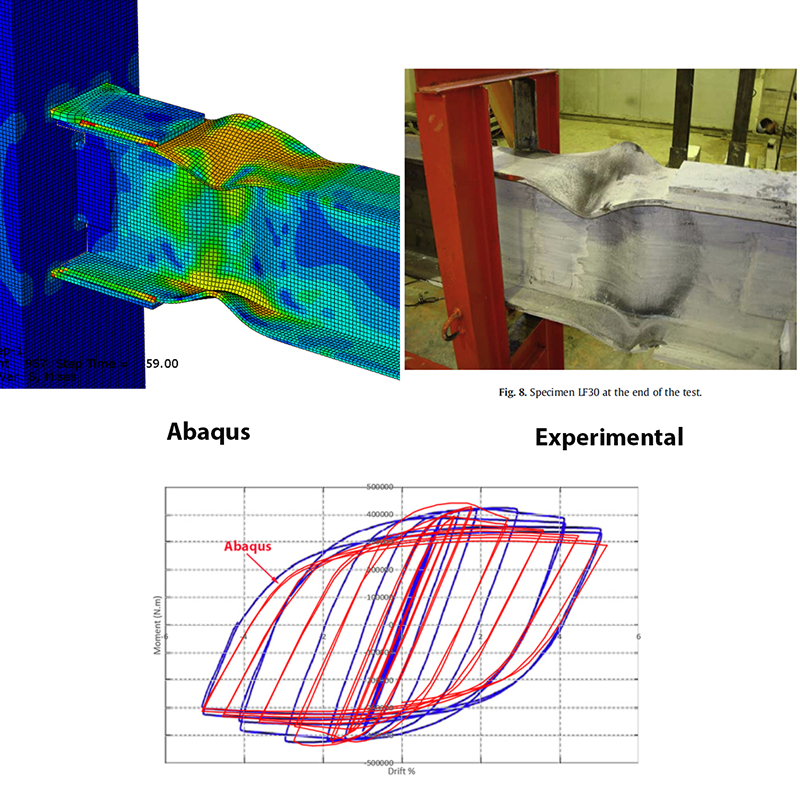
In this project, the connection of a beam to a column using top and bottom flange plates is modeled in Abaqus and its behavior under cyclic loading is investigated.
The main purpose of the flange plate connection is to move the inelastic region away from the column face and promote the formation of a plastic hinge in the beam at the nose of the flange plate.
The numerical model is developed based on an experimental study reported in the reference article. The Abaqus results are compared with the experimental results to evaluate the accuracy of the numerical model.
Model Description
The model represents a beam-to-column connection using top and bottom flange plates.
The main components of the numerical model include the beam, column, top flange plate, bottom flange plate, shear plate, continuity plate, and weld.
In this project, the LF30 specimen is modeled in Abaqus based on the experimental test.
The flange plates are connected to the beam flanges using 10 mm longitudinal fillet welds.

Connection Components
The numerical model consists of several structural components that work together to represent the experimental connection.
- Beam – the main structural member subjected to cyclic loading.
- Column – the supporting structural member.
- Top Flange Plate – connects the upper flange region of the beam to the column.
- Bottom Flange Plate – connects the lower flange region of the beam to the column.
- Shear Plate – transfers shear between the beam and column.
- Continuity Plate – provides additional reinforcement in the connection region.
- Weld – represents the welded connection between the structural components.
Cyclic Loading
A cyclic loading is applied to the end of the beam to investigate the behavior of the connection under repeated loading and unloading cycles.
The loading history is defined using the Amplitude option in Abaqus according to the loading protocol used in the experimental study.
The resulting force and displacement response is used to obtain the hysteresis behavior of the beam-to-column connection.

Deformation and Structural Response
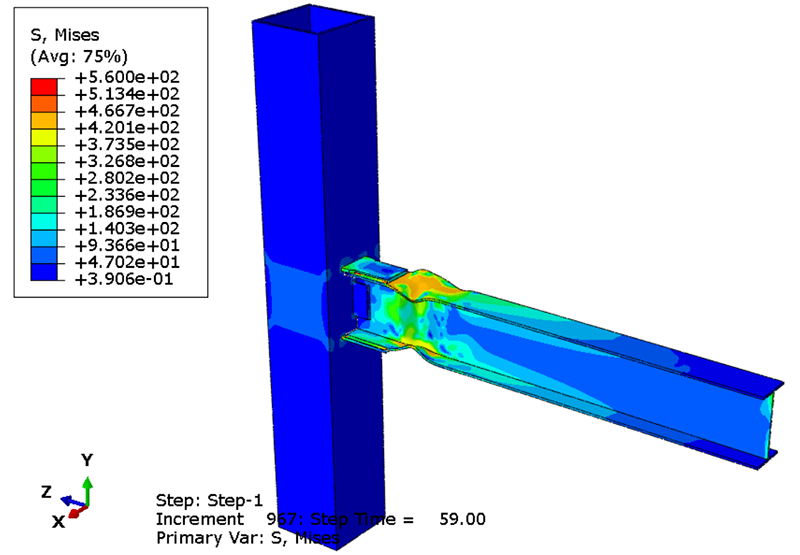
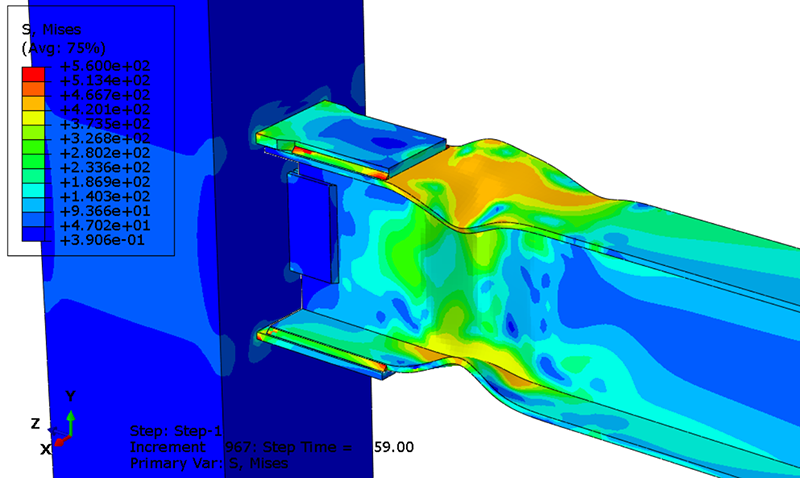
Under reversed cyclic loading, yielding initially develops in the beam flange at the nose of the flange plate. As the story drift increases, the inelastic deformation becomes concentrated in the beam, leading to the formation of a plastic hinge at the end of the flange plate, away from the column face.
With increasing cyclic deformation, local buckling of the beam flange develops in the plastic hinge region and becomes more pronounced as the deformation increases. This local buckling contributes to the gradual degradation of the connection strength during cyclic loading.
Results and Hysteresis Response
The Abaqus results are extracted and processed to evaluate the structural response of the connection under cyclic loading.
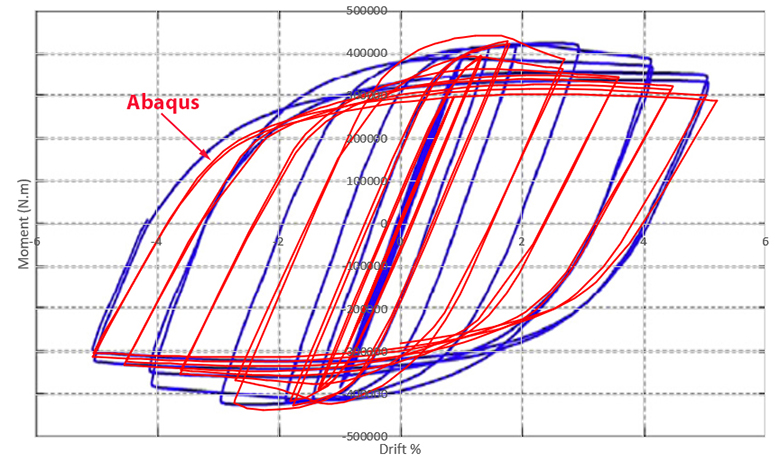
The moment–drift hysteresis diagram obtained from the Abaqus analysis is compared with the experimental results reported in the reference article.
Local buckling of the beam flange contributes to the gradual degradation of the connection strength during cyclic loading.
Experimental Validation
The numerical results obtained from Abaqus are compared with the experimental results reported in the reference research article.
The comparison focuses on the moment–drift hysteresis response and the overall structural behavior of the beam-to-column connection under cyclic loading.
The results obtained from the Abaqus model are similar to the experimental results, demonstrating that the numerical model can reproduce the main characteristics of the tested connection.

Key Features
- Beam-to-column connection using top and bottom flange plates.
- Shear plate and continuity plate included in the model.
- Welded structural components.
- Nonlinear analysis under cyclic loading.
- Cyclic loading applied to the end of the beam.
- Moment–drift hysteresis response.
- Comparison with experimental results.
- Validated numerical model.
- Complete Abaqus model files.
- Excel file for amplitude loading.
- Excel file containing numerical results.
- Reference research paper.
- Step-by-step video tutorial.
What You Will Learn
- How to model a beam-to-column connection in Abaqus.
- How to model top and bottom flange plates.
- How to model the shear plate and continuity plate.
- How to model welds between the structural components.
- How to define the geometry and material properties of the model.
- How to define interactions between the structural components.
- How to define boundary conditions for the connection.
- How to apply cyclic loading to the end of the beam.
- How to define cyclic loading using the Amplitude option in Abaqus.
- How to perform nonlinear analysis under cyclic loading.
- How to obtain a moment–drift hysteresis diagram.
- How to extract and process Abaqus results using Excel.
- How to compare numerical and experimental results.
Reference
This project is based on the experimental research study used as the reference for the numerical simulation.
The reference paper is included with the project files and can be used to review the experimental setup, loading protocol, and reported results.

Project Information
Important information about this project
Payment & Support
Need help with your purchase?
Secure Payment
Your payment is processed securely through our online payment system.
Need Help?
If you have any questions about this product, please contact us by email.
saeedofmoeini@gmail.com
There are no reviews yet.