Price €27

ABAQUS COURSE ARC WELDING

Arc Welding Analysis in Abaqus

A practical course covering 8 Abaqus welding tutorials focused on heat source modeling, moving heat flux, welding paths, and thermal analysis.

8 Tutorials
5+ Hours
1 Validated Project
✓ Includes one research-based project validated against reference results
Arc Welding Abaqus Simulation
ABAQUS SIMULATION Arc Welding Analysis
COURSE OVERVIEW

Learn Arc Welding Analysis Through Practical Abaqus Examples

This course provides a practical approach to modeling and analyzing arc welding processes in Abaqus. It is designed for students, researchers, and engineers who want to understand how welding processes can be represented through finite element simulation and how thermal behavior can be investigated using Abaqus.

Throughout the course, you will work through 8 practical welding tutorials covering different arc welding configurations and simulation techniques. The tutorials introduce the main steps required to create the model, define material properties, apply thermal loading, develop suitable welding paths, and perform the numerical analysis in Abaqus.

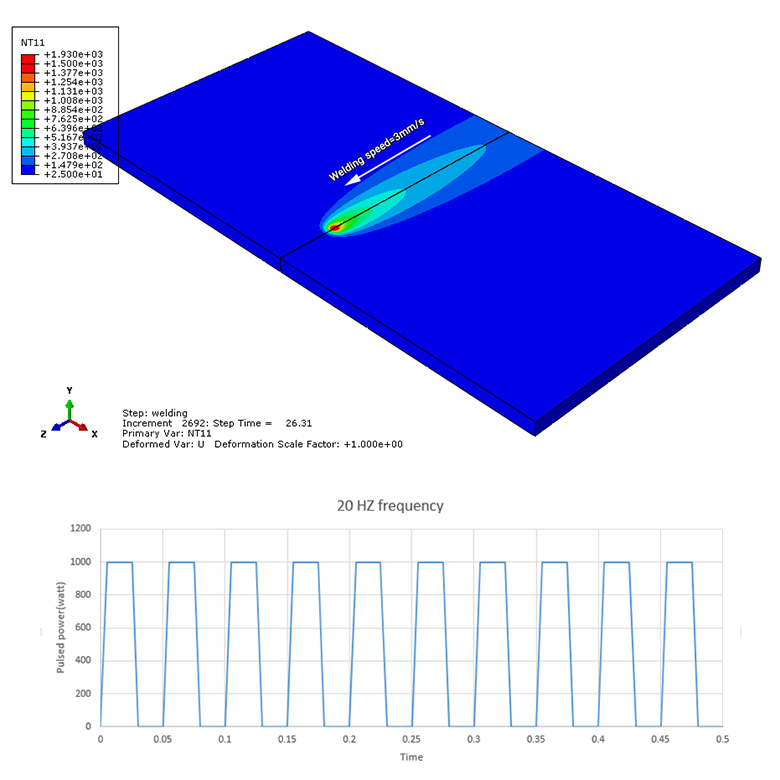
A key part of the course is learning how to represent a moving welding heat source in Abaqus. You will work with techniques such as the DFLUX subroutine and heat source definitions to simulate the movement of heat during the welding process.

The course also introduces different welding conditions and modeling approaches, including different welding paths, single-pass and multi-pass welding, and other practical arc welding configurations. These examples help you understand how changes in the welding process can affect the temperature distribution and numerical response of the model.

The course also covers the main heat transfer mechanisms in arc welding, including conduction, convection, and radiation, as well as the cooling process after welding. You will also learn how to extract and plot temperature–stress curves and residual stresses to evaluate the thermal and mechanical response of the welded structure.

One tutorial is based on a published research paper and is validated against the reference study. The numerical results obtained from Abaqus are compared with the corresponding research results to demonstrate how a welding simulation can be evaluated against published experimental or numerical data.

The remaining tutorials are practical welding examples designed to help you develop your understanding of arc welding simulation in Abaqus. These examples focus on learning different modeling techniques and are not presented as research validation studies.

By completing this course, you will gain practical experience in modeling arc welding processes in Abaqus, working with moving heat sources and DFLUX, setting up different welding configurations, and analyzing the resulting thermal response.

✓ 8 TUTORIALS INCLUDED

All 8 Tutorials — Included in the Course

Explore all 8 practical Abaqus tutorials covering arc welding, DFLUX, heat sources, welding paths, multi-pass welding, and thermal analysis.

WHAT YOU WILL LEARN

What You Will Learn in Abaqus

Develop practical skills for modeling and analyzing arc welding processes in Abaqus through thermal, mechanical, and research-based examples.

From model setup to research validation
01
FOUNDATION

Welding Model Setup

Create the welding model, define material properties, establish the required interactions, and prepare the finite element model for thermal and mechanical analysis.

02
HEAT TRANSFER

Thermal Analysis

Model heat transfer through conduction, convection, and radiation and investigate the temperature distribution during the welding process.

03
WELDING PROCESS

Arc Welding Simulation

Simulate the welding process in Abaqus and study how the moving heat input affects the temperature field and thermal response of the welded components.

04
RESULTS

Temperature, Stress & Cooling

Extract temperature and stress results, plot temperature–stress responses, investigate residual stresses, and analyze the cooling process after welding.

05
VALIDATION

Research Validation

Work through one research-based welding model and compare the Abaqus results with the corresponding published study to evaluate the accuracy of the simulation.

COURSE PACKAGE

What's Included

Everything you need to follow the welding simulations, study the Abaqus models, and reproduce the included analysis examples.

CAE

Complete Abaqus Model

Ready-to-use CAE files for the included arc welding simulations.

INP

Abaqus Input File

INP files for running and studying the numerical simulations.

SUB

Subroutine File

User subroutine files used in the relevant welding simulations.

XL

Numerical Results

Excel files containing the extracted Abaqus simulation results.

PDF

Research Paper

Reference paper for the research-based and validated welding project.

▶

Video Tutorials

Step-by-step explanations covering the eight course tutorials.

WHY THIS COURSE

Learn Welding Analysis

Build practical Abaqus skills through arc welding simulations, while also learning how a research-based welding model can be developed and validated against published results.

01

Practical Tutorials

Learn arc welding analysis through practical Abaqus examples covering different modeling and simulation cases.

02

Thermal Analysis

Study heat transfer through conduction, convection, and radiation in welding simulations.

03

Welding Cooling Process

Analyze the cooling stage after welding and investigate the temperature response during the process.

04

Research Validation

Work through one research-based project and compare Abaqus results with the published reference study.

WHO IS THIS FOR?

Built for Welding Analysis

This course is designed for students, researchers, and engineers who want to learn how welding processes can be modeled and analyzed in Abaqus through practical examples.

01

Students

Learn the fundamentals of welding simulation in Abaqus through practical examples covering different thermal and structural analysis techniques.

02

Researchers

Study a research-based welding simulation and compare the numerical results with the results reported in the reference paper.

03

Structural & Welding Engineers

Develop practical skills for simulating welding processes, evaluating thermal effects, and interpreting structural results in Abaqus.

FREQUENTLY ASKED QUESTIONS

Questions? We've Got Answers.

Find answers to the most common questions about the course, files, Abaqus version, and access.

What Abaqus version is used in this course? +
The models in this course were developed using Abaqus 2017.
Do I need previous Abaqus experience? +
Basic knowledge of Abaqus and structural analysis is recommended. You do not need advanced experience to follow the projects.
Are the CAE and INP files included? +
Yes. The course package includes the CAE model and INP file required for the analysis.
Is the research paper included? +
Yes. The reference research paper used for the project is included with the course files.
Can I use the files with a newer Abaqus version? +
Yes. The models were created in Abaqus 2017. You can also open CAE files in newer versions of Abaqus.
How will I receive the course files? +
After completing your purchase, the download links will be sent to your email immediately.
∞
LIFETIME BENEFIT

Lifetime Access. Free Updates.

Once you purchase the course, you will receive all future course updates at no additional cost.

FREE FUTURE UPDATES
AFTER PURCHASE

You're Not On Your Own.

If you need help with the included Abaqus models or course materials, you can contact us after your purchase for assistance.

01

Purchase

Get access to the complete course and included files.

02

Work With the Models

Follow the tutorials and use the included Abaqus files.

03

Get Support

Contact us if you have questions about the included models or course materials.

✓ Support is available after your purchase.

chat_bubble_outlineReviews

  • Hamid

    Hello Mr, Moeini
    I will work on a projct about WEDM (wire electric discharge machining) . But I dont Know if this package , that is about Arc welding Process , can be helpful for me or not! if you have any Info about EDM process please tell me , can i use Deflux or Goldak’s subroutines to simulate my work or not
    if this package works for simulation of EDM I will surely buy it.
    Thank you and have good day
    Hamid Hesni

Add a review

Your email address will not be published. Required fields are marked *