Price €27

ABAQUS COURSE MASONRY WALL

Masonry Wall Analysis in Abaqus

A complete practical course covering 7 tutorials on modeling and analyzing masonry wall systems in Abaqus, including practical examples and one research-based validated model.

7 Tutorials
4+ Hours
✓ Validated
✓ One tutorial includes research-based validation
Masonry Wall Abaqus Simulation
ABAQUS SIMULATION Masonry Wall Analysis
COURSE OVERVIEW

Learn Masonry Wall Modeling Through Practical Abaqus Examples

This course provides a practical approach to modeling and analyzing masonry walls in Abaqus. It is designed for students, researchers, and engineers who want to understand how masonry wall behavior can be represented in a finite element model and how different failure mechanisms can be investigated through numerical simulation.

Throughout the course, you will work through 7 practical tutorials covering different masonry wall modeling and analysis examples in Abaqus. The tutorials introduce the main steps required to create the model, define material properties and interactions, apply boundary conditions and loading, generate the mesh, and perform the numerical analysis.

A key part of the course is the use of the Simplified Micro-Modeling approach for masonry. This approach provides a practical way to represent the behavior of masonry units and mortar joints in a finite element model without using the full level of detail required by a detailed micro-model.

The course also focuses on the different failure modes of masonry walls. Through the Abaqus simulations, you will examine how masonry walls respond under loading and how different damage and failure patterns develop in the wall. This helps you better understand the numerical behavior of masonry and the relationship between the applied loading and the resulting failure mechanisms.

In addition to the practical examples, one tutorial is based on a published research paper and is validated against the reference study. The numerical results obtained from Abaqus are compared with the corresponding research results to demonstrate how a masonry wall model can be evaluated against published data.

The remaining tutorials are practical examples that help you develop your understanding of masonry wall modeling, analysis, and failure behavior in Abaqus. These examples are intended to build practical modeling skills and are not presented as research validation studies.

By completing this course, you will gain practical experience in modeling masonry walls using the Simplified Micro-Modeling approach, analyzing their structural response, and investigating different masonry failure modes in Abaqus.

✓ 7 TUTORIALS INCLUDED

All 7 Tutorials — Included in the Course

Work through practical masonry wall modeling examples in Abaqus, including one research-based project validated against published results.
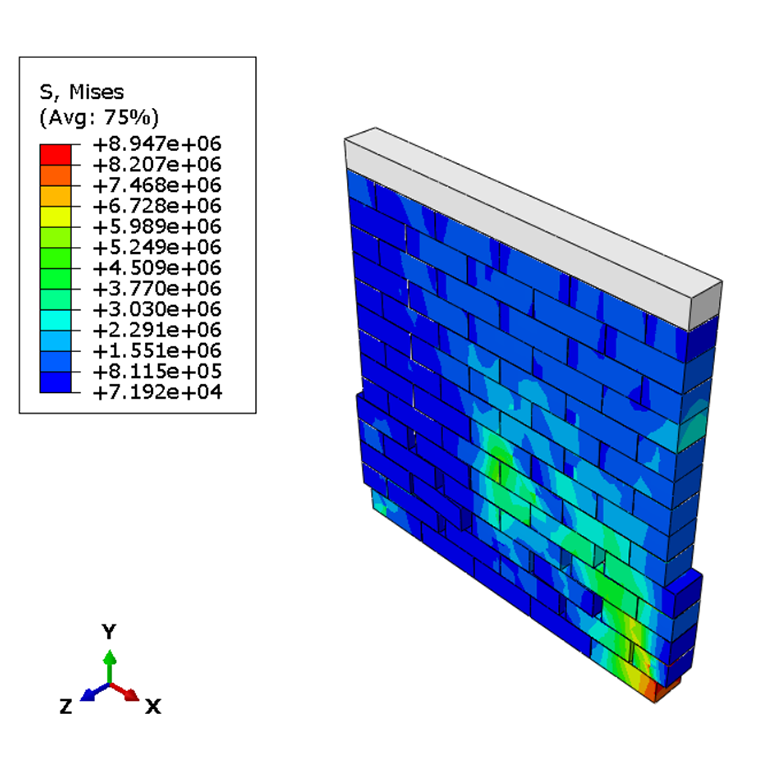
WHAT YOU WILL LEARN

What You Will Learn in Abaqus

Develop practical skills for modeling and analyzing masonry walls in Abaqus through different examples, including the Simplified Micro modeling approach and research-based validation.

From simplified micro modeling to failure analysis and validation
01
MODELING APPROACH

Simplified Micro Modeling

Learn how the Simplified Micro modeling approach can be used to represent masonry walls in Abaqus while maintaining a practical and computationally efficient finite element model.

02
MATERIALS

Masonry Material Definition

Define the mechanical behavior of masonry components and establish the material properties required for numerical analysis of masonry wall systems.

03
MODEL DEVELOPMENT

Building the Masonry Wall Model

Create the wall geometry, assign sections and materials, define interactions and boundary conditions, and prepare the model for analysis in Abaqus.

04
FAILURE ANALYSIS

Understanding Masonry Failure Modes

Examine different failure modes that can develop in masonry walls and learn how to identify and interpret the resulting damage and structural response in Abaqus.

05
RESEARCH VALIDATION

Comparing Results with Research

Work through a research-based masonry wall model and compare the Abaqus results with the corresponding results reported in the reference paper.

COURSE PACKAGE

What's Included

Everything you need to follow the project, reproduce the Abaqus analysis, and compare your results with the reference study.

CAE

Complete Abaqus Model

Ready-to-use CAE file of the complete Masonry Wall model.

INP

Abaqus Input File

Complete INP file for running the numerical analysis.

XL

Amplitude Loading Data

Excel file containing the cyclic loading data.

XL

Numerical Results

Excel file containing the extracted Abaqus results.

PDF

Research Paper

Reference paper used to develop and validate the model.

▶

Video Tutorial

Step-by-step explanation of the complete project.

WHY THIS COURSE

Understand Masonry Wall Analysis

Learn how masonry walls can be modeled and analyzed in Abaqus through practical examples, with a focus on the Simplified Micro Modeling approach and different failure modes.

01

Simplified Micro Modeling

Learn how to model masonry walls using the Simplified Micro approach and define the main components of the masonry system

02

Different Failure Modes

Examine different masonry wall failure mechanisms and learn how they appear in the Abaqus results.

03

Research Validation

One of the course projects is developed from a published research paper and validated by comparing the numerical results.

04

Practical Examples

Work through seven practical Abaqus tutorials covering different masonry wall modeling and analysis scenarios.

WHO IS THIS FOR?

Built for Masonry Analysis

This course is designed for students, researchers, and engineers who want to learn how masonry walls are modeled and analyzed in Abaqus through practical examples.

01

Students

Learn masonry wall modeling in Abaqus through practical examples and understand the main steps of the analysis.

02

Researchers

Study the Simplified Micro approach, examine masonry failure modes, and work with a research-based validation example.

03

Structural Engineers

Develop practical skills for modeling masonry walls and interpreting their structural response in Abaqus.

FREQUENTLY ASKED QUESTIONS

Questions? We've Got Answers.

Find answers to the most common questions about the course, files, Abaqus version, and access.

What Abaqus version is used in this course? +
The models in this course were developed using Abaqus 2017.
Do I need previous Abaqus experience? +
Basic knowledge of Abaqus and structural analysis is recommended. You do not need advanced experience to follow the projects.
Are the CAE and INP files included? +
Yes. The course package includes the CAE model and INP file required for the analysis.
Is the research paper included? +
Yes. The reference research paper used for the project is included with the course files.
Can I use the files with a newer Abaqus version? +
Yes. The models were created in Abaqus 2017. You can also open CAE files in newer versions of Abaqus.
How will I receive the course files? +
After completing your purchase, the download links will be sent to your email immediately.
∞
LIFETIME BENEFIT

Lifetime Access. Free Updates.

Once you purchase the course, you will receive all future course updates at no additional cost.

FREE FUTURE UPDATES
AFTER PURCHASE

You're Not On Your Own.

If you need help with the included Abaqus models or course materials, you can contact us after your purchase for assistance.

01

Purchase

Get access to the complete course and included files.

02

Work With the Models

Follow the tutorials and use the included Abaqus files.

03

Get Support

Contact us if you have questions about the included models or course materials.

✓ Support is available after your purchase.

chat_bubble_outlineReviews

  • Amr Dahab

    I would like to request a simplified micro modeling brick modeling course.

  • Vamsi Krishna Gali(verified owner)

    I want to buy masonry tutorials

Add a review

Your email address will not be published. Required fields are marked *