
Product Overview
In this example, we intend to simulate the progressive collapse of a reinforced concrete frame in the Abaqus software.
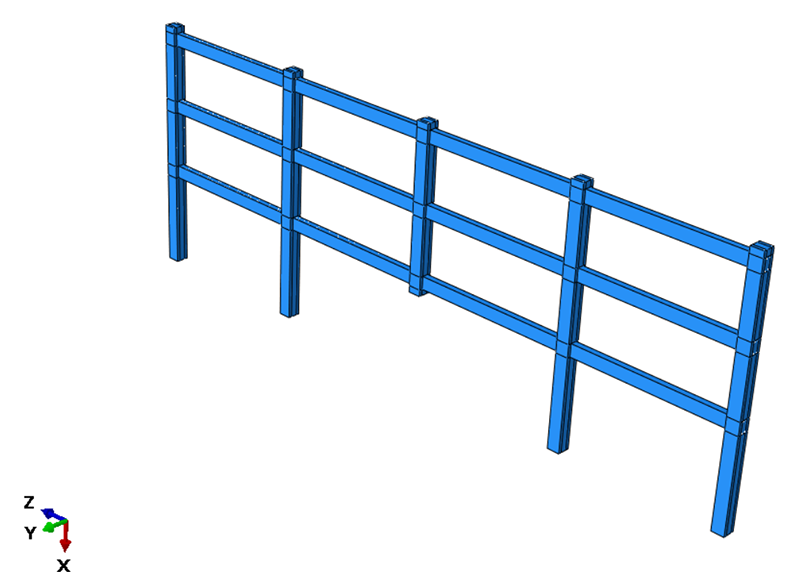
The experimental model represents a four-bay, three-story reinforced concrete frame with reinforced concrete beams and columns. The model includes the structural reinforcement and nonlinear concrete behavior to investigate the response of the frame during progressive collapse.
A constant vertical load is applied to the top of the middle column to represent the gravity load transferred from the upper stories. The loss of the lower middle column is simulated by gradually unloading its load-carrying capacity, allowing the redistribution of forces and the progressive development of the frame response.
Model Description
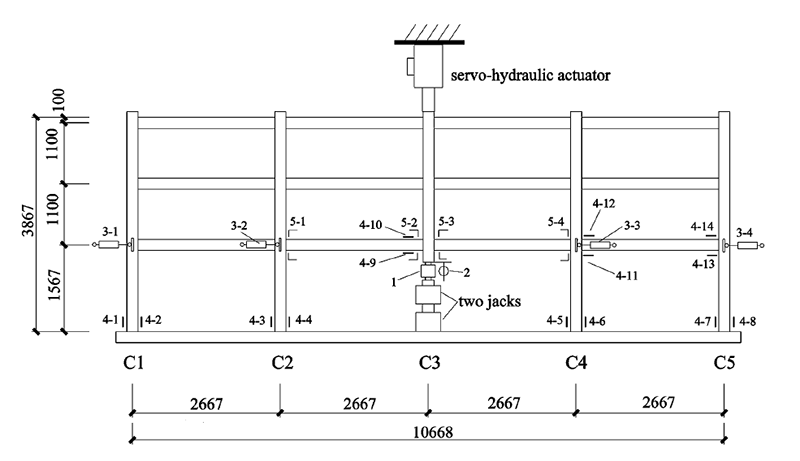
The height of the first story is 1567 mm, while the height of the second and third stories is 1100 mm. The bay span is 2667 mm. The beams have a cross section of 200 × 100 mm, while the columns have a cross section of 200 × 200 mm.
Reinforcement of Beam and Column
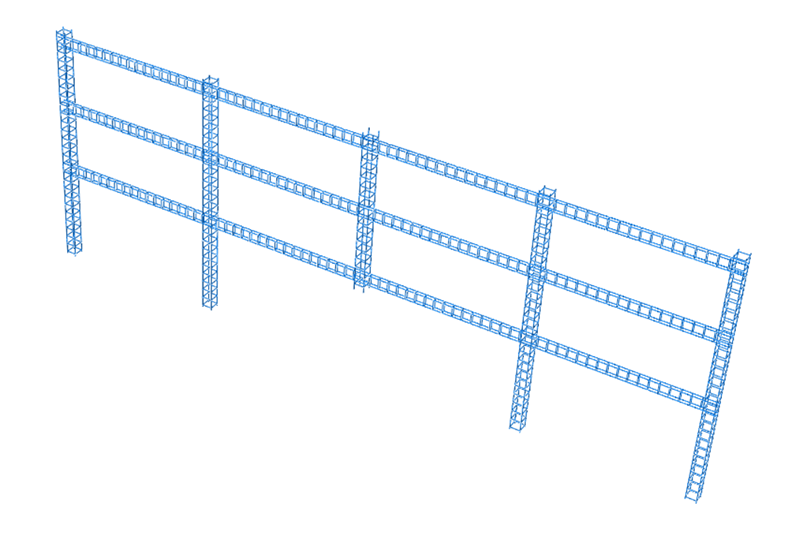
The reinforced concrete beams and columns are modeled with the reinforcement configuration reported in the reference experimental study.
The columns are reinforced with 4D12 longitudinal bars, while the beams contain 2D12 top bars and 2D12 bottom bars. Transverse reinforcement is provided using D6 stirrups at 150 mm spacing. The stirrup spacing is reduced near the beam-column joints according to the reinforcement details reported in the reference study.
Concrete Damaged Plasticity (CDP)
In this project, the Concrete Damaged Plasticity (CDP) model available in Abaqus is used to define the nonlinear behavior of the concrete inside the steel tube.
The CDP model accounts for the behavior of concrete under both compression and tension, including compressive crushing and tensile cracking.
The compressive and tensile behavior of concrete are defined using the corresponding stress–strain relationships, while the damage parameters are used to describe the degradation of concrete stiffness.
Vertical Loading
A constant vertical load of 109 kN is applied to the top of the middle column to represent the gravity load transferred from the upper stories of the structure.
After applying the vertical load, the load-carrying capacity of the lower middle column is gradually unloaded to simulate column loss. This loading procedure allows the redistribution of internal forces within the frame and the development of the progressive collapse response.
Compressive Damage of Concrete
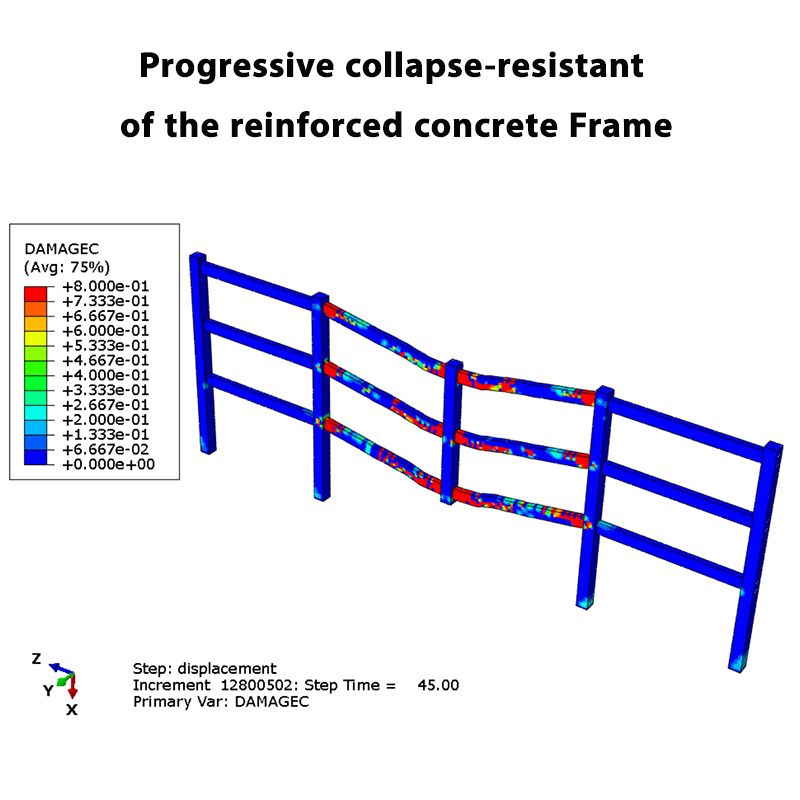
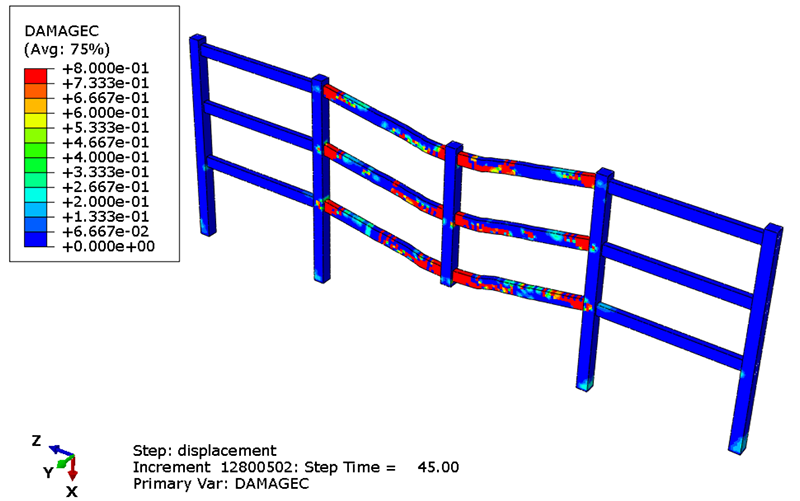
As shown in the picture, the compressive damage of concrete can be observed from the Abaqus results.
The damage develops mainly in the beam regions near the middle column, where significant deformation and concrete crushing occur as the frame progresses from the elastic and plastic stages toward the catenary stage.
Force–Displacement Diagram
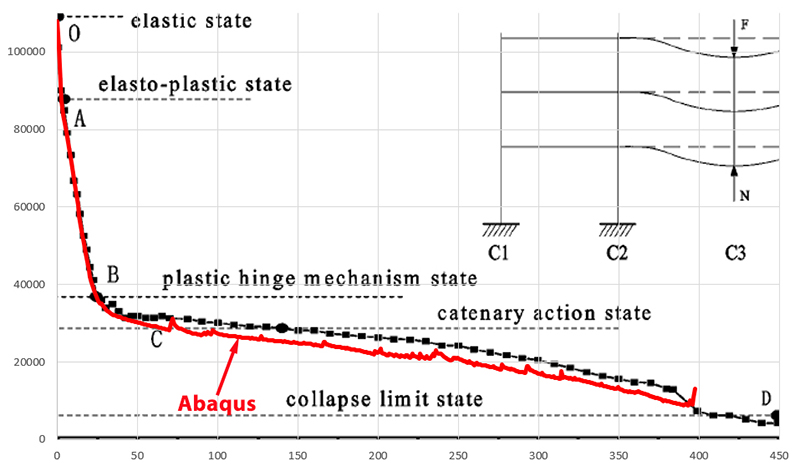
In this picture, the Force–Displacement diagram is obtained from the Abaqus analysis.
As you observe, the results obtained from the Abaqus software are very close to those reported in the article.
Validation
This project has been validated, which means that the results obtained from the Abaqus software are similar to the results reported in the article.
In other words, this project is based on the reference article and the numerical model has been developed to reproduce the behavior reported in the study.

Key Features
- Progressive collapse analysis of a reinforced concrete frame.
- Four-span and three-story reinforced concrete frame.
- Modeling of beam and column reinforcement.
- Concrete material definition using the CDP model.
- Investigation of compressive damage of concrete.
- Application of vertical loading to the middle column.
- Investigation of structural response.
- Force–Displacement diagram.
- Comparison with the results reported in the article.
- Validated Abaqus model.
- Complete Abaqus CAE file.
- Abaqus INP file.
- Excel material file for concrete.
- Excel results file.
- Reference research paper.
- Step-by-step video tutorial.
What You Will Learn
- How to model a three-story reinforced concrete frame in Abaqus.
- How to define the geometry of the reinforced concrete frame.
- How to model the beams and columns.
- How to define the reinforcement of the beams.
- How to define the reinforcement of the columns.
- How to define the concrete material properties.
- How to define concrete using the Concrete Damaged Plasticity (CDP) model.
- How to define the compressive behavior and damage of concrete.
- How to assemble the reinforced concrete frame.
- How to apply the vertical load to the top of the middle column.
- How to investigate the progressive collapse behavior of the frame.
- How to obtain the Force–Displacement diagram.
- How to compare the Abaqus results with the results reported in the article.
- How to investigate the compressive damage of concrete.
- How to validate the numerical model using the reference article.
Reference
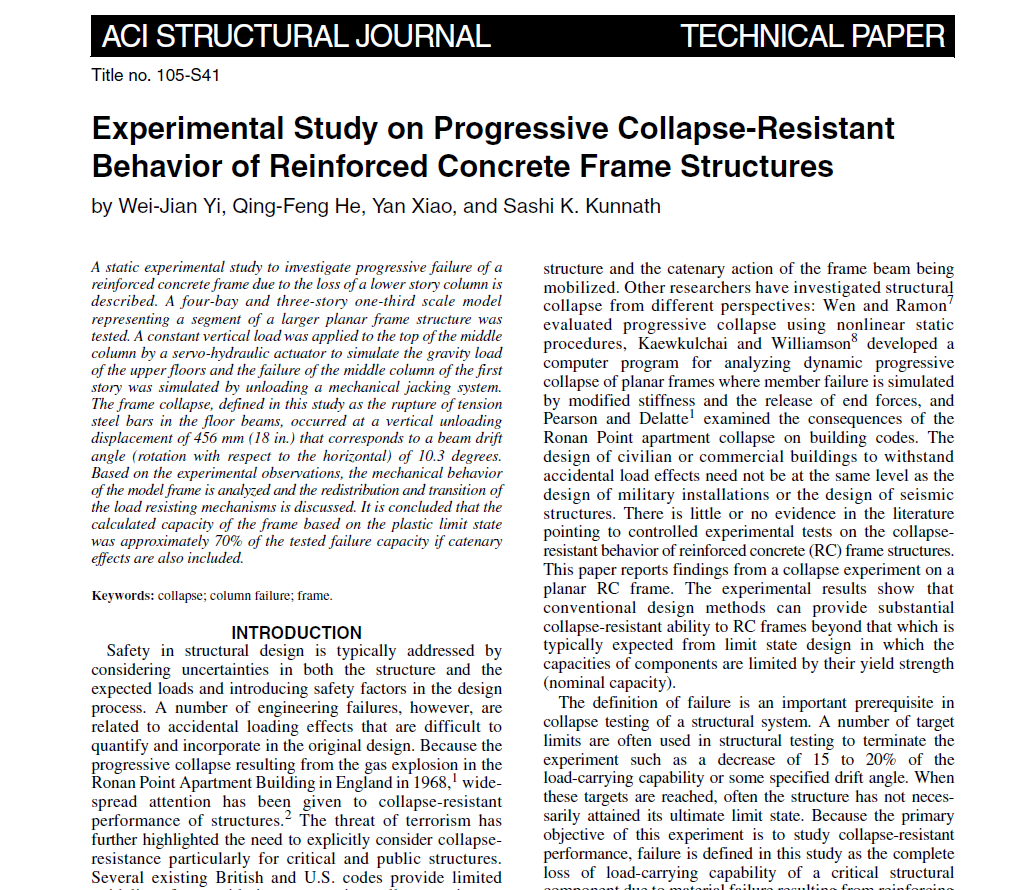
This project is based on the reference research article. The paper is included with the project files and can be used to review the experimental configuration, material properties, and reported results.
Project Information
Important information about this project
Payment & Support
Need help with your purchase?
Secure Payment
Your payment is processed securely through our online payment system.
Need Help?
If you have any questions about this product, please contact us by email.
saeedofmoeini@gmail.com
There are no reviews yet.