
Product Overview
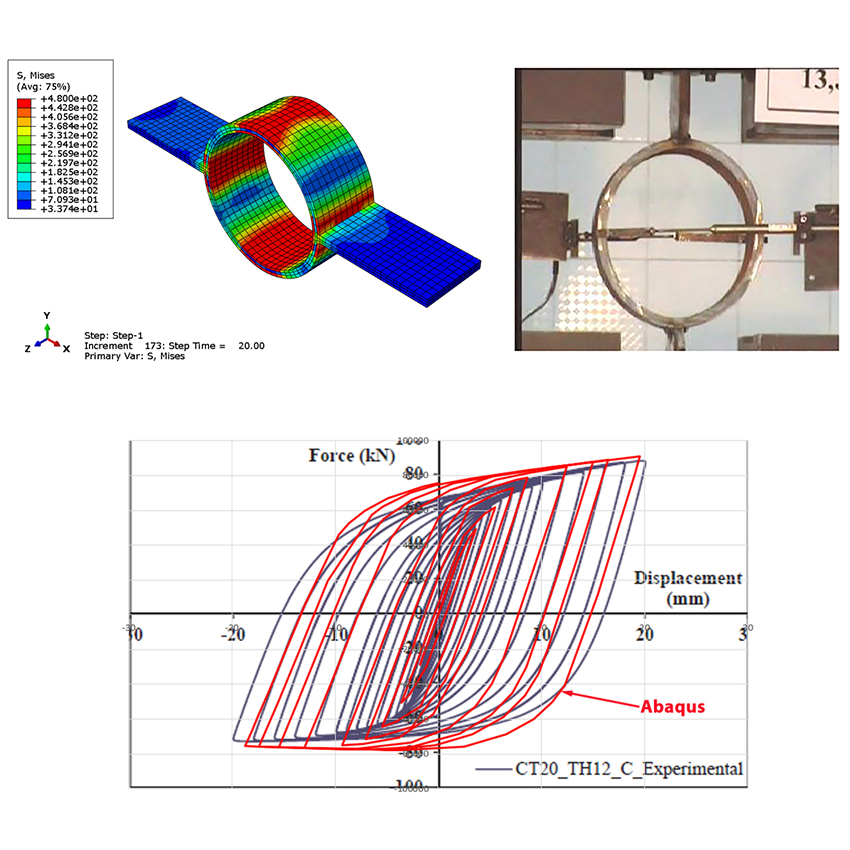
In this example, we intend to simulate the hysteresis behavior of a steel ring yielding damper in the Abaqus software.
The model is based on the reference steel ring specimen CT20-TH12-C, which consists of a steel ring made from two half-rings connected to steel connection plates. The ring has an outer diameter of 220 mm, a thickness of 12 mm, and a length of 100 mm.
The steel ring is designed to dissipate energy through inelastic deformation under repeated axial loading. The numerical model is used to investigate the force–displacement response, deformation, stress distribution, ductility, and energy dissipation of the ring.
The cyclic response obtained from Abaqus is compared with the experimental results reported in the reference study.
Steel Ring Energy Dissipater
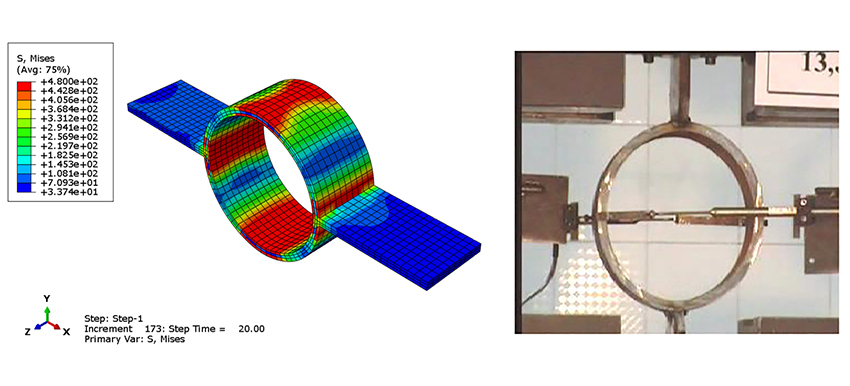
The steel ring energy dissipater is designed to absorb and dissipate energy through the inelastic deformation of the steel ring under cyclic axial loading.
The dissipater consists of two half-steel rings connected to steel connection plates. The use of two half-rings provides a practical alternative to conventional steel pipe rings while allowing the ring geometry and thickness to be selected independently.
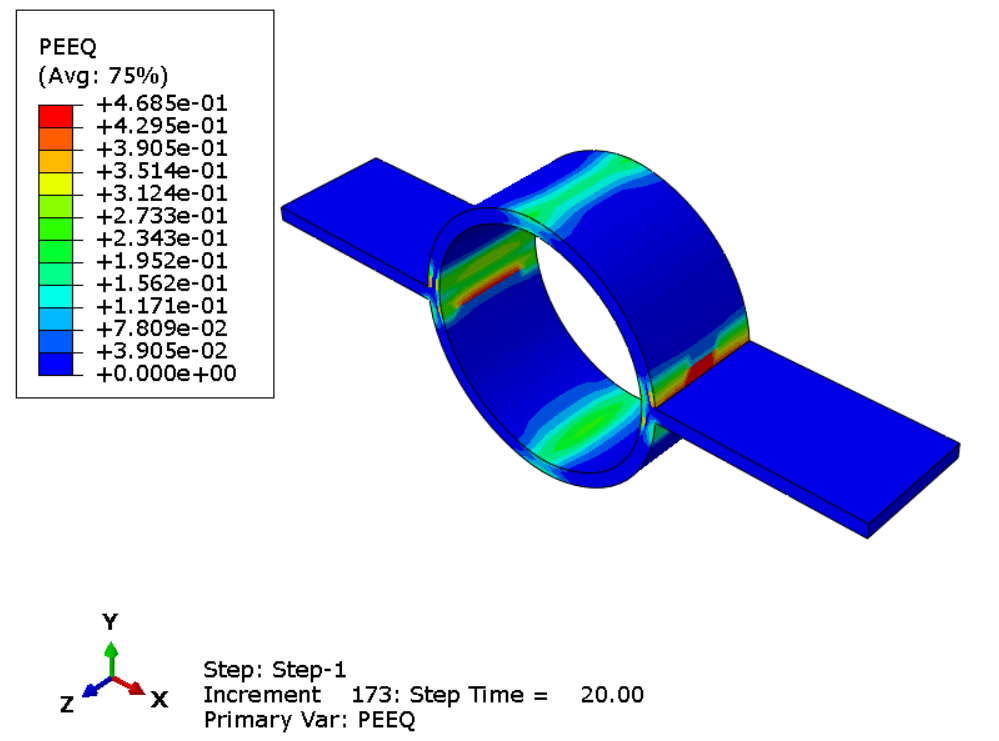
As the axial displacement increases, the steel ring undergoes increasing deformation and develops plastic hinges. The formation of these plastic regions allows the ring to undergo significant inelastic deformation while dissipating energy during repeated loading.
The deformation and stress distribution of the ring can be evaluated from the Abaqus results to investigate the behavior of the energy-dissipating region under cyclic loading.
Cyclic Loading
The steel ring energy dissipater is subjected to displacement-controlled cyclic loading in Abaqus to reproduce the loading procedure used for the reference specimen.
One end of the assembly is fully restrained, while the opposite end is connected to the loading region where the prescribed axial displacement is applied.
During cyclic loading, the steel ring undergoes repeated deformation in both tension and compression.
The loading history is defined in Abaqus using the amplitude data corresponding to the cyclic loading protocol.
Comparison of Abaqus and Experimental Results
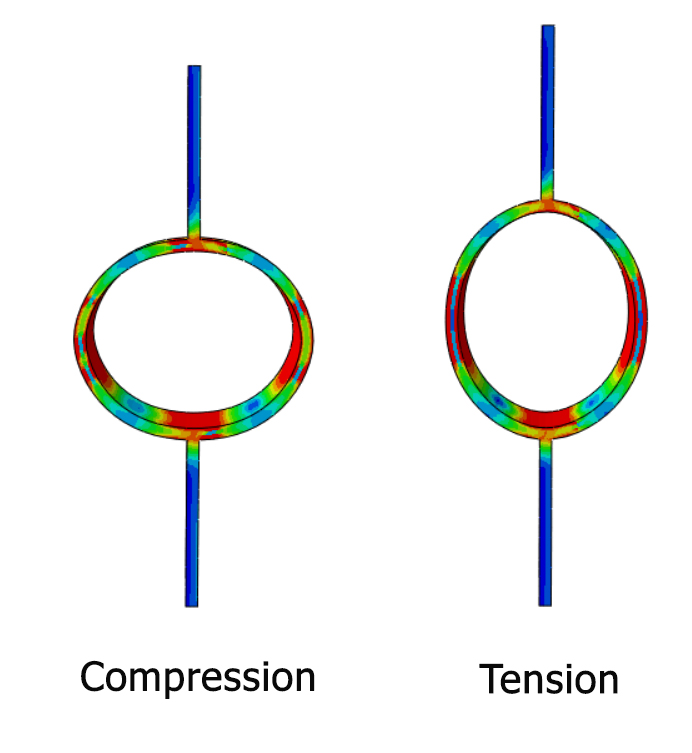
In this picture, the force-displacement hysteresis diagram obtained from the Abaqus software is compared with the experimental results.
This comparison is used to evaluate the accuracy of the numerical model and its ability to reproduce the experimental behavior of the steel ring yielding damper.
Plastic Deformation and Plastic Hinges
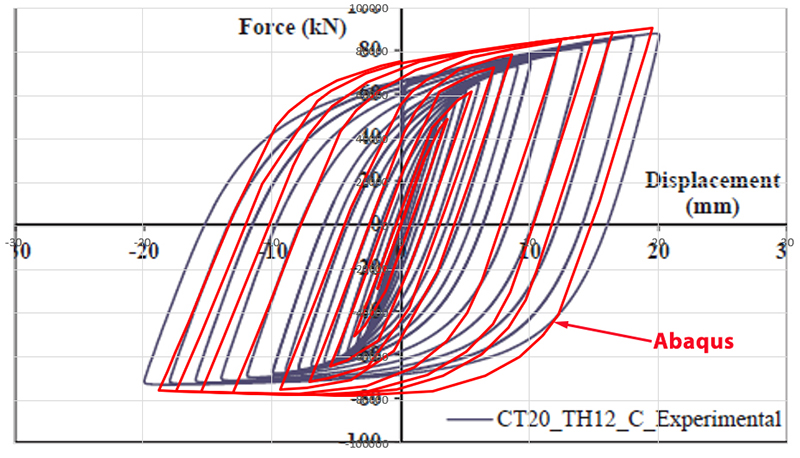
As the axial displacement increases, the steel ring develops plastic deformation at four critical regions. Plastic hinges form approximately at the 3, 6, 9, and 12 o’clock positions of the ring.
These plastic regions undergo significant inelastic deformation and contribute to the energy absorption and dissipation of the steel ring during cyclic loading.
Validation
This project has been validated, which means that the results obtained from the Abaqus software are similar to the results reported in the article.
In other words, this project is based on the reference article and the numerical model has been developed to reproduce the hysteresis behavior of the steel ring yielding damper.
What You Will Learn
- How to model a steel ring yielding damper in Abaqus.
- How to define the material properties of the steel ring.
- How to assemble the complete model.
- How to define the boundary conditions.
- How to apply cyclic loading to the steel ring.
- How to define the cyclic loading amplitude.
- How to obtain the hysteresis diagram from Abaqus.
- How to compare the Abaqus results with experimental results.
- How to validate the numerical model using the reference article.
Key Features
- Steel ring yielding damper modeling in Abaqus.
- Cyclic loading analysis.
- Cyclic loading amplitude definition.
- Hysteresis diagram obtained from Abaqus.
- Comparison between Abaqus and experimental results.
- Validation against the reference article.
- Complete Abaqus CAE file.
- Abaqus INP file.
- Excel amplitude loading file.
- Excel results file.
- Reference research paper.
- Step-by-step video tutorial.
Reference
This project is based on the reference research article. The paper is included with the project files and can be used to review the experimental model, loading protocol, and reported results.

Project Information
Important information about this project
Payment & Support
Need help with your purchase?
Secure Payment
Your payment is processed securely through our online payment system.
Need Help?
If you have any questions about this product, please contact us by email.
saeedofmoeini@gmail.com
There are no reviews yet.