
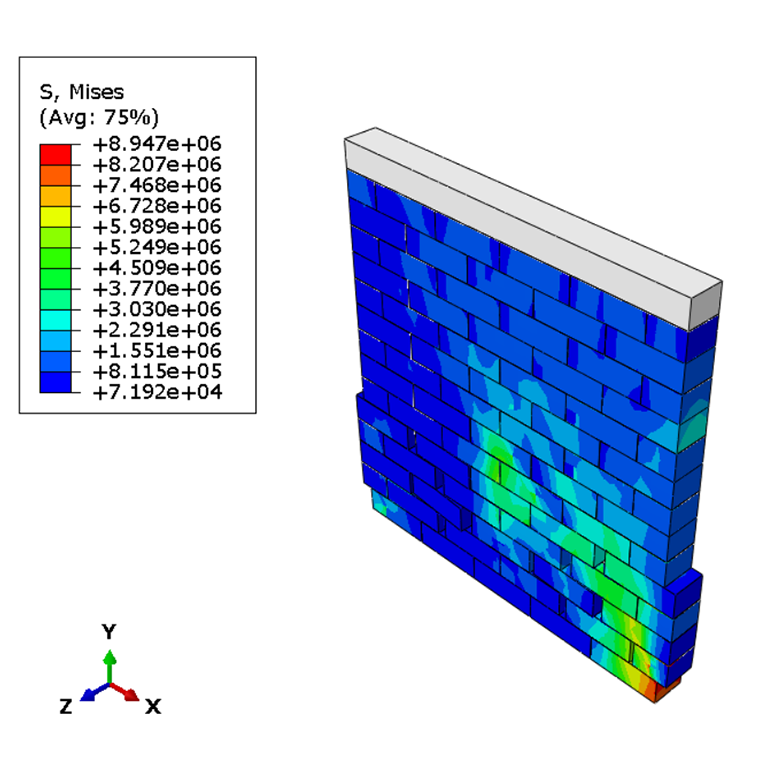
Product Overview
In this example, we intend to simulate the masonry wall (brick wall with mortar) under in-plane cyclic loading using the Simplified Micro Approach in Abaqus software.
Methods of Simulating Masonry Walls in Abaqus
There are three common methods for simulating masonry walls in Abaqus software:
- Micro Method
- Simplified Micro Method
- Macro Method
1. Micro Method
In the Micro Method, the geometric shapes of the brick and mortar are created as separate parts in the Part module. Following this, the material properties of the brick and mortar are defined separately in the Property module.
In addition, the required damage properties of the mortar are defined to simulate the failure and degradation of the mortar during loading.
2. Simplified Micro Method
In the Simplified Micro Method, only the geometric shape of the brick is created in the Part module, and there is no need to create the geometric shape of the mortar.
Instead, the mechanical behavior of the mortar, or the interaction between the bricks, is defined in the Interaction module using the Cohesive Behavior and Damage options.
This approach simplifies the modeling process while allowing the interaction between the bricks and the failure behavior of the mortar to be represented in the numerical model.
3. Macro Method
In the Macro Method, the brick and mortar are not modeled separately. Instead, the masonry wall is created as an integrated and continuous part.
The material properties assigned to the masonry wall represent a combination of the mechanical properties of both the brick and mortar.
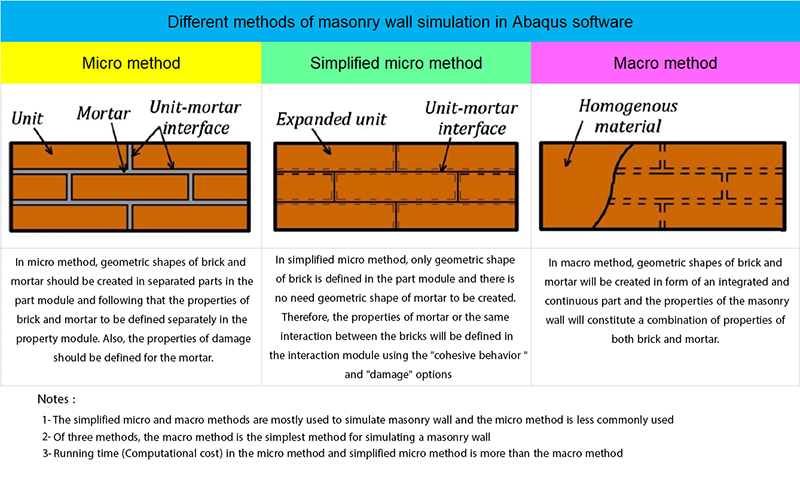
Comparison of Masonry Modeling Methods
The main difference between these three approaches is the level of detail used to represent the brick and mortar. The Micro Method provides the highest level of detail, while the Macro Method represents the masonry wall as a homogenized material. The Simplified Micro Method provides a balance between modeling detail and computational efficiency.
Model Description
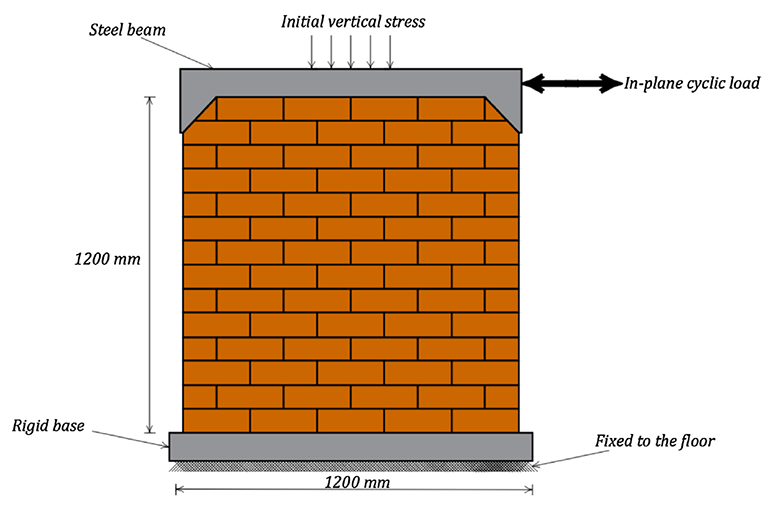
The masonry wall has a height of 1200 mm and a width of 1200 mm. The wall consists of 14 rows of masonry units.
In the analysis, a compressive load equal to 0.7 MPa is first applied to the masonry wall. After applying the compressive load, an in-plane cyclic loading is applied to investigate the hysteretic behavior of the wall.
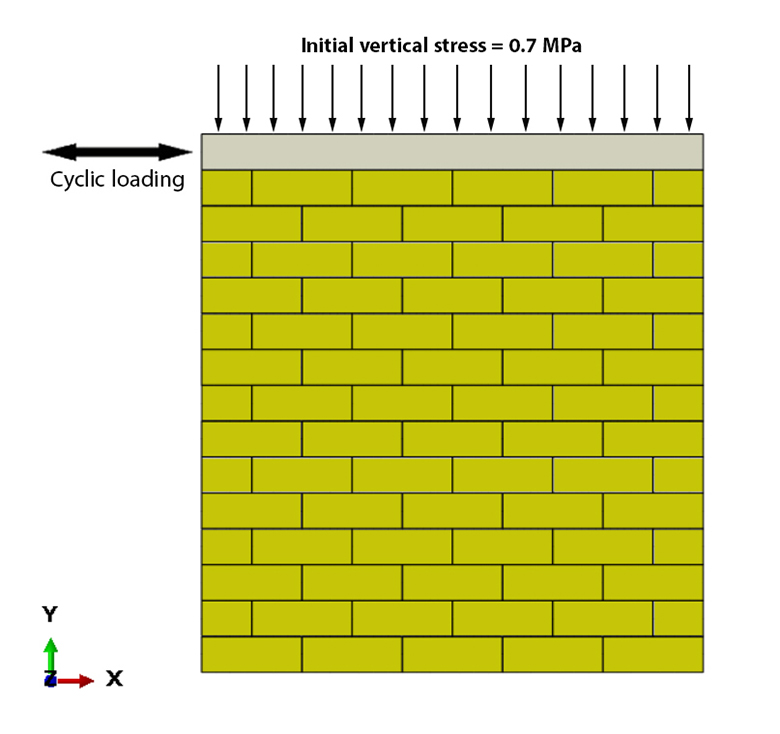
Simplified Micro Approach
The masonry wall is modeled using the Simplified Micro Approach. In this approach, the geometric shape of the bricks is created explicitly in the Part module, while the mortar is not modeled as a separate geometric part.
Instead, the mechanical behavior of the mortar is defined in the Interaction module using Cohesive Behavior and Damage options between the contacting surfaces of the bricks.
Definition of Mortar Interaction
In the Simplified Micro Approach, the mortar is represented through an interaction property between the bricks. The interaction property includes Cohesive Behavior to describe the bonding between the bricks and Damage to simulate the degradation and failure of the mortar interface.
In-Plane Cyclic Loading
After applying the initial compressive load, an in-plane cyclic loading is applied to the masonry wall. The cyclic loading is used to investigate the response of the wall under repeated loading and unloading cycles.
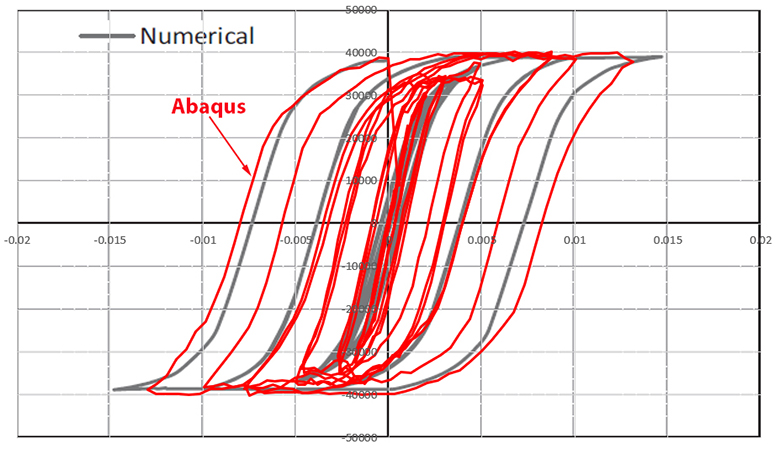
Hysteresis Diagram
The hysteresis diagram of the masonry wall is obtained from the Abaqus results. This diagram is used to evaluate the load-carrying behavior of the wall under cyclic loading.
Comparison with Article Results
The Abaqus hysteresis results are compared with the results reported in the reference article. The comparison shows a proper agreement between the numerical results obtained from Abaqus and the results reported in the article.
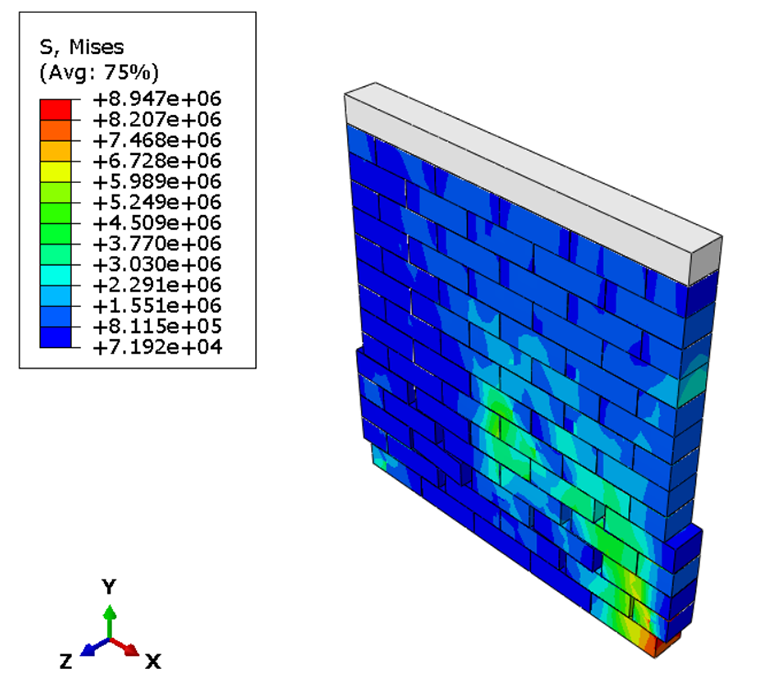
Deformation of Masonry Wall
The deformation behavior of the masonry wall under cyclic loading is investigated using the Abaqus results. The deformation pattern illustrates the response of the wall as the cyclic loading is applied.
Validation
This project has been validated, which means that the results obtained from the Abaqus software are in proper agreement with the results reported in the reference article.
In other words, this project is based on the reference research article, and the numerical results are compared with the reported results.
What You Will Learn
- How to model a masonry wall in Abaqus.
- How to use the Simplified Micro Approach for masonry wall modeling.
- How to model the bricks explicitly in Abaqus.
- How to define mortar behavior without creating a separate mortar part.
- How to define Cohesive Behavior for the mortar interaction.
- How to define Damage for the mortar interaction.
- How to apply a compressive load of 0.7 MPa.
- How to apply in-plane cyclic loading to a masonry wall.
- How to obtain the hysteresis diagram from Abaqus results.
- How to compare Abaqus results with the results reported in an article.
- How to validate a masonry wall numerical model.
Key Features
- Masonry wall under in-plane cyclic loading.
- Simplified Micro Approach.
- 1200 mm × 1200 mm masonry wall.
- 14 rows of masonry units.
- 0.7 MPa compressive load.
- Cohesive Behavior for mortar interaction.
- Damage definition for mortar interaction.
- In-plane cyclic loading.
- Hysteresis diagram.
- Comparison between Abaqus and article results.
- Validation against the reference article.
- Complete Abaqus CAE file.
- Abaqus INP file.
- Excel file for amplitude loading.
- Excel file containing results.
- Reference research paper.
- Step-by-step video tutorial.
Reference
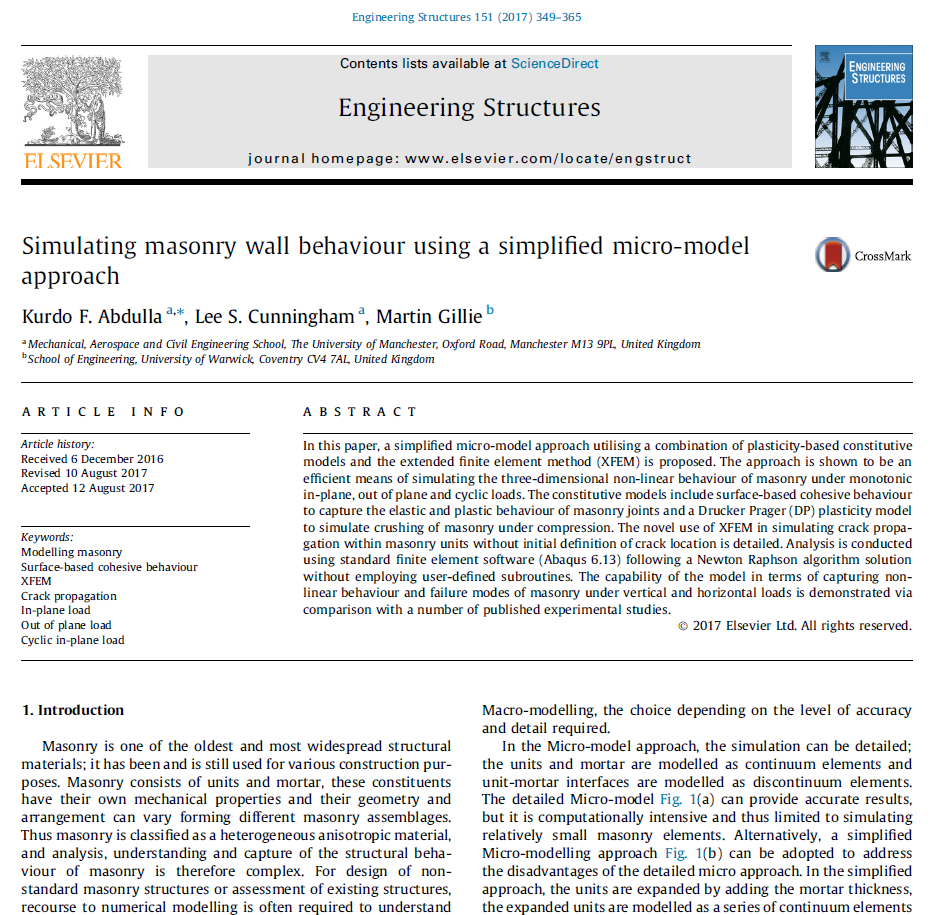
This project is based on the reference research article. The research paper is included with the project files and can be used to review the masonry wall model, loading procedure, and reported results.
Project Information
Important information about this project
Payment & Support
Need help with your purchase?
Secure Payment
Your payment is processed securely through our online payment system.
Need Help?
If you have any questions about this product, please contact us by email.
saeedofmoeini@gmail.com
hadi
let me know how can buy this
Admin
Hello
You can purchase from the site using a debit card. To do this, simply click on “Add to cart”.