
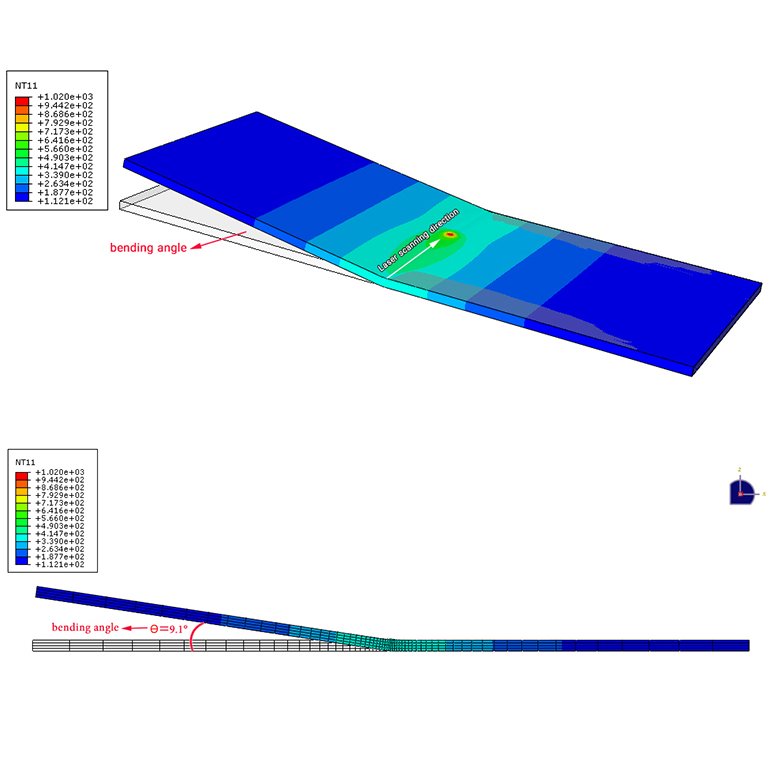
Project Overview
In this example, the laser forming process is simulated using the DFLUX subroutine in the Abaqus software.
The energy input from the laser beam is defined as a surface heat flux with a Gaussian energy distribution. Therefore, a Gaussian heat source is used to represent the laser beam.
The DFLUX subroutine is used to define the nonuniform heat flux and control the movement of the laser beam during the forming process.

Laser forming simulation using the DFLUX subroutine.
Laser Beam Movement
The laser beam moves along the Y direction at a constant speed of 10 mm/s.
As the laser beam moves over the sheet, the thermal energy causes the sheet to deform and bend.
The movement of the heat source is defined using the DFLUX Fortran subroutine, which applies the nonuniform Gaussian heat flux to the appropriate location on the sheet as a function of time.

Movement of the laser beam along the Y direction.
Gaussian Heat Source
A Gaussian heat source is used to describe the energy distribution of the laser beam over the surface of the sheet.
The laser energy is therefore introduced into the model as a surface heat flux rather than a uniform heat flux. The DFLUX subroutine defines the spatially nonuniform heat flux produced by the moving laser beam.
Laser Scanning and Cooling
The analysis is performed in two steps.
In the first step, the laser scanning process is simulated for a duration of 60 seconds.
In the second step, the laser beam is removed and the cooling process is simulated for a duration of 180 seconds.
Thermal-Mechanical Analysis
Two Coupled Temperature-Displacement steps are defined to simulate the thermal and mechanical response of the sheet during the laser forming process.
This type of analysis allows the temperature field and the resulting deformation of the sheet to be considered simultaneously.
Material Properties
The material of the sheet is ST37 steel.
Several material properties are defined as temperature-dependent, including:
- Thermal conductivity
- Specific heat
- Thermal expansion
- Elastic properties
- Plastic properties
Laser Power and Bending Angle
The power of the laser beam is considered to be 100 W.
As a result of the laser forming process, the sheet reaches a bending angle of 9.1 degrees.
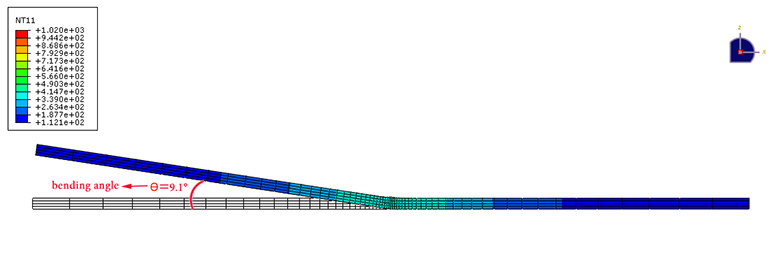
Bending deformation of the sheet caused by laser forming.
What You Will Learn
- How to simulate laser forming in Abaqus.
- How to use the DFLUX subroutine for laser forming.
- How to define a Gaussian heat source.
- How to define a surface heat flux with Gaussian energy distribution.
- How to define a nonuniform heat flux using DFLUX.
- How to define the movement of a laser beam.
- How to move the laser beam in the Y direction.
- How to define a laser scanning speed of 10 mm/s.
- How to simulate deformation and bending caused by laser heating.
- How to define a 60-second laser scanning step.
- How to define a 180-second cooling step.
- How to perform a Coupled Temperature-Displacement analysis.
- How to define temperature-dependent material properties.
- How to define a laser power of 100 W.
- How to evaluate the bending angle produced by laser forming.
- How to implement a Fortran DFLUX subroutine in Abaqus.
Key Features
- Laser forming simulation in Abaqus.
- DFLUX Fortran subroutine.
- Gaussian heat source.
- Gaussian surface heat flux.
- Nonuniform heat flux distribution.
- Laser beam movement in the Y direction.
- Laser scanning speed of 10 mm/s.
- Laser power of 100 W.
- 60-second laser scanning stage.
- 180-second cooling stage.
- Two Coupled Temperature-Displacement steps.
- Temperature-dependent material properties.
- ST37 steel sheet.
- Bending angle of 9.1 degrees.
- Research article included.
Project Information
Important information about this project
Payment & Support
Need help with your purchase?
Secure Payment
Your payment is processed securely through our online payment system.
Need Help?
If you have any questions about this product, please contact us by email.
saeedofmoeini@gmail.com
There are no reviews yet.