
Project Overview
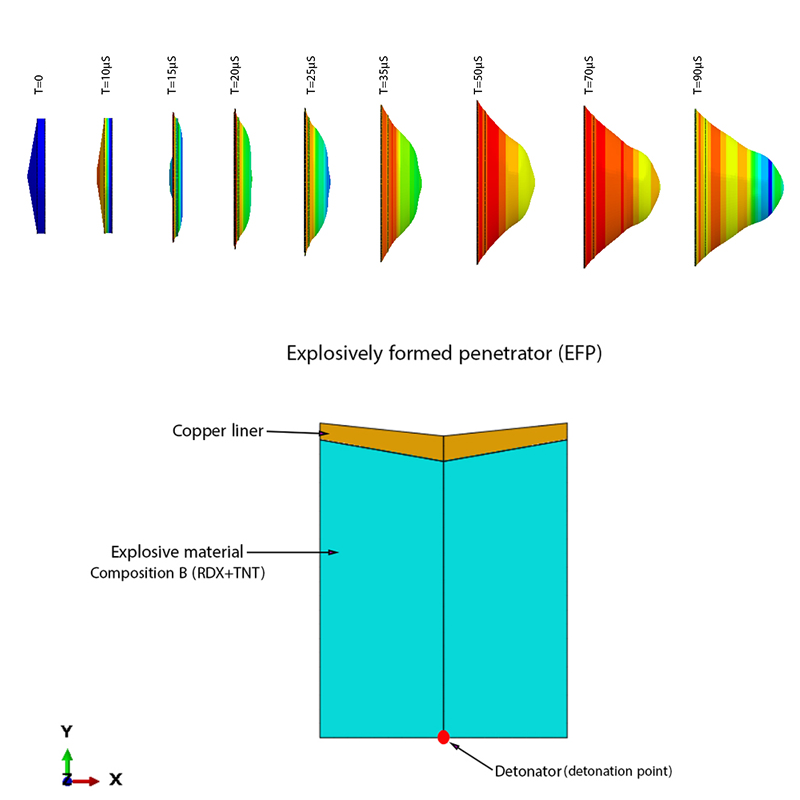
In this Abaqus project, the dynamic deformation of an Explosively Formed Penetrator (EFP) is investigated using Abaqus simulation.
An EFP is a special type of shaped-charge configuration in which a metallic liner undergoes severe deformation during the detonation process. The simulation focuses on the deformation of the liner and the development of its velocity during the analysis.
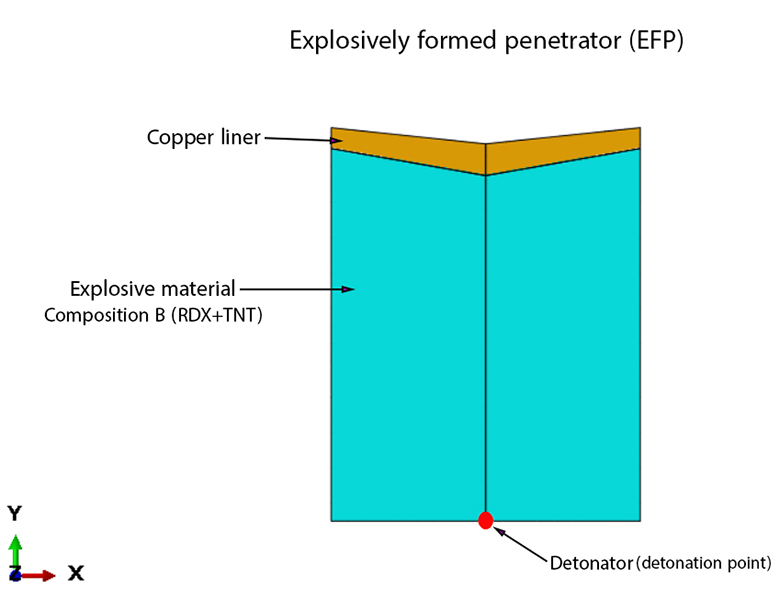
Explosively Formed Penetrator model used in the Abaqus simulation.
EFP Configuration
As shown in the model, the system consists of an explosive material, a metallic liner, and a detonator. The detonator is indicated in red in the model.
The explosive material used in the model is Composition B, which is a mixture of RDX and TNT, while the liner undergoes significant deformation during the detonation process.
Liner Deformation During Detonation
During the detonation process, the pressure generated by the explosive causes the liner to undergo severe deformation. The deformation develops rapidly as the analysis progresses.
The Abaqus simulation makes it possible to observe the deformation history of the liner and the evolution of its shape during the highly dynamic analysis.
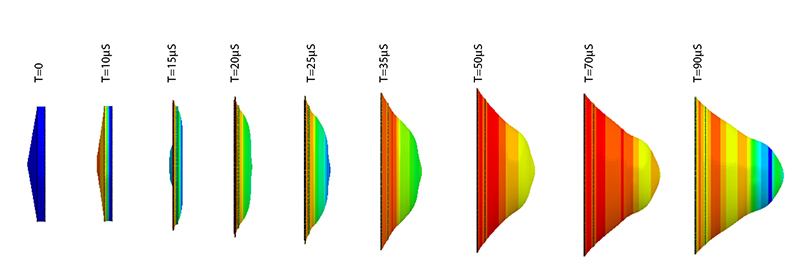
Deformation of the liner during the detonation process.
Liner Velocity
The velocity of the liner increases rapidly during the detonation process. The velocity history can be obtained from the Abaqus results and used to investigate the dynamic response of the liner.
In this simulation, the liner reaches a maximum velocity of approximately 1116 m/s.
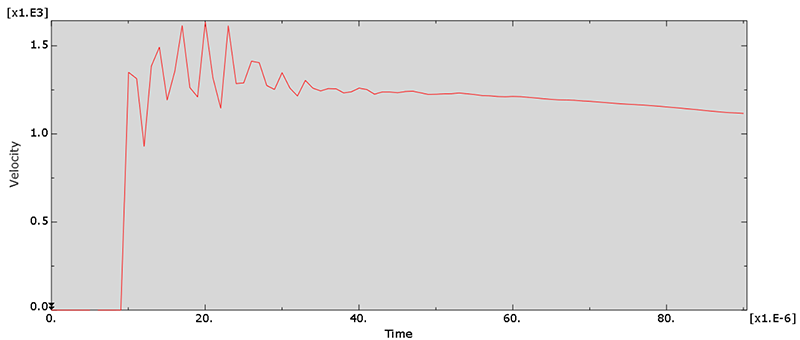
Velocity of the liner during the simulation.
Final Shape and Velocity of the Liner
Two important results in the simulation are the final deformation pattern of the liner and its velocity. These results provide useful information for evaluating the dynamic response of the liner throughout the analysis.
By examining the deformation history and velocity response, the evolution of the liner can be clearly observed from the beginning of the detonation process to the final stage of the simulation.
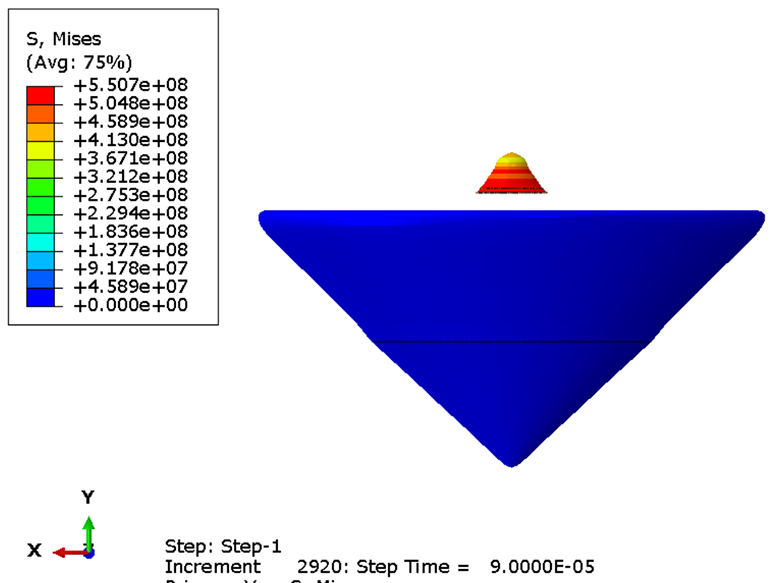
Final deformation and velocity response of the liner.
What You Will Learn
- How to set up a highly dynamic Abaqus simulation.
- How to model an EFP configuration at a conceptual level.
- How to investigate severe deformation of a metallic liner.
- How to monitor liner velocity during the analysis.
- How to extract velocity results from Abaqus.
- How to visualize the deformation history of the liner.
- How to interpret highly dynamic simulation results.
Key Features
- Highly dynamic EFP simulation.
- Metallic liner deformation.
- Detonation process visualization.
- Liner velocity analysis.
- Maximum liner velocity of approximately 1116 m/s.
- Deformation history of the liner.
- Step-by-step training video.
- Abaqus CAE file.
- Abaqus INP file.
- Text file containing the model code.
Project Information
Important information about this project
Payment & Support
Need help with your purchase?
Secure Payment
Your payment is processed securely through our online payment system.
Need Help?
If you have any questions about this product, please contact us by email.
saeedofmoeini@gmail.com
There are no reviews yet.