
Project Overview
In this Abaqus tutorial, a 3D triaxial test of soil is simulated using four different soil plasticity models: Cam-Clay plasticity, Cap plasticity, Mohr-Coulomb plasticity, and Drucker-Prager.
The main objective is to investigate the mechanical response of the soil under triaxial loading and compare the results obtained from different constitutive models.

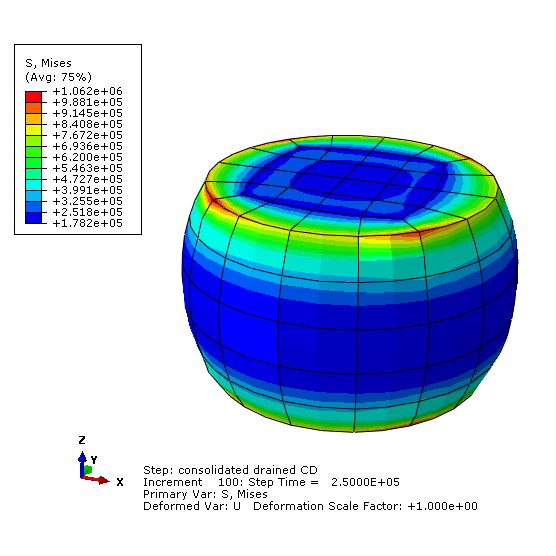
3D triaxial test model of the soil.
Soil Specimen
The soil specimen is modeled as a three-dimensional cylinder with a diameter of 5 cm and a height of 5 cm.
The cylindrical soil specimen is subjected to confining pressure followed by vertical loading to simulate the triaxial test conditions.
Triaxial Test Conditions
There are three common types of triaxial soil tests:
- Consolidated-Drained (CD)
- Consolidated-Undrained (CU)
- Unconsolidated-Undrained (UU)
In this tutorial, a Consolidated-Drained (CD) triaxial test is simulated.
During the consolidation stage, the soil is subjected to an all-round confining pressure while drainage is allowed. This allows the excess pore water pressure generated during loading to dissipate from the soil.
After consolidation, the vertical load is applied while the drainage condition remains open.

Triaxial test.
Analysis Steps
The triaxial test is performed in two main steps.
- Step 1 – Geostatic and Consolidation: A confining pressure of 210 kPa is applied to all sides of the soil specimen while drainage is allowed.
- Step 2 – Vertical Loading: A vertical load is applied to the soil specimen until failure, while the drainage condition remains open.
Soil Plasticity Models
The behavior of the soil is investigated using several constitutive models available in Abaqus.
- Cam-Clay Plasticity
- Cap Plasticity
- Mohr-Coulomb Plasticity
- Drucker-Prager
In addition to the three-dimensional Cam-Clay model, an axisymmetric Cam-Clay model is also considered for comparison.
Deviator Stress vs. Axial Strain
The relationship between deviator stress and axial strain is obtained from the Abaqus simulations.
The results from the different soil plasticity models are compared to investigate their differences in predicting the stress–strain response of the soil.
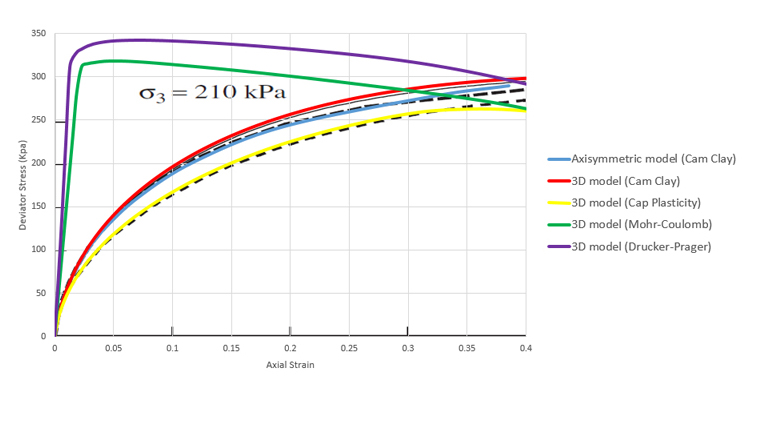
Deviator stress versus axial strain obtained from different soil plasticity models.
Volumetric Strain vs. Axial Strain
The volumetric strain versus axial strain response is also obtained from the simulations.
This comparison provides additional information about the volumetric behavior of the soil during the triaxial loading process.
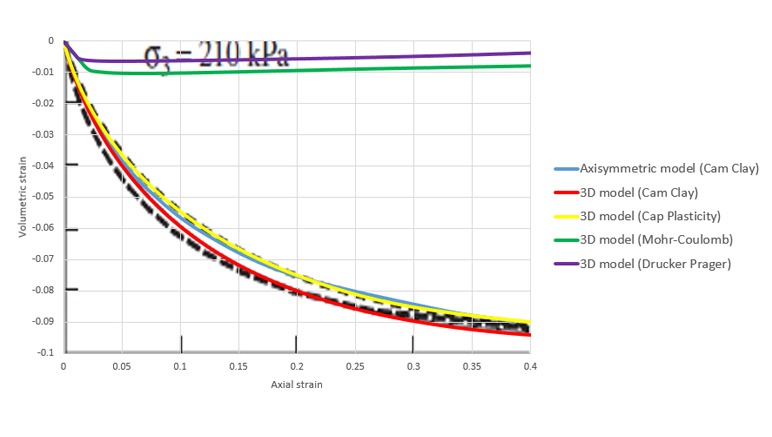
Volumetric strain versus axial strain obtained from the different soil models.
Comparison of Axial Strain in Four Soil Plasticity Models
The distribution of axial strain in the soil specimen is obtained from the Abaqus analysis.
The contour plot helps visualize the development and distribution of axial deformation throughout the soil specimen during loading.

Axial strain contour in the soil specimen.
Comparison of the Results
The numerical results obtained using the different constitutive models are compared in terms of their deviator stress–axial strain and volumetric strain–axial strain responses.
This comparison demonstrates how the selected soil plasticity model can affect the predicted response of the soil under triaxial loading.
What You Will Learn
- How to model a 3D triaxial test of soil in Abaqus.
- How to create a cylindrical soil specimen.
- How to define Cam-Clay plasticity.
- How to define Cap plasticity.
- How to define Mohr-Coulomb plasticity.
- How to define the Drucker-Prager model.
- How to perform a Consolidated-Drained (CD) triaxial test.
- How to apply confining pressure to the soil specimen.
- How to define drainage conditions.
- How to apply vertical loading until failure.
- How to obtain deviator stress versus axial strain.
- How to obtain volumetric strain versus axial strain.
- How to obtain axial strain contours.
- How to compare different soil plasticity models.
- How to compare 3D and axisymmetric Cam-Clay models.
Key Features
- 3D triaxial test of soil.
- Cylindrical soil specimen.
- Specimen diameter: 5 cm.
- Specimen height: 5 cm.
- Confining pressure: 210 kPa.
- Consolidated-Drained (CD) triaxial test.
- Cam-Clay plasticity.
- 3D Cam-Clay model.
- Axisymmetric Cam-Clay model.
- Cap plasticity.
- Mohr-Coulomb plasticity.
- Drucker-Prager model.
- Deviator stress versus axial strain.
- Volumetric strain versus axial strain.
- Axial strain contour.
- Comparison of different constitutive models.
- CAE file.
- INP file.
- Excel file containing material and cap hardening data.
- Excel file containing deviator stress versus axial strain results.
- Excel file containing volumetric strain versus axial strain results.
Project Information
Important information about this project
Payment & Support
Need help with your purchase?
Secure Payment
Your payment is processed securely through our online payment system.
Need Help?
If you have any questions about this product, please contact us by email.
saeedofmoeini@gmail.com
There are no reviews yet.