
Project Overview
In this Abaqus tutorial, the response of a concrete gravity dam subjected to an earthquake with a magnitude of 6.5 on the Richter scale is simulated using the Abaqus software.
The objective of this simulation is to investigate the dynamic response of the concrete gravity dam under earthquake loading and to evaluate the resulting tensile damage and horizontal displacement of the dam.
Dam Geometry
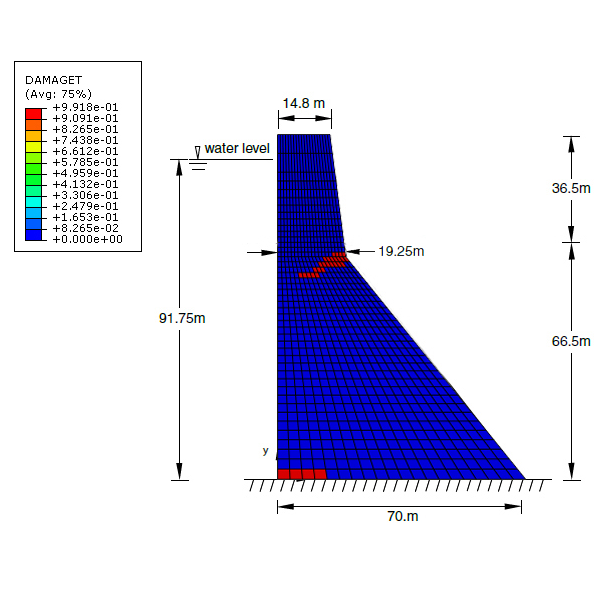
The concrete gravity dam is 103 m high and 70 m wide at its base.
The upstream face of the dam is assumed to be straight and vertical. At the time of the earthquake, the reservoir has a water depth of 91.75 m.

Geometry and dimensions of the concrete gravity dam.
Earthquake Ground Motion
The earthquake loading is based on the Koyna earthquake. The transverse and vertical components of the recorded ground acceleration are used as the seismic excitation.
These acceleration components are applied to the nodes located at the base of the dam during the dynamic analysis.

Transverse and vertical ground acceleration components of the Koyna earthquake.
Boundary Conditions and Assumptions
In this example, the interaction between the dam and its foundation is neglected by assuming that the foundation is rigid.
Before applying the earthquake excitation, the dam is subjected to its self-weight and the hydrostatic pressure generated by the reservoir water on the upstream face.
Analysis Steps
The analysis is performed in three main steps.
- Step 1 – Gravity Loading: The self-weight of the concrete gravity dam is applied.
- Step 2 – Hydrostatic Pressure: The hydrostatic pressure of the reservoir water is applied to the upstream wall of the dam.
- Step 3 – Dynamic Analysis: The transverse and vertical components of the earthquake ground acceleration are applied to the base of the dam.
Concrete Dam Material
The mechanical behavior of the concrete is modeled using the Concrete Damaged Plasticity (CDP) model in Abaqus.
This model is used to capture the nonlinear behavior and damage development in the concrete during the earthquake excitation.
Rayleigh Damping
Rayleigh stiffness-proportional damping is used to account for damping effects during the dynamic analysis.
A natural frequency extraction analysis is first performed to determine the fundamental frequency of the dam. The first eigenfrequency is obtained as approximately 18.61 rad/s.
Based on this value, β is calculated as 3.23 × 10⁻³ s.
Tensile Damage in the Concrete
The development of tensile damage in the concrete dam is investigated during the earthquake analysis.
The tensile damage contour allows the damaged regions of the concrete dam to be identified and provides useful information about the potential development of tensile cracking.

Tensile damage distribution in the concrete gravity dam.
Horizontal Displacement of the Dam Crest
The horizontal displacement at the left corner of the dam crest is obtained from the Abaqus analysis.
The displacement is evaluated relative to the ground motion to investigate the dynamic response of the dam during the earthquake.
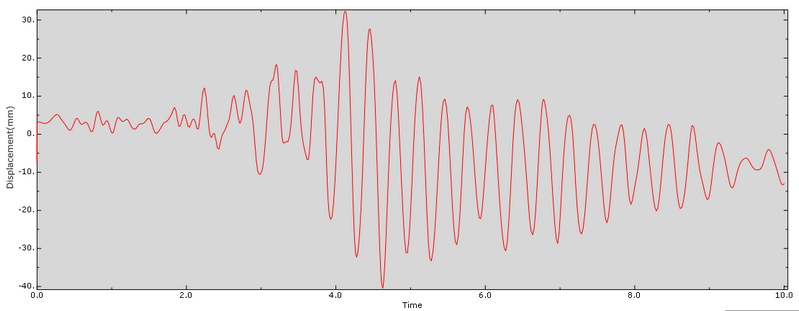
Horizontal displacement of the dam crest relative to the ground motion.
What You Will Learn
- How to model a concrete gravity dam in Abaqus.
- How to apply gravity loading to the dam.
- How to apply hydrostatic pressure from the reservoir.
- How to define earthquake ground acceleration in Abaqus.
- How to apply transverse and vertical earthquake components.
- How to model concrete using the Concrete Damaged Plasticity model.
- How to perform a natural frequency extraction analysis.
- How to determine the first eigenfrequency of the dam.
- How to define Rayleigh damping for dynamic analysis.
- How to investigate tensile damage in the concrete.
- How to obtain the horizontal displacement of the dam crest.
- How to analyze the dynamic response of a concrete gravity dam.
Key Features
- Concrete gravity dam.
- Earthquake magnitude of 6.5 on the Richter scale.
- Koyna earthquake ground motion.
- Dam height of 103 m.
- Dam base width of 70 m.
- Reservoir water depth of 91.75 m.
- Rigid foundation assumption.
- Gravity loading.
- Hydrostatic pressure.
- Transverse and vertical earthquake acceleration components.
- Concrete Damaged Plasticity (CDP).
- Rayleigh stiffness-proportional damping.
- Natural frequency extraction.
- First eigenfrequency of 18.61 rad/s.
- Tensile damage analysis.
- Horizontal displacement of the dam crest.
- CAE file.
- INP file.
- Excel file containing concrete material data.
- Excel file containing earthquake acceleration records.
- Step-by-step video tutorial.
Project Information
Important information about this project
Payment & Support
Need help with your purchase?
Secure Payment
Your payment is processed securely through our online payment system.
Need Help?
If you have any questions about this product, please contact us by email.
saeedofmoeini@gmail.com
There are no reviews yet.