
Project Overview
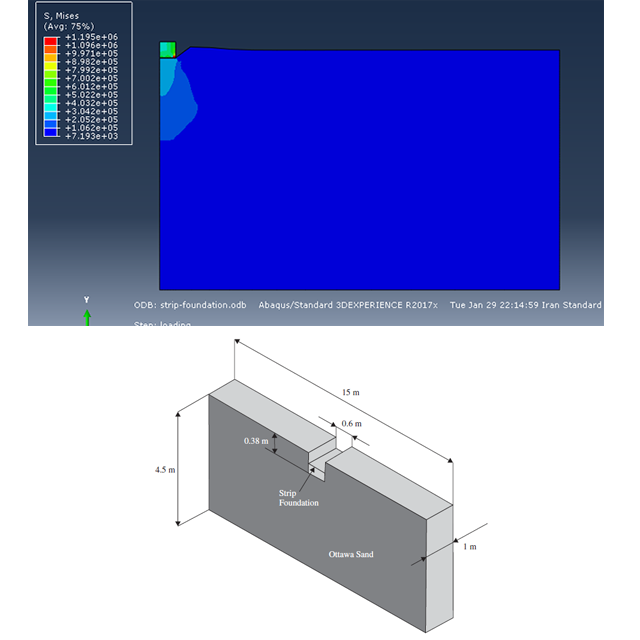
In this Abaqus tutorial, the bearing capacity failure of a strip foundation is simulated using a numerical model based on Example 6.2 from Sam Helwany's book.
The example investigates a 0.6 m-wide strip foundation placed on a thick homogeneous layer of Ottawa sand. The numerical results obtained from Abaqus are compared with the bearing capacity predicted in the reference book.

Strip foundation placed on a homogeneous layer of Ottawa sand.
Strip Foundation Model
The foundation has a width of 0.6 m and is located at a depth of 0.38 m below the ground surface.
The sand layer has a depth of 4.5 m and a width of 15 m. The foundation is modeled as a concrete component with linear elastic behavior.
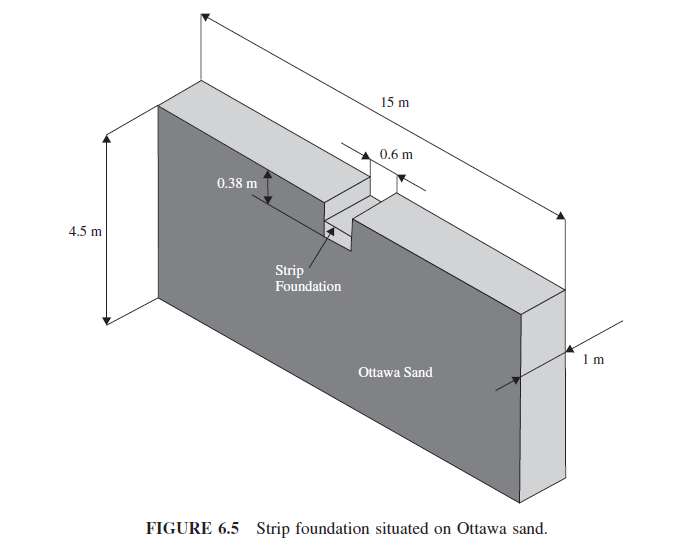
Geometry and dimensions of the strip foundation and sand layer.
Concrete Foundation
The concrete foundation is assumed to behave as a linear elastic material.
The Young's modulus of the concrete is 1435 MPa, and the Poisson's ratio is 0.2.
Analysis Steps
The analysis is performed using two steps. The first step is used to establish the initial loading condition in the sand layer, while the second step is used to apply the foundation loading.
- Step 1: Gravity loads and surcharge loads are applied to the sand layer.
- Step 2: The foundation load is applied using a constant downward displacement boundary condition at the top surface of the foundation.
Foundation Settlement
A constant-velocity boundary condition is applied to the top surface of the foundation. This boundary condition causes the foundation to settle at a constant rate.
As the foundation gradually settles, the pressure beneath the foundation increases until the soil reaches its bearing capacity and a failure surface develops.

Settlement of the strip foundation during the analysis.
Comparison with Analytical Results
The numerical result obtained from Abaqus is compared with the result reported by Sam Helwany.
The bearing capacity represents the maximum foundation pressure that can be reached before the soil undergoes a significant failure mechanism.
According to Sam Helwany's book, the predicted bearing capacity is 440 kPa.
The Abaqus simulation predicts a bearing capacity of 444 kPa, showing very close agreement with the reference solution.
| Method | Bearing Capacity |
|---|---|
| Sam Helwany Book | 440 kPa |
| Abaqus | 444 kPa |
The difference between the two results is very small, demonstrating that the Abaqus model can accurately reproduce the bearing capacity reported in the reference example.
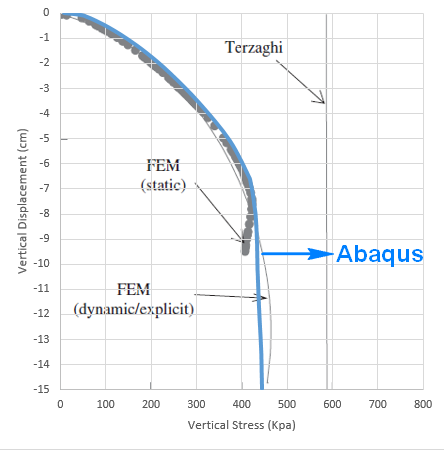
Comparison between Abaqus results and the results from Sam Helwany's book.
What You Will Learn
- How to model a strip foundation in Abaqus.
- How to model a homogeneous Ottawa sand layer.
- How to define the geometry of the foundation and soil domain.
- How to define a linear elastic concrete foundation.
- How to apply gravity loads to the soil.
- How to apply surcharge loads to the sand layer.
- How to apply a constant downward displacement to the foundation.
- How to simulate foundation settlement.
- How to investigate bearing capacity failure.
- How to obtain the bearing capacity from Abaqus.
- How to compare Abaqus results with a reference solution.
Key Features
- Strip foundation with a width of 0.6 m.
- Foundation depth of 0.38 m.
- Homogeneous Ottawa sand layer.
- Sand layer depth of 4.5 m.
- Sand layer width of 15 m.
- Linear elastic concrete foundation.
- Young's modulus of concrete: 1435 MPa.
- Poisson's ratio of concrete: 0.2.
- Two analysis steps.
- Gravity and surcharge loading.
- Constant downward displacement boundary condition.
- Bearing capacity failure simulation.
- Comparison with Sam Helwany's reference result.
- Abaqus bearing capacity: 444 kPa.
- Reference bearing capacity: 440 kPa.
- CAE file.
- INP file.
- Excel file containing the results.
Project Information
Important information about this project
Payment & Support
Need help with your purchase?
Secure Payment
Your payment is processed securely through our online payment system.
Need Help?
If you have any questions about this product, please contact us by email.
saeedofmoeini@gmail.com
There are no reviews yet.