
Project Overview
In this Abaqus tutorial, a 2D fatigue analysis is performed using Paris law to investigate crack propagation under cyclic loading.
The model consists of a plate with a circular hole. The stress concentration around the hole provides a suitable location for crack nucleation and subsequent crack propagation during the fatigue analysis.

2D fatigue analysis of a plate with a circular hole in Abaqus.
Geometry of the Specimen
The specimen is a plate with a circular hole. The plate has a length of 0.34 m, a width of 0.2 m, and a thickness of 0.02 m.
The radius of the circular hole is 0.02 m.
Crack Nucleation
A Static Step is first used to initiate a crack at the location of stress concentration around the circular hole.
After crack nucleation, the model is prepared for the cyclic fatigue analysis, where the crack can progressively propagate under repeated loading.
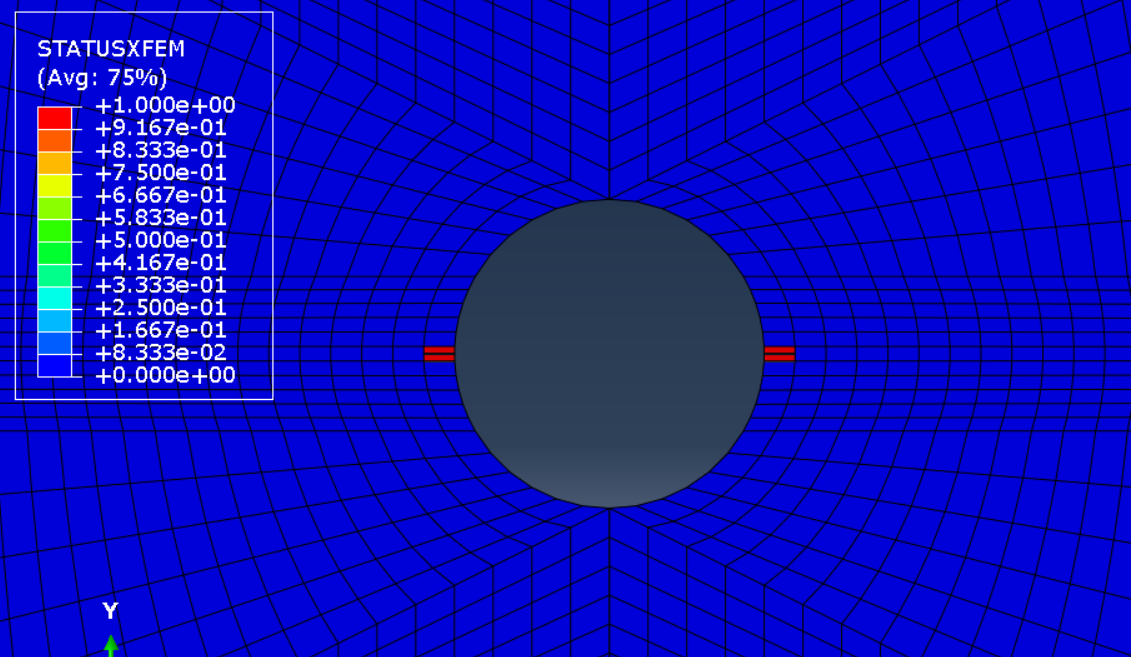
Crack nucleation at the stress concentration region.
Cyclic Loading
During the fatigue analysis, a cyclic distributed load with a peak value of 350 kPa is applied.
Equal and opposite loading is applied at both ends of the specimen in the longitudinal direction, producing the cyclic loading condition required for the fatigue analysis.
Direct Cyclic Analysis
The fatigue analysis is performed using the Direct Cyclic procedure. In this example, the model is analyzed for a total of 1000 cycles.
The Direct Cyclic approach allows the cyclic response and crack propagation behavior to be investigated over the specified loading cycles.
Crack Propagation
The crack progressively propagates as the number of loading cycles increases. The crack growth can be observed at different stages of the analysis.
In this example, the crack propagation is investigated at 164, 547, 841, and 1000 cycles.
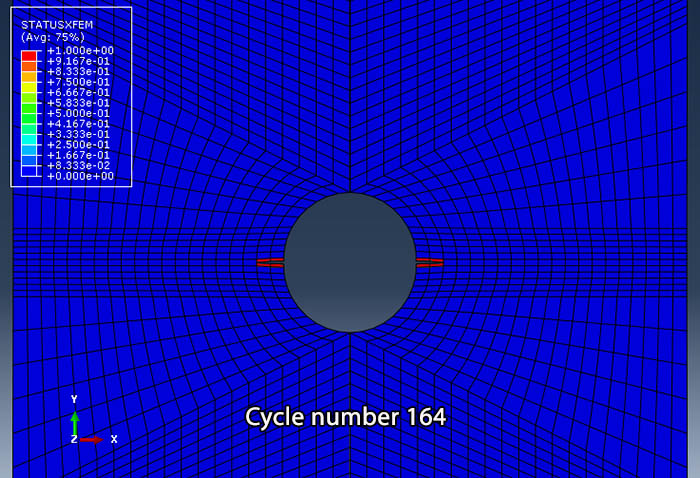
Crack propagation after 164 cycles.
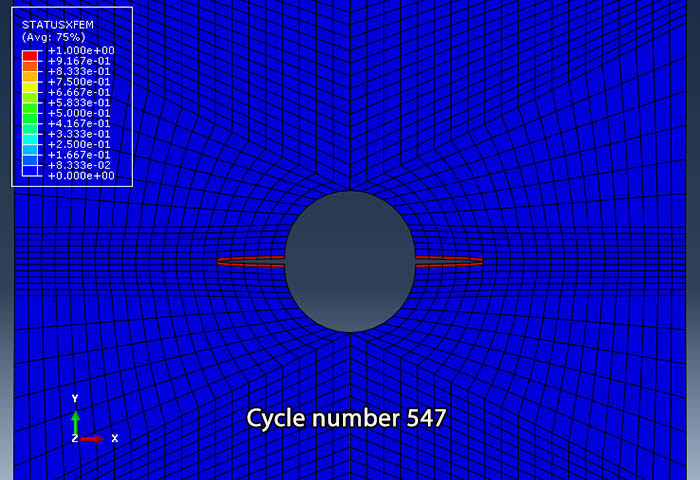
Crack propagation after 547 cycles.

Crack propagation after 841 cycles.

Crack propagation after 1000 cycles.
Paris Law
Paris law is used to describe the fatigue crack growth behavior. The crack progressively grows under cyclic loading as the number of cycles increases.
This approach makes it possible to investigate the relationship between cyclic loading and fatigue crack propagation in the specimen.
Input File Modification
In this example, the Abaqus input file is edited to define the required fracture and surface behavior properties.
The input file includes the Fracture Criterion and Surface Behavior definitions required for the simulation.
What You Will Learn
- How to perform a 2D fatigue analysis in Abaqus.
- How to use Paris law for fatigue crack propagation.
- How to model a plate with a circular hole.
- How to initiate a crack at a stress concentration region.
- How to define a Static Step for crack nucleation.
- How to define cyclic distributed loading.
- How to apply equal and opposite loading at both ends.
- How to use Direct Cyclic analysis.
- How to analyze 1000 loading cycles.
- How to investigate crack propagation at different cycles.
- How to modify the Abaqus input file.
- How to define Fracture Criterion and Surface Behavior.
Key Features
- 2D fatigue analysis in Abaqus.
- Paris law for fatigue crack propagation.
- Plate with a circular hole.
- Plate dimensions of 0.34 × 0.2 × 0.02 m.
- Circular hole radius of 0.02 m.
- 350 kPa peak cyclic distributed loading.
- Equal and opposite longitudinal loading.
- Direct Cyclic analysis.
- 1000 loading cycles.
- Crack propagation investigation at 164 cycles.
- Crack propagation investigation at 547 cycles.
- Crack propagation investigation at 841 cycles.
- Crack propagation investigation at 1000 cycles.
- Fracture Criterion definition.
- Surface Behavior definition.
- CAE file.
- INP file.
- Step-by-step video tutorial.
Project Information
Important information about this project
Payment & Support
Need help with your purchase?
Secure Payment
Your payment is processed securely through our online payment system.
Need Help?
If you have any questions about this product, please contact us by email.
saeedofmoeini@gmail.com
There are no reviews yet.