
Project Overview
In this Abaqus tutorial, a 3D low-cycle fatigue analysis is performed using Paris law to investigate fatigue crack propagation under cyclic loading.
The simulation uses a three-dimensional specimen with an initial crack. The crack propagation behavior is investigated as the number of loading cycles increases.
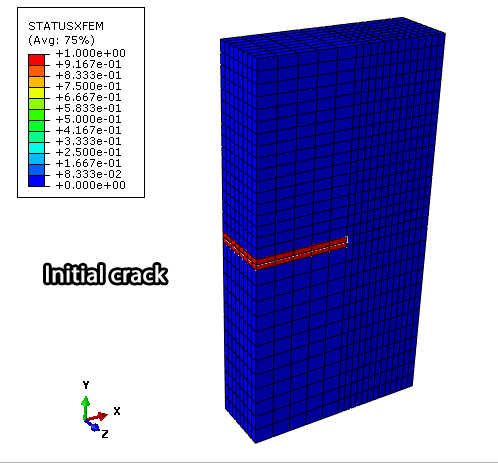
Three-dimensional low-cycle fatigue model in Abaqus.
Specimen Geometry
The specimen has a length of 6 m and a width of 3 m. An initial crack with a length of 1.5 m is defined in the model before the fatigue analysis begins.
Initial Crack
An initial crack with a length of 1.5 m is introduced into the specimen. This initial crack provides the starting point for the subsequent fatigue crack propagation.
The crack growth is then evaluated during the cyclic loading process using the fatigue analysis procedure.
Cyclic Displacement Loading
A cyclic displacement loading is applied to the specimen. The peak displacement value is 0.00019 m.
Equal and opposite displacements are applied at both ends of the specimen in the width direction to produce the required cyclic loading condition.
Direct Cyclic Analysis
The fatigue simulation is performed using the Direct Cyclic analysis procedure.
In this example, the model is analyzed for a total of 5000 loading cycles. The crack propagation is evaluated at several stages throughout the analysis.
Crack Propagation
As the number of loading cycles increases, the initial crack progressively grows. The crack propagation is investigated at 1000, 2000, 3000, 4000, and 5000 cycles.
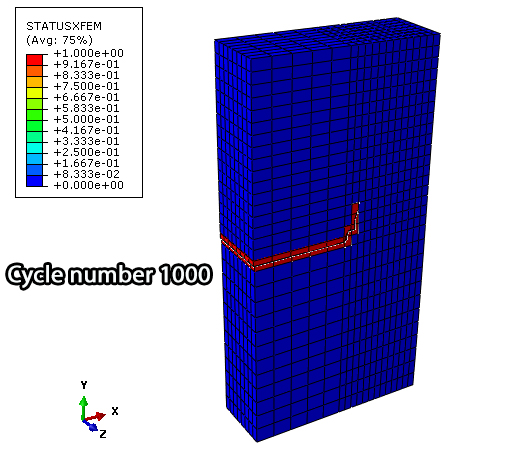
Crack propagation after 1000 cycles.

Crack propagation after 2000 cycles.
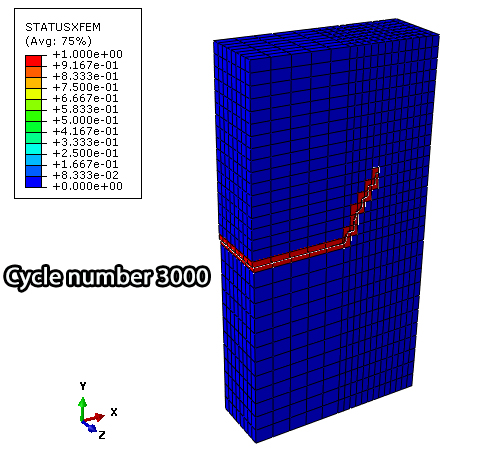
Crack propagation after 3000 cycles.
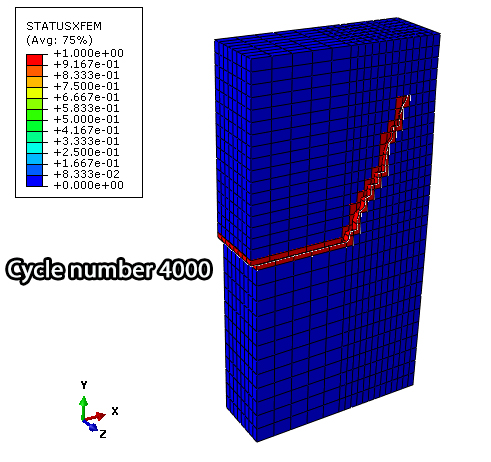
Crack propagation after 4000 cycles.

Crack propagation after 5000 cycles.
Paris Law
Paris law is used to describe the fatigue crack growth behavior. This allows the crack propagation to be investigated as a function of the applied cyclic loading and the number of fatigue cycles.
Input File Modification
To complete the simulation, the Abaqus input file needs to be edited and additional codes must be introduced.
In this example, the Fracture Criterion and Surface Behavior definitions are added to the input file to define the required crack-related behavior.
What You Will Learn
- How to perform a 3D low-cycle fatigue analysis in Abaqus.
- How to use Paris law for fatigue crack propagation.
- How to create a three-dimensional fatigue model.
- How to define an initial crack.
- How to apply cyclic displacement loading.
- How to apply equal and opposite displacements at both ends.
- How to use the Direct Cyclic analysis procedure.
- How to analyze 5000 fatigue cycles.
- How to investigate crack propagation at different cycles.
- How to modify the Abaqus input file.
- How to define Fracture Criterion.
- How to define Surface Behavior.
Key Features
- 3D low-cycle fatigue simulation.
- Paris law for fatigue crack propagation.
- Three-dimensional specimen.
- Specimen length of 6 m.
- Specimen width of 3 m.
- Initial crack length of 1.5 m.
- Cyclic displacement loading.
- Peak displacement of 0.00019 m.
- Equal and opposite displacement loading.
- Direct Cyclic analysis.
- 5000 loading cycles.
- Crack propagation at 1000 cycles.
- Crack propagation at 2000 cycles.
- Crack propagation at 3000 cycles.
- Crack propagation at 4000 cycles.
- Crack propagation at 5000 cycles.
- Fracture Criterion definition.
- Surface Behavior definition.
- CAE file.
- INP file.
- Step-by-step video tutorial.
Project Information
Important information about this project
Payment & Support
Need help with your purchase?
Secure Payment
Your payment is processed securely through our online payment system.
Need Help?
If you have any questions about this product, please contact us by email.
saeedofmoeini@gmail.com
hoaithanh(verified owner)
good
Moses Negedu(verified owner)
Good Day,
I am interested in your video on Simulation of low cycle fatigue in Abaqus.
Im a student from Nigeria and i don’t have a paypal account, is there an alternative method of payment?
Admin
Hello
You can pay by credit card online on the website