
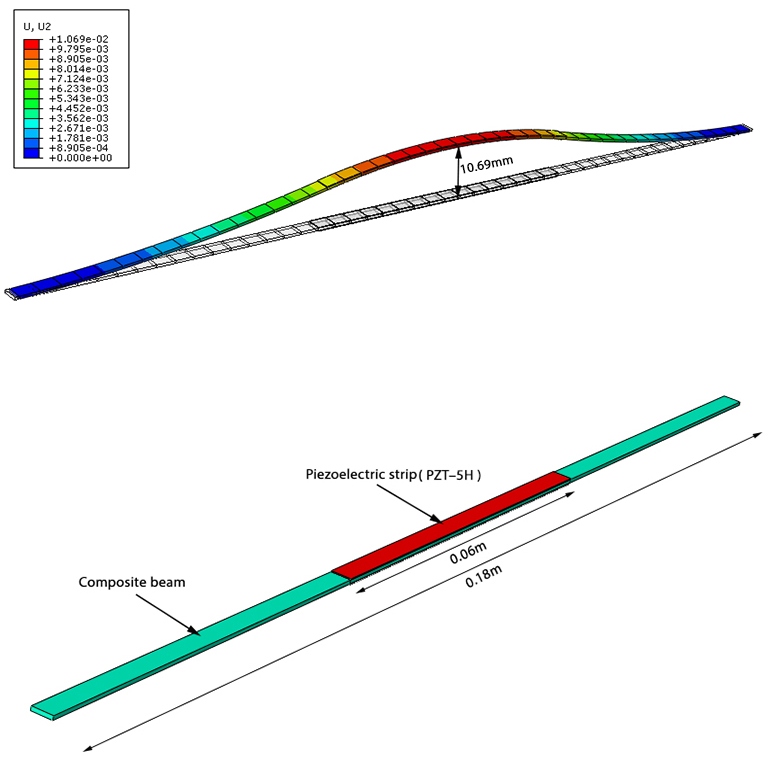
Project Overview
In this Abaqus project, the inverse piezoelectric effect is simulated and investigated.
Two piezoelectric strips are attached to the top and bottom surfaces of a composite beam. The piezoelectric material used in this model is PZT-5H.
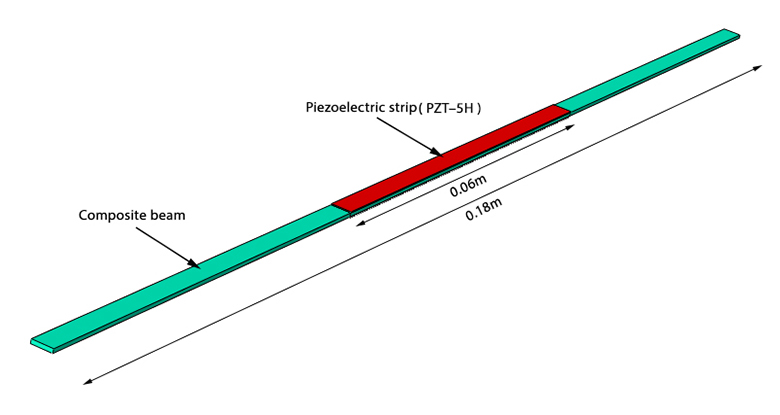
Piezoelectric strips attached to the top and bottom surfaces of the composite beam.
PZT-5H Piezoelectric Material
The piezoelectric strips are made of PZT-5H, a piezoelectric material that can convert electrical energy into mechanical deformation when an electric potential difference is applied.
In this simulation, the electrical response of the PZT-5H material is coupled with its mechanical behavior to investigate the deformation generated by the applied voltage.
Application of Electric Potential
An electric potential difference of 1000 V is applied to the piezoelectric strips. The applied voltage generates an electric field inside the piezoelectric material.
Inverse Piezoelectric Effect
When an electric potential difference is applied to a piezoelectric material, an electric field is generated inside the material. As a result, the piezoelectric material undergoes mechanical deformation.
This phenomenon is known as the inverse piezoelectric effect, in which electrical energy is converted into mechanical energy.

Deformation generated in the piezoelectric material due to the applied electric field.
Electric Field and Deformation
The applied voltage creates an electric field within the piezoelectric strips. This electric field causes the strips to deform, which in turn affects the overall deformation of the composite beam.
Vertical Displacement
The deformation of the composite beam is evaluated after applying the electrical potential. The maximum vertical displacement obtained from the simulation is approximately 10.69 mm.

Vertical displacement of the composite beam after applying 1000 V.
Input Voltage
The relationship between the applied input voltage and the response of the piezoelectric material can also be investigated during the analysis.
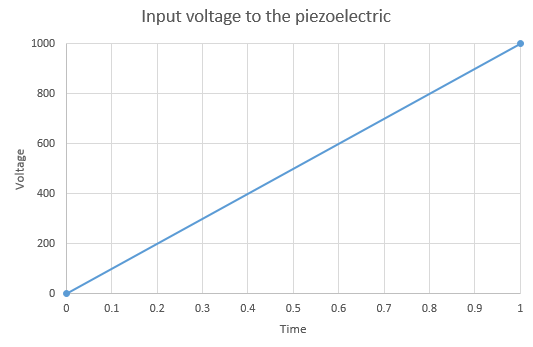
Input voltage applied to the piezoelectric strips.
What You Will Learn
- How to model a piezoelectric strip in Abaqus.
- How to model a composite beam with piezoelectric strips.
- How to define PZT-5H material properties.
- How to apply an electric potential difference to a piezoelectric material.
- How to simulate the inverse piezoelectric effect.
- How electrical energy is converted into mechanical deformation.
- How to evaluate the electric field generated inside the piezoelectric material.
- How to evaluate the deformation of the composite beam.
- How to determine the maximum vertical displacement.
Key Features
- Inverse piezoelectric effect simulation.
- Composite beam with two piezoelectric strips.
- PZT-5H piezoelectric material.
- 1000 V electric potential difference.
- Electrical-to-mechanical energy conversion.
- Electric field generation inside the piezoelectric material.
- Maximum vertical displacement of approximately 10.69 mm.
- Abaqus CAE file.
- Abaqus INP file.
- Excel file containing PZT-5H material properties.
- Step-by-step training video.
Project Information
Important information about this project
Payment & Support
Need help with your purchase?
Secure Payment
Your payment is processed securely through our online payment system.
Need Help?
If you have any questions about this product, please contact us by email.
saeedofmoeini@gmail.com
hua zeng(verified owner)
I am working on piezoelectric effect simulations and hope they will be effective.