
Project Overview
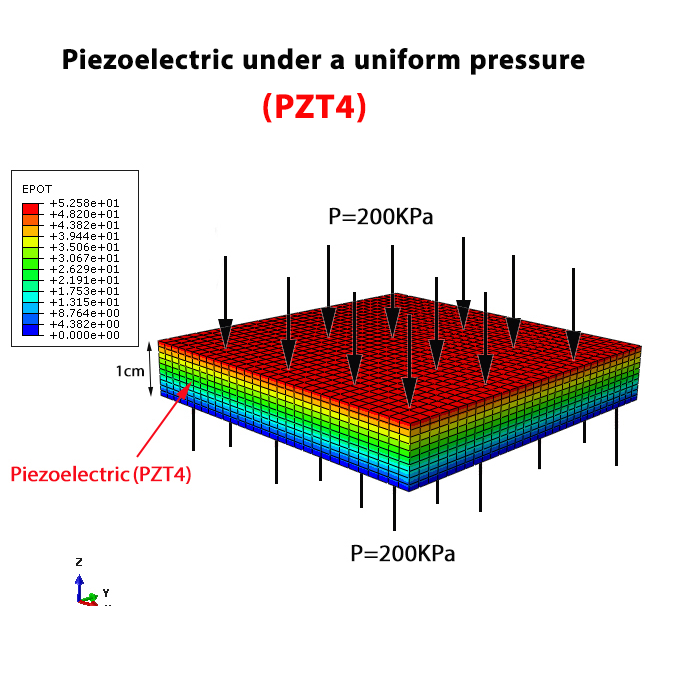
In this Abaqus tutorial, the behavior of a piezoelectric material under uniform pressure is simulated. The piezoelectric material used in this example is PZT4.
A uniform pressure of 200 kPa is applied to the top and bottom surfaces of the piezoelectric material. The resulting electrical response is then investigated using Abaqus.
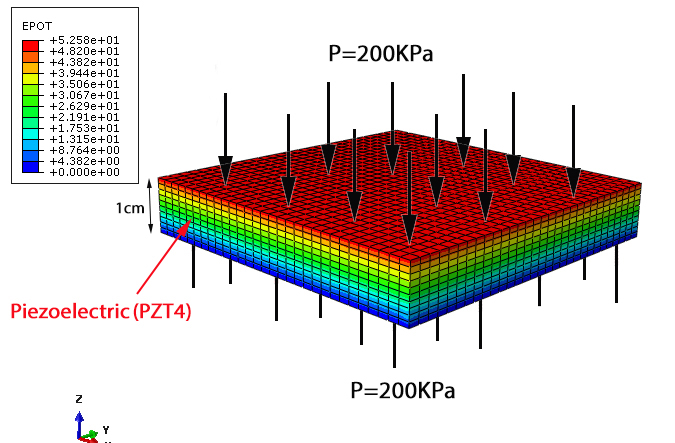
Piezoelectric material subjected to uniform pressure.
Electric Potential Difference
When the pressure is applied to the piezoelectric material, an electric potential difference is generated across the piezoelectric.
The electrical response is obtained from the Abaqus results by evaluating the electric potential generated by the applied mechanical loading.
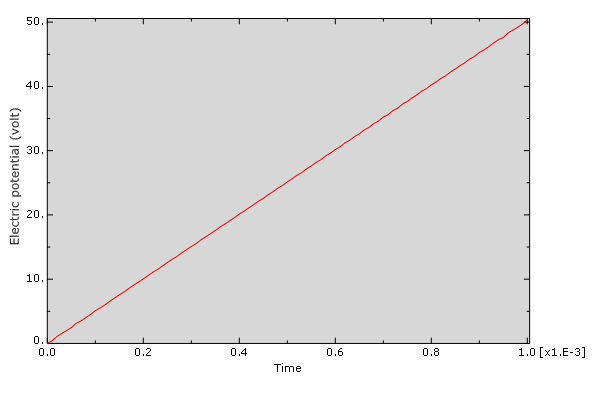
Electric potential difference generated in the piezoelectric.
Output Voltage
As a result of applying a uniform pressure of 200 kPa, an output voltage of approximately 50 Volts is obtained from the piezoelectric material.
Therefore, the simulation demonstrates how mechanical pressure can generate an electrical voltage in a piezoelectric material.
What You Will Learn
- How to simulate a piezoelectric material in Abaqus.
- How to model PZT4 piezoelectric material.
- How to apply uniform pressure to a piezoelectric material.
- How to apply 200 kPa pressure to the top and bottom surfaces.
- How mechanical pressure produces an electrical response.
- How to obtain the electric potential difference in Abaqus.
- How to determine the output voltage generated by the piezoelectric.
- How to obtain an output voltage of approximately 50 V in this example.
Key Features
- PZT4 piezoelectric material.
- Uniform pressure loading.
- 200 kPa applied pressure.
- Mechanical-electrical coupling.
- Electric potential difference.
- Output voltage calculation.
- Approximately 50 V output voltage.
- Abaqus piezoelectric simulation.
- Free educational tutorial.
Project Information
Important information about this project
Payment & Support
Need help with this tutorial?
Free Tutorial
This Abaqus tutorial is available free of charge.
Need Help?
If you have any questions about this tutorial, please contact us by email.
saeedofmoeini@gmail.com
There are no reviews yet.