
Project Overview
This tutorial focuses on obtaining the Shear Force Diagram and Bending Moment Diagram using the Abaqus software and the Analytical Solution.
In this training, the Shear Force and Bending Moment diagrams are first obtained using the Analytical Solution. The same diagrams are then obtained using the Abaqus software. Finally, the results obtained from both methods are compared to verify the Abaqus results.
Problem Description
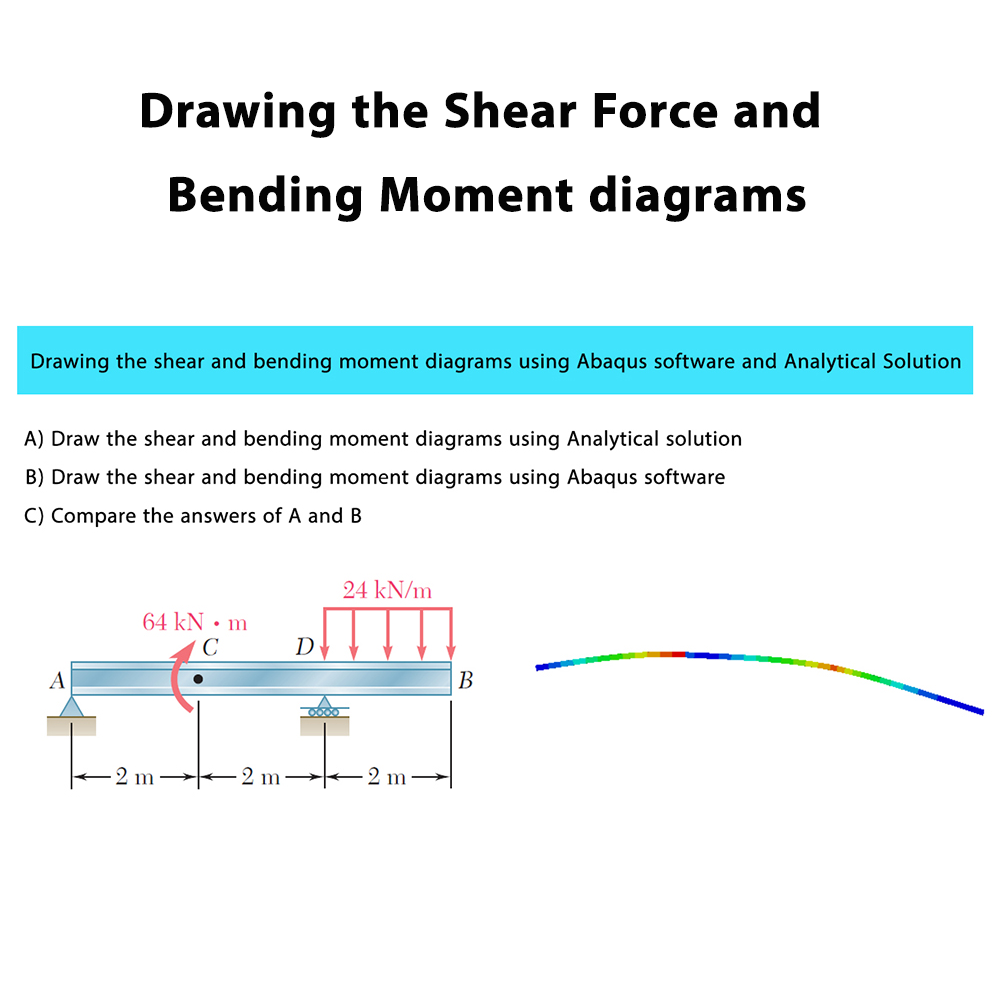
In this example, a beam is subjected to the specified loading and boundary conditions. The objective is to determine the Shear Force and Bending Moment along the beam.
As you observe in this figure, a concentrated moment of 64 kN·m is applied at point C, while a linear load of 24 kN/m is applied to the DB section of the beam.
These loading conditions are considered in both the analytical calculation and the Abaqus simulation to determine and compare the Shear Force and Bending Moment diagrams.

Analytical Solution
First, the Shear Force Diagram and Bending Moment Diagram are determined using the Analytical Solution.
The analytical calculations provide reference results that can be used to evaluate the accuracy of the numerical results obtained from Abaqus.

Abaqus Simulation
The beam is then modeled in the Abaqus software according to the given geometry, loading, and boundary conditions. After performing the analysis, the required results are extracted to obtain the Shear Force and Bending Moment diagrams.
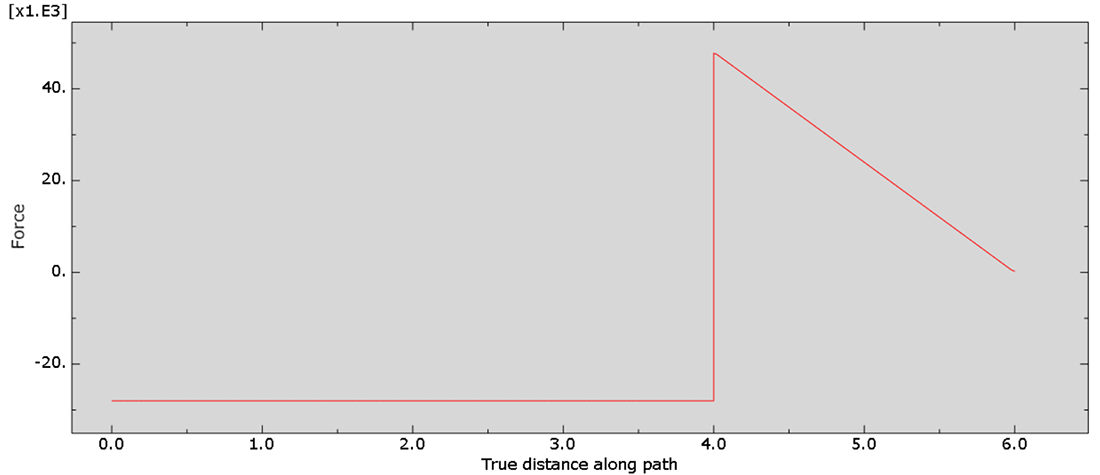
Shear Force Diagram
The Shear Force Diagram obtained from the Abaqus analysis is presented below and can be compared directly with the corresponding analytical result.
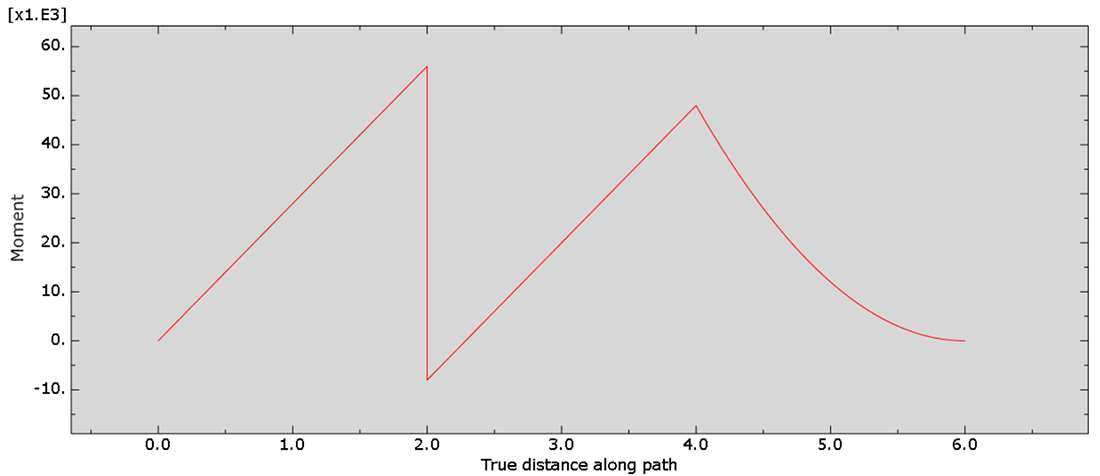
Bending Moment Diagram
The Bending Moment Diagram obtained from the Abaqus analysis is presented below and can be compared with the analytical result.
Comparison of Results
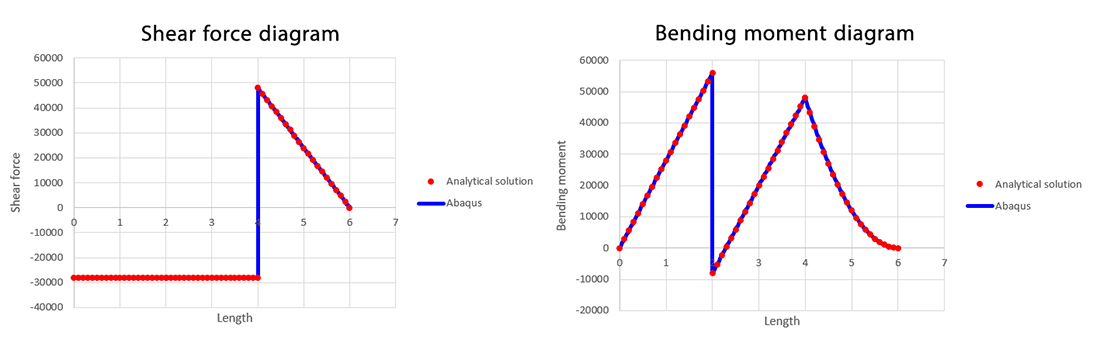
Finally, the Shear Force Diagram and Bending Moment Diagram obtained from the Abaqus software are compared with the corresponding results obtained from the Analytical Solution.
This comparison allows us to evaluate the accuracy of the Abaqus simulation and verify whether the numerical results are consistent with the analytical results.
As observed, the results obtained from the Abaqus software are in very good agreement with those obtained from the Analytical Solution.
What You Will Learn
- How to model a beam in Abaqus.
- How to obtain the Shear Force Diagram using Abaqus.
- How to obtain the Bending Moment Diagram using Abaqus.
- How to calculate Shear Force using the Analytical Solution.
- How to calculate Bending Moment using the Analytical Solution.
- How to compare Abaqus results with the Analytical Solution.
- How to verify numerical results using analytical results.
Key Features
- Shear Force Diagram calculation.
- Bending Moment Diagram calculation.
- Beam analysis using Abaqus.
- Analytical Solution.
- Comparison of numerical and analytical results.
- Excel file for processing and comparing results.
- Free Abaqus tutorial.
Project Information
Important information about this project
Payment & Support
Need help with this tutorial?
Free Tutorial
This Abaqus tutorial is available free of charge.
Need Help?
If you have any questions about this tutorial, please contact us by email.
saeedofmoeini@gmail.com
There are no reviews yet.