
Project Overview
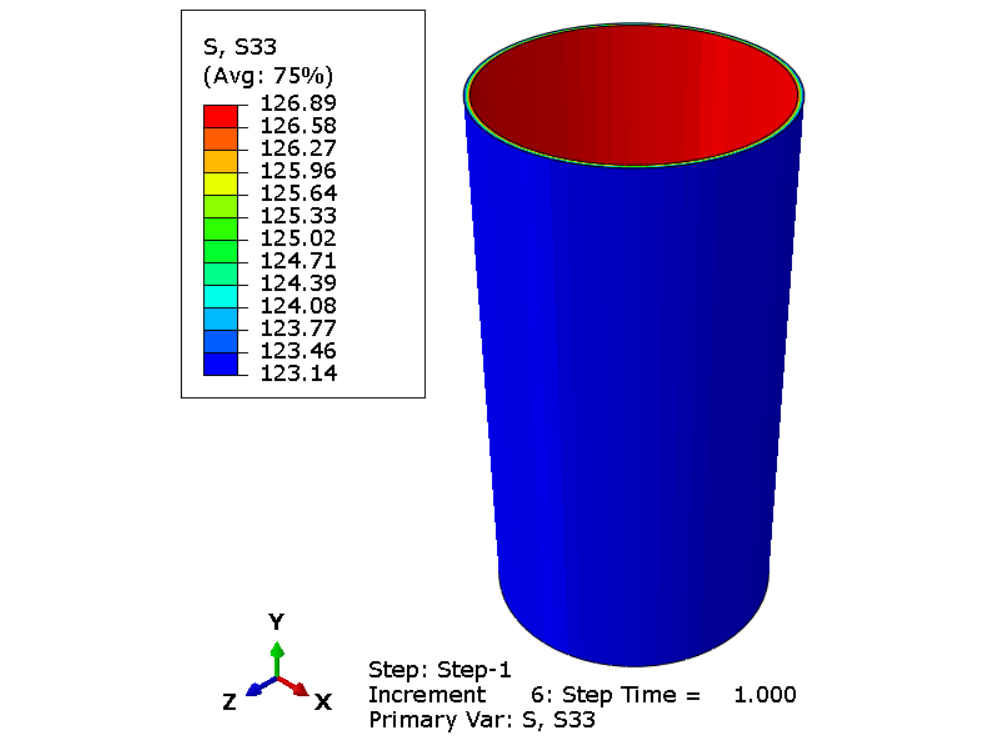
In this training, we perform a finite element analysis of a thin-walled cylinder subjected to internal pressure using the Abaqus software. The numerical results are then compared with the Analytical Solution based on the thin-walled cylinder theory to evaluate the accuracy of the simulation.
The main objective is to investigate the hoop stress in the cylinder wall and compare its values at the inner and outer surfaces with the analytical prediction.
Model Description
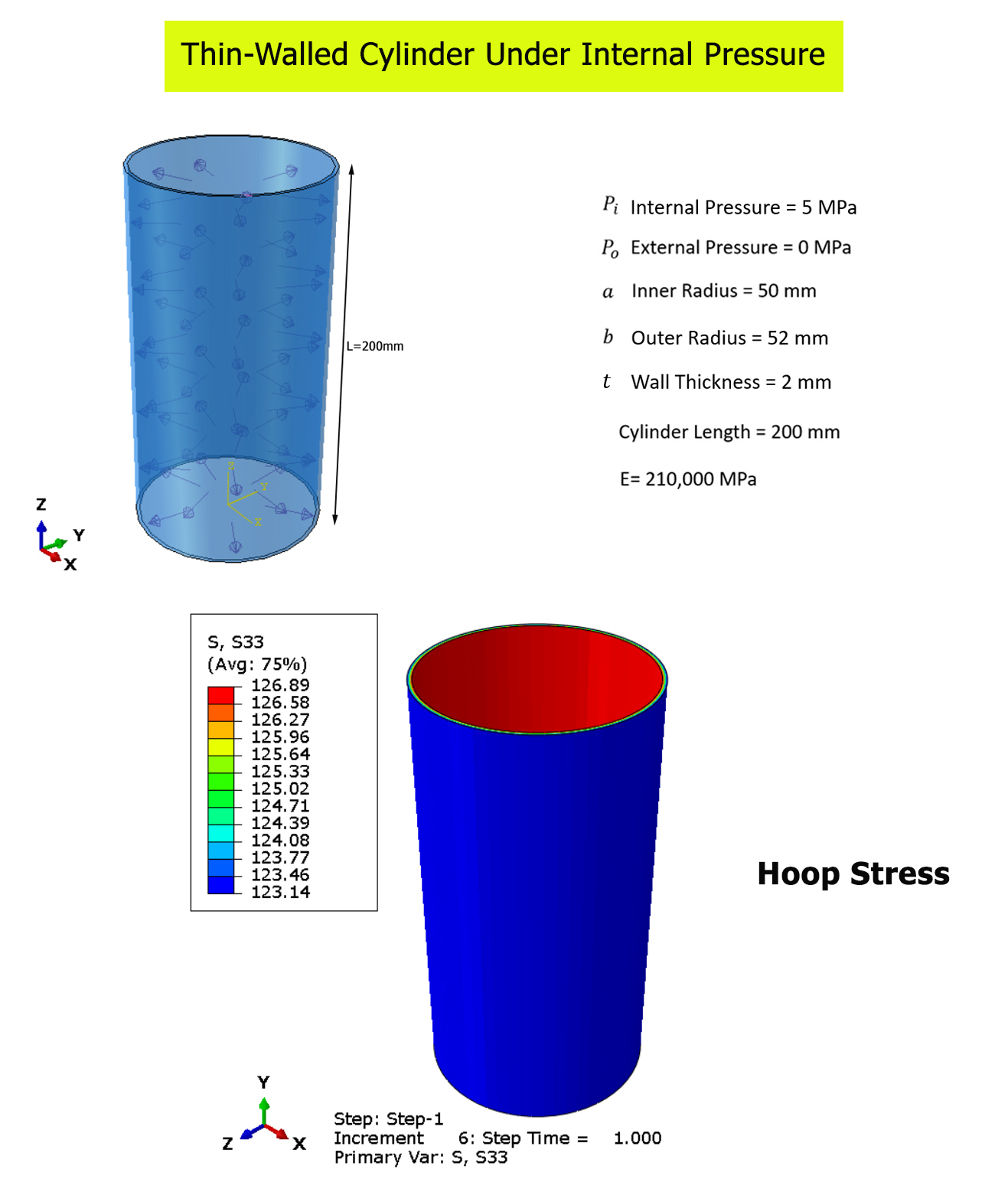
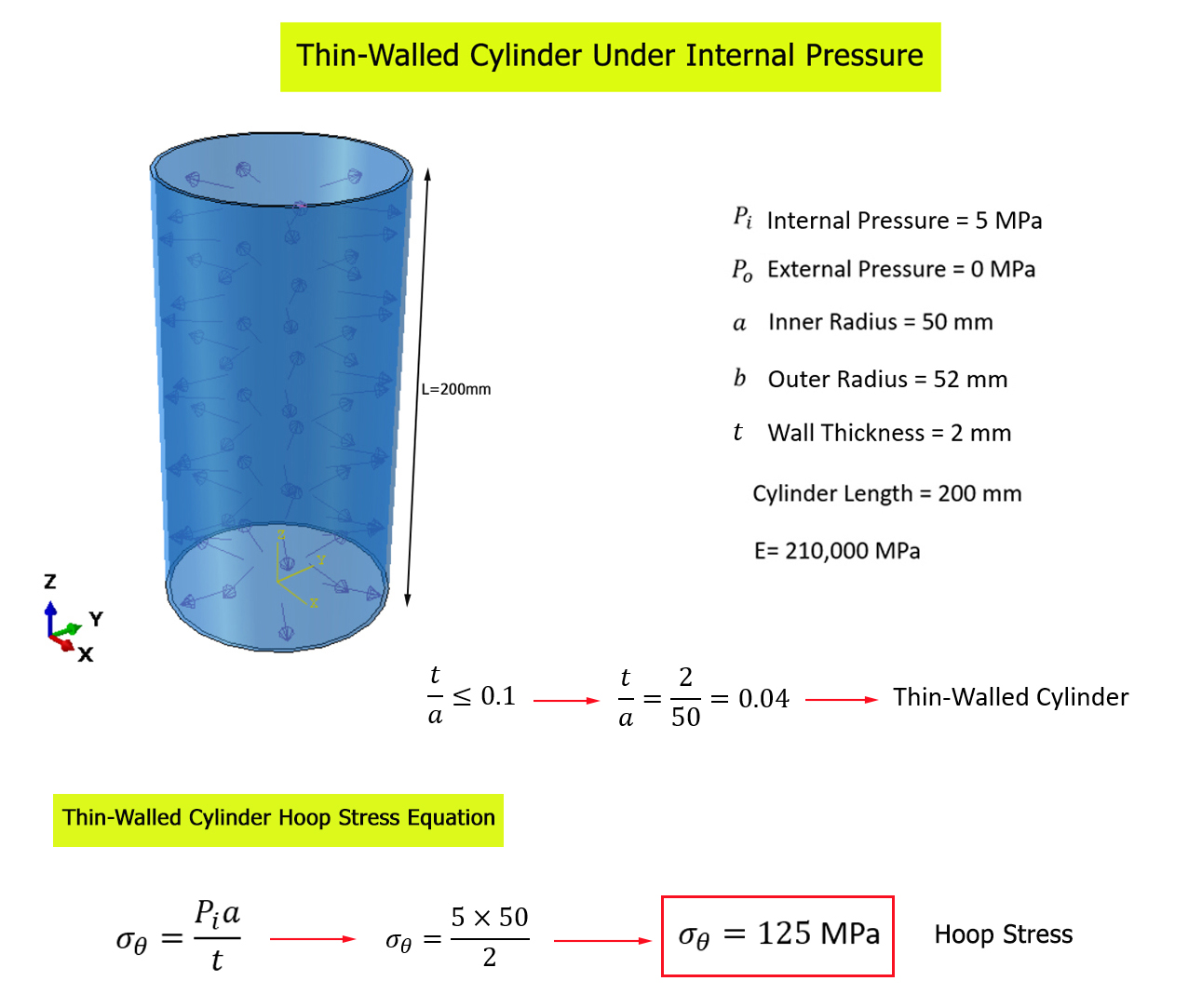
The model consists of a thin-walled steel cylinder with an inner radius of 50 mm, an outer radius of 52 mm, and a length of 200 mm. The wall thickness is therefore 2 mm.
The cylinder is subjected to an internal pressure of 5 MPa, while the external pressure is zero. Both ends of the cylinder are open.
The material is assumed to be homogeneous, isotropic, and linearly elastic. The material properties are defined as follows: Young's modulus is 210,000 MPa and Poisson's ratio is 0.3.
Since the wall thickness is small compared to the inner radius, the cylinder is classified as a thin-walled cylinder. Therefore, the thin-walled cylinder theory is used to calculate the analytical hoop stress.
Abaqus Simulation
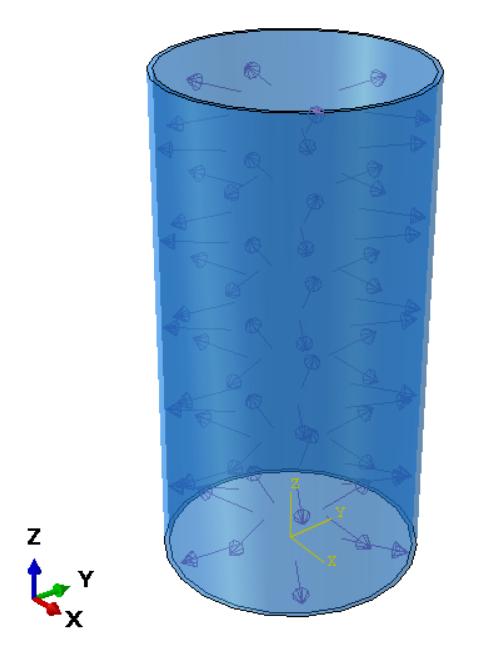
First, the cylinder is modeled in the Abaqus software using a two-dimensional Axisymmetric formulation.
The internal pressure is applied to the inner surface of the cylinder, and a static stress analysis is performed to obtain the stress distribution throughout the cylinder wall.
The model is discretized using CAX4R elements. The axial boundary conditions allow the cylinder to expand freely in the axial direction, representing an open-ended configuration.
Hoop Stress Results
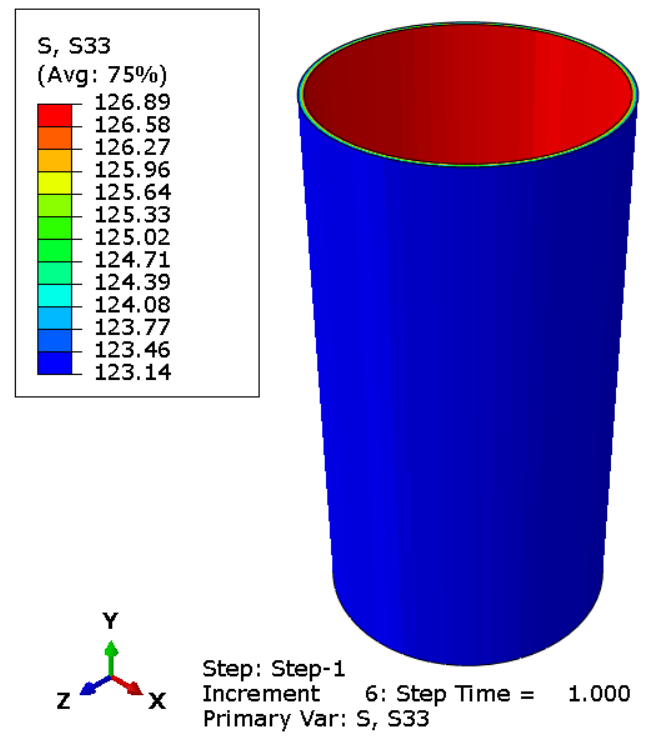
After completing the analysis, the hoop stress distribution is extracted from the Abaqus results.
The hoop stress is tensile throughout the cylinder wall. Its value is slightly higher at the inner surface and decreases toward the outer surface.
Analytical Solution
Next, the hoop stress is calculated using the Analytical Solution based on the thin-walled cylinder theory.
For a thin-walled cylinder subjected to internal pressure, the hoop stress is calculated using the following equation:
σθ = Pia / t
In this equation, Pi represents the internal pressure, a is the inner radius of the cylinder, and t is the wall thickness.
For the given cylinder, the parameters are:
Pi = 5 MPa
a = 50 mm
t = 2 mm
Substituting these values into the equation gives:
σθ = (5 × 50) / 2
σθ = 125 MPa
According to the thin-walled cylinder theory, the hoop stress is assumed to be uniformly distributed across the wall thickness. Therefore, the analytical hoop stress is approximately 125 MPa at both the inner and outer surfaces.
Comparison of Results
Finally, the hoop stress values obtained from the Abaqus simulation are compared with those calculated using the Analytical Solution.
The comparison is performed at the inner and outer surfaces of the cylinder. The numerical results show good agreement with the analytical prediction.
The relative differences between the Abaqus and analytical results are approximately 1.5% at both the inner and outer surfaces.
These results demonstrate good agreement between the finite element simulation and the analytical solution. The small variation in the Abaqus results across the wall thickness is consistent with the fact that the thin-walled cylinder theory assumes an approximately uniform hoop stress.
What You Will Learn
- How to model a thin-walled cylinder in Abaqus.
- How to define material properties in Abaqus.
- How to apply internal pressure to a cylindrical structure.
- How to define an axisymmetric model using CAX4R elements.
- How to perform a static stress analysis.
- How to obtain hoop stress from Abaqus results.
- How to calculate hoop stress using thin-walled cylinder theory.
- How to determine the hoop stress distribution across the cylinder wall.
- How to compare numerical results with the Analytical Solution.
- How to evaluate the accuracy of a finite element model.
Key Features
- Thin-walled cylinder subjected to internal pressure.
- Open-ended cylinder configuration.
- Two-dimensional axisymmetric finite element model.
- Linear elastic material behavior.
- Hoop stress analysis.
- Analytical Solution based on thin-walled cylinder theory.
- Numerical simulation using Abaqus.
- Stress comparison at the inner and outer surfaces.
- Comparison between Abaqus and Analytical Solution.
Project Information
Important information about this project
Payment & Support
Need help with this project?
Project Support
If you need assistance with this project or have questions about the Abaqus model, please contact us.