

Product Overview
In this example, we intend to obtain the natural frequencies of an FGM ring using the Abaqus software.
Functionally Graded Materials (FGMs) are materials whose properties vary gradually through their volume. In this project, an FGM ring is modeled in Abaqus and its natural frequencies are obtained using a frequency analysis.
Functionally Graded Material (FGM)
The ring is made of a Functionally Graded Material, whose material properties vary gradually according to the selected material distribution law.
In this model, the inner material is ceramic (Si₃N₄), while the outer material is stainless steel (SUS304). The material properties gradually vary from the inner ceramic layer to the outer stainless-steel layer, forming a functionally graded material (FGM).
FGM Material Definition
The required material properties are calculated for the FGM and introduced into Abaqus. The corresponding material data are also provided in an Excel file included with the project.
Frequency Analysis
A frequency analysis is performed in Abaqus to determine the natural frequencies and corresponding mode shapes of the FGM ring.
The eigenvalue analysis provides the vibration characteristics of the ring and allows the natural frequencies obtained from Abaqus to be evaluated against the reference results.
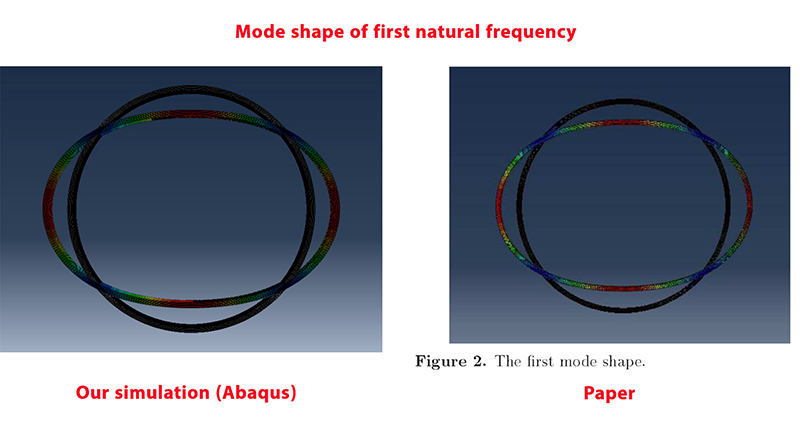
Mode Shapes
The calculated eigenmodes are visualized in Abaqus to examine the vibration patterns corresponding to the obtained natural frequencies.
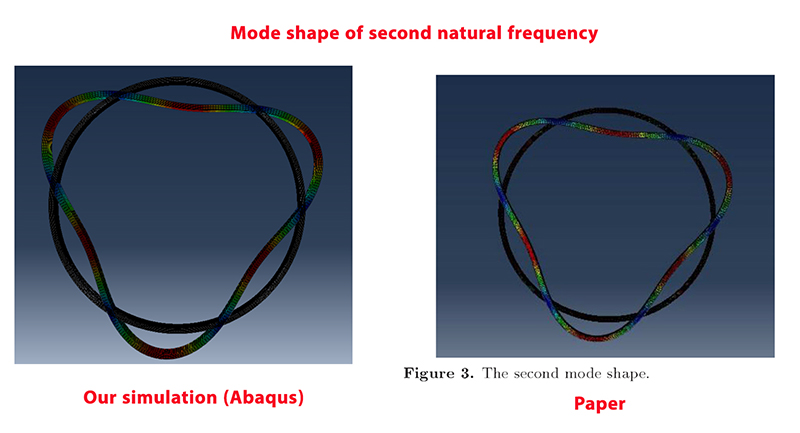
Natural Frequencies
The natural frequencies obtained from the Abaqus analysis are extracted and organized for comparison with the reference results.
This allows the effect of the FGM material definition on the dynamic characteristics of the ring to be evaluated.
Comparison with Reference Results
The natural frequencies obtained from the Abaqus simulation are compared with the results reported in the reference paper.
The comparison is used to evaluate the accuracy of the numerical model and to verify that the FGM ring has been modeled correctly.
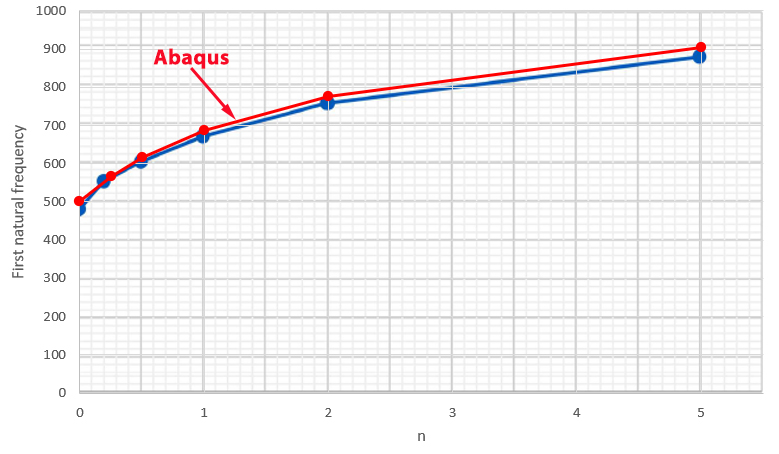

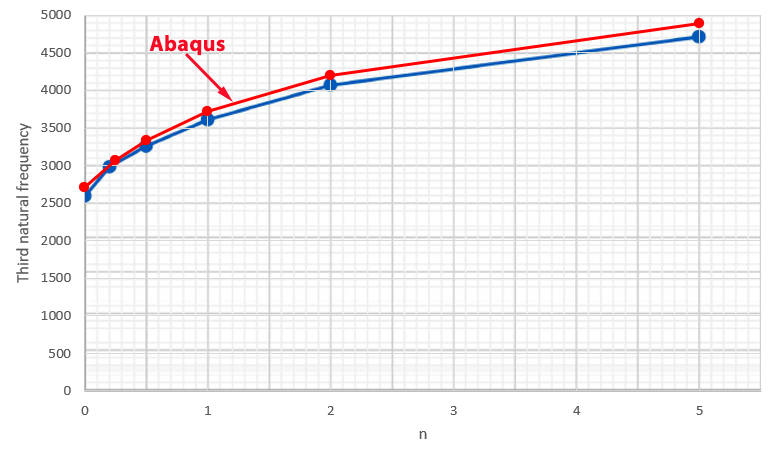
Validation
This project has been validated by comparing the natural frequencies obtained from Abaqus with the results reported in the reference research paper.
The agreement between the numerical and reference results demonstrates the reliability of the developed Abaqus model for calculating the natural frequencies of the FGM ring.
Reference
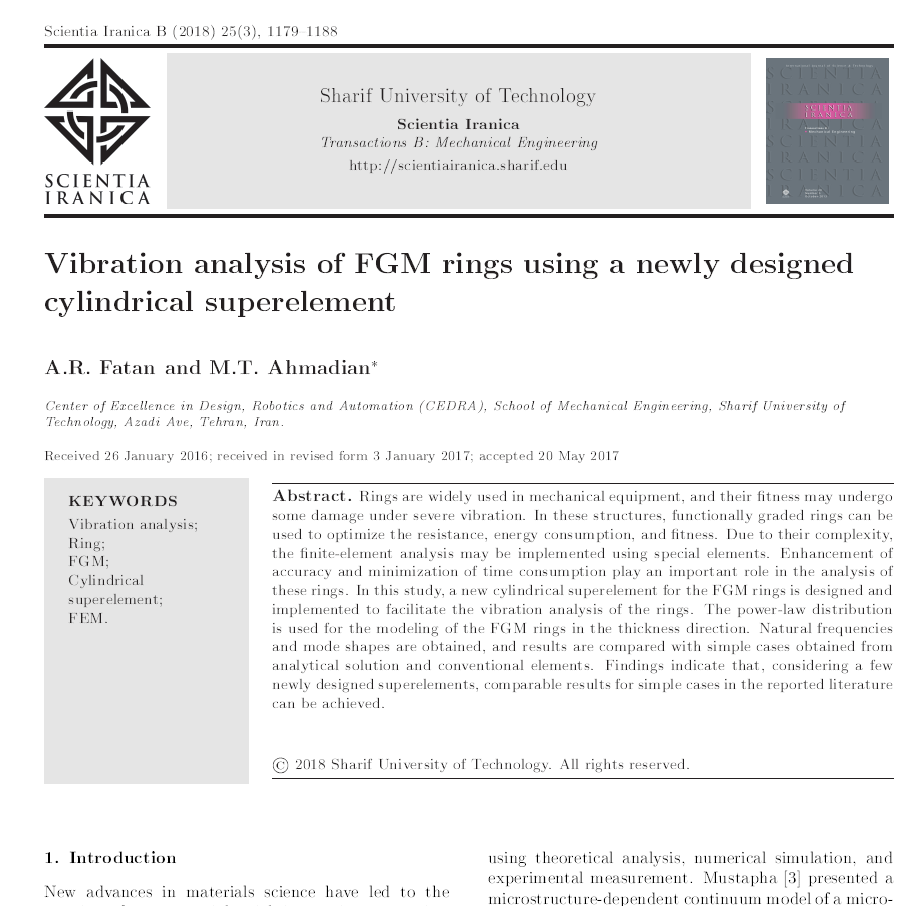
The numerical model in this project is developed according to a research paper on the vibration characteristics and natural frequencies of an FGM ring. The paper is also provided with the project files for reference and validation.
What You Will Learn
- How to model an FGM ring in Abaqus.
- How to define Functionally Graded Material properties.
- How to perform a frequency analysis in Abaqus.
- How to obtain natural frequencies from an eigenvalue analysis.
- How to visualize vibration mode shapes in Abaqus.
- How to organize FGM material data using Excel.
- How to compare Abaqus results with reference results.
- How to validate a numerical model using a research paper.
Key Features
- Natural frequency analysis of an FGM ring.
- Functionally Graded Material modeling.
- Frequency and eigenvalue analysis in Abaqus.
- Natural frequency extraction.
- Visualization of vibration mode shapes.
- FGM material-property calculations.
- Excel files containing material data.
- Comparison with reference results.
- Validation using a research paper.
- Complete Abaqus model files.
- Step-by-step video tutorial.
Project Information
Important information about this project
Payment & Support
Need help with this project?
Secure Payment
Your payment is processed securely through our online payment system. .
Need Help?
If you have any questions about this project, please contact us by email.
saeedofmoeini@gmail.com
There are no reviews yet.