
Project Overview
In this Abaqus tutorial, the behavior of a Functionally Graded Material (FGM) is simulated using the USDFLD subroutine.
In an FGM, the material properties change continuously and gradually with position. In this example, the material properties are defined as a function of the radial coordinate.
The purpose of this tutorial is to show how the USDFLD subroutine can be used in Abaqus to assign spatially varying material properties to an FGM model.

Functionally graded material cylinder modeled using the USDFLD subroutine.
FGM Cylinder Geometry
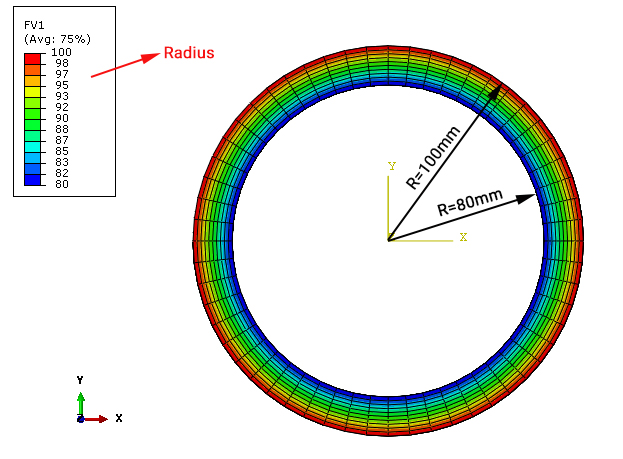
The model consists of a cylindrical component with an inner radius of 80 mm, an outer radius of 100 mm, and a total length of 1000 mm.
The inner region of the cylinder is made of ceramic, while the outer region is made of aluminum.
Instead of defining a sharp interface between the two materials, the material properties change continuously from the inner radius toward the outer radius.

Geometry of the cylindrical FGM model and the transition from ceramic to aluminum.
Functionally Graded Material
The main characteristic of the model is that the material properties are not constant throughout the cylinder. Instead, they depend on the radial position.
As the radius changes, the corresponding material properties also change gradually.
The following properties are defined as functions of the radius:
- Density
- Young's modulus
- Poisson's ratio
- Thermal conductivity
- Thermal expansion coefficient
Using the USDFLD Subroutine
The USDFLD subroutine is used to define Field 1 in the Abaqus model.
Field 1 is determined according to the position of each material point. Since the material properties depend on the radius, the radial coordinate is used to determine the appropriate value of the field variable.
Abaqus then uses the field variable to assign the corresponding material properties at different locations within the FGM.
Definition of Field 1 using the USDFLD subroutine.
FGM Material Properties
The material-property data for the FGM is provided in an Excel file. Separate material-property data for the ceramic and aluminum materials are also provided.
The supplied data can be used to determine the variation of the material properties from the inner ceramic region toward the outer aluminum region.
Material Property Distribution
The material properties vary continuously according to the radial coordinate of the cylinder.
Therefore, different points within the model can have different values of density, Young's modulus, Poisson's ratio, thermal conductivity, and thermal expansion coefficient.
This approach allows the gradual transition from the ceramic material at the inner radius to the aluminum material at the outer radius to be represented in Abaqus.
What You Will Learn
- What a Functionally Graded Material (FGM) is.
- How to model an FGM cylinder in Abaqus.
- How to define material properties as a function of position.
- How to use the radial coordinate to define material properties.
- How to define Field 1 in Abaqus.
- How to use the USDFLD subroutine.
- How to assign spatially varying material properties.
- How to define density as a field-dependent property.
- How to define Young's modulus as a field-dependent property.
- How to define Poisson's ratio as a field-dependent property.
- How to define thermal conductivity as a field-dependent property.
- How to define thermal expansion as a field-dependent property.
- How to use Excel data for FGM material properties.
- How to connect the USDFLD subroutine to an Abaqus model.
Key Features
- Functionally Graded Material (FGM) simulation.
- Cylindrical FGM model.
- Inner radius of 80 mm.
- Outer radius of 100 mm.
- Cylinder length of 1000 mm.
- Ceramic inner material.
- Aluminum outer material.
- Radially varying material properties.
- USDFLD subroutine.
- Field 1 definition.
- Density dependent on radius.
- Young's modulus dependent on radius.
- Poisson's ratio dependent on radius.
- Thermal conductivity dependent on radius.
- Thermal expansion coefficient dependent on radius.
- CAE file.
- INP file.
- Excel file containing FGM material properties.
- Excel file containing ceramic and aluminum material properties.
- USDFLD subroutine file.
- Pictures showing the calculation of FGM properties.
Project Information
Important information about this project
Payment & Support
Need help with your purchase?
Secure Payment
Your payment is processed securely through our online payment system.
Need Help?
If you have any questions about this product, please contact us by email.
saeedofmoeini@gmail.com
Adjeloua(verified owner)
Subject: Request for Payment Link – Abaqus Programs on FGM
Dear
I am contacting you to request the payment link for the video containing all the Abaqus programs related to Functionally Graded Materials (FGM).
I am particularly interested in the practical examples, scripts, and explanations provided in the video. Could you also let me know the access details after payment (duration, format, download availability, etc.)?
Looking forward to your response.
Best regards,
Adjeloua
adjelouaziz@gmail.com
Admin
Hello
You see this tutorial
https://www.7abaqus.com/product/obtaining-natural-frequencies-of-a-fgm-ring-abaqus/
This training can help you a lot because it has an article, has been done according to the article, and its results have been verified.
—————
You can make online purchases from the site using a debit card.
Just click on the “Add to cart”