
Project Overview
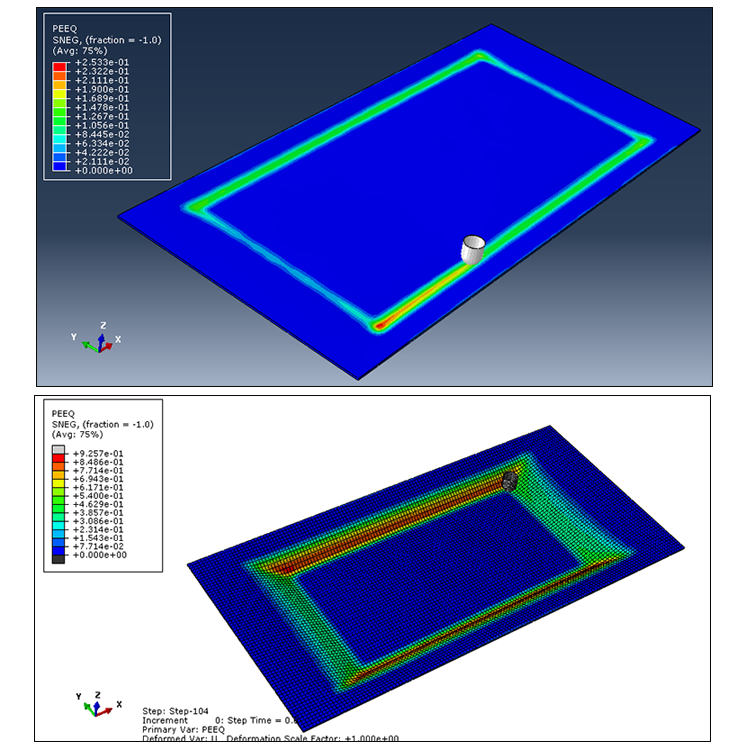
In this Abaqus project, the Single Point Incremental Forming (SPIF) process is simulated to form a truncated pyramid. The simulation is performed using Abaqus to demonstrate how a moving forming tool can progressively deform an aluminum sheet into the desired geometry.
In the SPIF process, a hemispherical forming tool moves along a predefined trajectory on the sheet. The tool gradually deforms the sheet until the final shape is obtained.

Single Point Incremental Forming (SPIF) model in Abaqus.
Truncated Pyramid Forming
The final geometry produced in this simulation is a truncated pyramid. The forming tool progressively moves over the sheet and causes the aluminum plate to deform into the desired shape.
Unlike conventional forming methods that require a dedicated forming die, incremental sheet forming produces the desired geometry through the controlled movement of the forming tool.
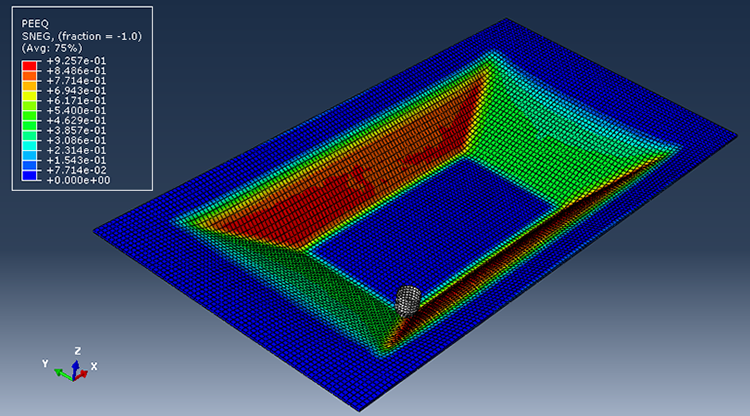
Final truncated pyramid geometry obtained from the SPIF simulation.
Tool Movement
During the simulation, the forming tool follows a rectangular path in the X-Y plane. This controlled movement progressively deforms the sheet and produces the truncated pyramid geometry.
The tool also rotates about the Z-axis with a constant angular velocity during the forming process.

Rectangular tool path followed by the forming tool.
Forming Tool
The forming tool is modeled as a three-dimensional discrete rigid surface. The hemispherical end of the tool comes into contact with the aluminum sheet and gradually forms the desired geometry.

Three-dimensional discrete rigid forming tool.
Aluminum Sheet
The sheet used in this simulation is made of aluminum. The sheet has a length of 400 mm, a width of 200 mm, and a thickness of 1.5 mm.
Contact and Friction
Contact is defined between the forming tool and the aluminum sheet. The coefficient of friction between the tool and the sheet is taken as 0.1.
The contact interaction allows the forming tool to transfer forces to the sheet while moving along its predefined path.
What You Will Learn
- How to simulate Single Point Incremental Forming (SPIF) in Abaqus.
- How to model an aluminum sheet for incremental forming.
- How to model a three-dimensional discrete rigid forming tool.
- How to define contact between the tool and the sheet.
- How to define a friction coefficient of 0.1.
- How to define the rotational motion of the tool about the Z-axis.
- How to define constant angular velocity for the forming tool.
- How to define a rectangular tool path in the X-Y plane.
- How the forming tool progressively deforms the sheet.
- How to obtain a truncated pyramid using the SPIF process.

Three-dimensional discrete rigid forming tool.
Key Features
- Single Point Incremental Forming (SPIF).
- Truncated pyramid forming.
- Aluminum sheet.
- Sheet dimensions: 400 × 200 mm.
- Sheet thickness: 1.5 mm.
- Three-dimensional discrete rigid forming tool.
- Rectangular tool path in the X-Y plane.
- Constant angular velocity about the Z-axis.
- Coefficient of friction: 0.1.
- Contact between the forming tool and sheet.
- Abaqus CAE file.
- Abaqus INP file.
- Excel material file for aluminum.
- Step-by-step training video.
Project Information
Important information about this project
Payment & Support
Need help with your purchase?
Secure Payment
Your payment is processed securely through our online payment system.
Need Help?
If you have any questions about this product, please contact us by email.
saeedofmoeini@gmail.com
There are no reviews yet.