

Product Overview
In this project, the seismic behavior of a beam to box-column moment connection with a vertical stiffener is investigated using the Abaqus software.
The connection uses a vertical stiffener inside the box column as an alternative to conventional horizontal continuity plates. An Reduced Beam Section (RBS) is also used to promote plastic deformation in the beam at a controlled distance from the column face.
The numerical model is developed based on the experimental RBS-V connection reported in the reference study. The Abaqus results are compared with the experimental results to evaluate the ability of the numerical model to reproduce the cyclic behavior of the connection.
Model Description
The main components of the model include the I-beam, box column, shear tab, and vertical stiffener. The vertical stiffener is positioned in the same plane as the beam web and extends along the column axis. Unlike the conventional connection, horizontal continuity plates are not used.
In this model, a continuity plate is not utilized. Instead, a vertical stiffener is used in the connection.
The required material properties, interactions, boundary conditions, and analysis settings are defined in Abaqus to reproduce the behavior of the experimental connection.

Cyclic Loading
The cyclic loading is applied as a displacement-controlled load at the beam tip. The loading history follows the reversed cyclic loading protocol used in the experimental study and is defined in Abaqus using an Amplitude.

Results and Hysteresis Response
The Abaqus results are extracted and processed to evaluate the structural response of the connection under cyclic loading.
The resulting response is used to obtain the Force–Displacement hysteresis diagram.
The hysteresis diagram obtained from Abaqus is compared with the experimental results reported in the reference study.

Deformation Under Cyclic Loading
The results show that plastic deformation develops primarily within the Reduced Beam Section (RBS), promoting the formation of a plastic hinge away from the column face.
As the cyclic loading progresses, plastic strain gradually develops and becomes concentrated in the RBS region. The numerical results are consistent with the experimental observations, where the plastic hinge develops within the reduced beam section.
The analysis also shows that local buckling is not observed in the numerical model during the investigated cyclic loading history.

Experimental Validation
The numerical results obtained from Abaqus are compared with the experimental results reported in the reference article.
The comparison focuses on the Force–Displacement hysteresis response and the overall structural behavior of the beam-column connection under cyclic loading.
This project has been validated, which means that the results obtained from Abaqus are similar to the results reported in the reference article. In other words, this project is based on the experimental study.
Key Features
- Numerical modeling of a beam-column connection with a vertical stiffener.
- Modeling of the beam, column, shear plate, and vertical stiffener.
- No continuity plate is used in the model.
- Cyclic analysis of the beam-column connection.
- Nonlinear analysis under cyclic loading.
- Force–Displacement hysteresis analysis.
- Evaluation of deformation under cyclic loading.
- Comparison with experimental results.
- Validated Abaqus numerical model.
- Complete Abaqus model files.
- Excel file for amplitude loading.
- Excel file containing numerical results.
- Reference research paper.
- Step-by-step video tutorial.
What You Will Learn
- How to model a beam-column connection with a vertical stiffener in Abaqus.
- How to define the geometry of the beam and column.
- How to model the shear plate and vertical stiffener.
- How to define the material properties of the model.
- How to define the required interactions and constraints.
- How to define the boundary conditions of the model.
- How to apply cyclic loading to the end of the beam.
- How to define cyclic loading using the Amplitude option in Abaqus.
- How to perform nonlinear analysis under cyclic loading.
- How to obtain a Force–Displacement hysteresis diagram.
- How to evaluate the deformation of the model during cyclic loading.
- How to extract and process Abaqus results using Excel.
- How to compare numerical and experimental results.
Reference
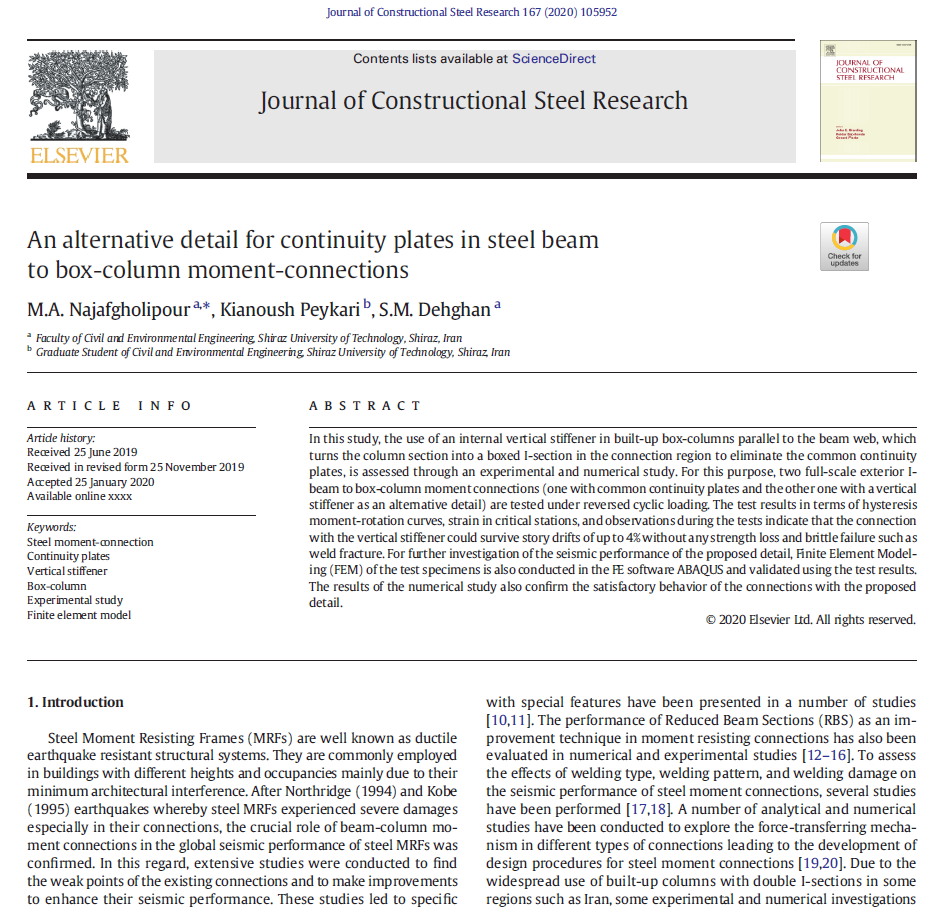
This project is based on the experimental study provided in the reference research paper. The paper is included with the project files and can be used to review the experimental configuration, loading protocol, and reported results.
Project Information
Important information about this project
Payment & Support
Need help with your purchase?
Secure Payment
Your payment is processed securely through our online payment system.
Need Help?
If you have any questions about this product, please contact us by email.
saeedofmoeini@gmail.com
There are no reviews yet.