

Product Overview
In this example, we simulate the laser forming of an AISI 304 stainless steel sheet using the Abaqus software.
A three-dimensional finite element model is developed to investigate the thermal and deformation response of the stainless steel sheet during laser scanning. A moving laser heat source is applied to the top surface of the sheet using the DFLUX user subroutine.
The effect of the main laser processing parameters, including laser power, laser beam speed, and laser spot diameter, is investigated through different simulation cases. The resulting bending angle is evaluated to study the influence of the laser parameters on the forming behavior of the sheet.
The results obtained from Abaqus are compared with the corresponding experimental results reported in the reference research article to evaluate the accuracy of the numerical model.

Moving Laser Heat Source
A moving heat source is used to simulate the laser beam during the laser bending process. The movement of the heat source is defined using the DFLUX user subroutine in Abaqus.
The DFLUX subroutine allows the heat flux to be applied according to the position of the moving laser beam during the analysis. This approach is used to represent the thermal loading generated by the moving laser heat source.
Laser Parameters
In this project, different simulation cases are considered by changing the main laser parameters, including laser power, laser beam speed, and laser spot diameter.
The laser power determines the amount of thermal energy introduced into the sheet, while the laser beam speed controls the rate at which the heat source moves along the scanning path. The laser spot diameter affects the area over which the heat is distributed on the sheet surface.
By changing these parameters, the effect of the laser processing conditions on the temperature distribution and bending response of the sheet can be investigated using Abaqus.
The temperature unit used in this simulation is Kelvin (K).

Laser Beam Diameter
The laser spot diameter is an important parameter in the laser forming process because it determines the area over which the laser heat is distributed on the surface of the sheet.
Changing the spot diameter modifies the size of the heated region and therefore affects the resulting temperature distribution and thermal deformation of the AISI 304 stainless steel sheet.
The effect of different laser spot diameters is investigated using the Abaqus model. The resulting deformation and bending angle are evaluated for the different simulation cases.
The numerical results can be used to examine the relationship between the laser spot size and the forming response of the sheet during laser scanning.

Material Definition
The AISI 304 stainless steel sheet is defined in Abaqus using temperature-dependent thermal and mechanical properties.
The thermal properties are defined as functions of temperature to account for changes in the material's thermal response during laser heating. The mechanical properties are also defined as temperature-dependent to capture the deformation behavior of the sheet at elevated temperatures.
Bending Angle
As the moving laser heat source travels across the sheet, the resulting temperature distribution produces thermal deformation. This deformation causes the sheet to bend out of its original plane.

Results
The results obtained from the different simulation cases are collected and presented to investigate the relationship between the laser parameters and the resulting bending angle.
The numerical results can be used to evaluate how changes in laser power, beam speed, and beam radius affect the laser bending response of the stainless steel sheet.

Validation
This project has been validated, which means that the results obtained from the Abaqus software are compared with the results reported in the reference article.
The comparison shows that the numerical results obtained from Abaqus are in good agreement with the results reported in the article.
What You Will Learn
- How to simulate the laser bending process in Abaqus.
- How to model laser forming of stainless steel sheets.
- How to define a moving laser heat source.
- How to use the DFLUX user subroutine in Abaqus.
- How to define laser power in a laser bending simulation.
- How to define laser beam speed.
- How to define the laser beam radius.
- How to define the laser beam diameter.
- How to model AISI 304 stainless steel.
- How to perform different laser bending simulation cases.
- How to calculate the bending angle.
- How to investigate the effect of laser parameters on bending angle.
- How to compare Abaqus results with published research results.
- How to validate a laser bending simulation using a reference article.
Key Features
- Laser bending process in Abaqus.
- Laser forming of AISI 304 stainless steel sheet.
- Moving laser heat source.
- DFLUX user subroutine.
- Investigation of laser power.
- Investigation of laser beam speed.
- Investigation of laser beam radius.
- Laser beam diameter definition.
- Bending angle calculation.
- Different simulation cases.
- Temperature unit: Kelvin.
- Comparison with reference article results.
- Validation of the Abaqus model.
- Complete Abaqus CAE file.
- Abaqus INP file.
- 4 Fortran subroutine codes.
- Excel file containing AISI 304 material data.
- Excel file containing results.
- Reference research paper.
- Step-by-step video tutorial.
Reference
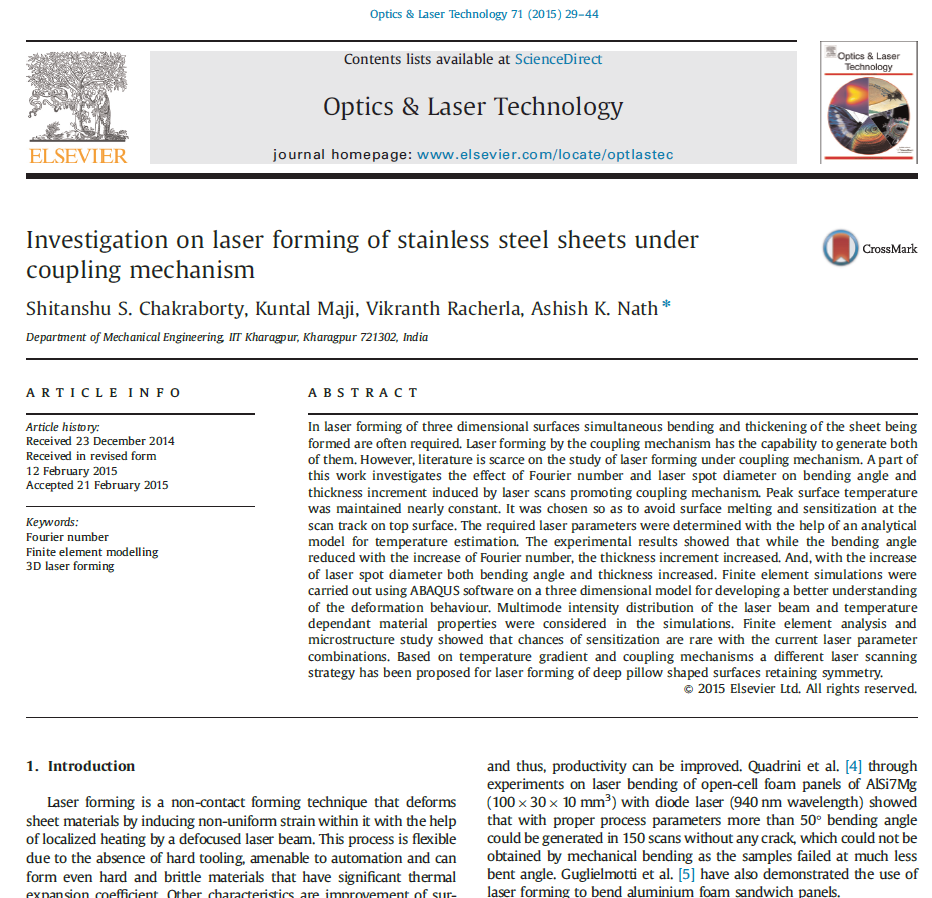
This project is based on the research article "Investigation on Laser Forming of Stainless Steel Sheets Under Coupling Mechanism". The reference paper is included with the project files and can be used to review the laser forming model and the reported results.
Project Information
Important information about this project
Payment & Support
Need help with your purchase?
Secure Payment
Your payment is processed securely through our online payment system.
Need Help?
If you have any questions about this product, please contact us by email.
saeedofmoeini@gmail.com
There are no reviews yet.