

Project Overview
In this example, the movement of a laser beam along a triangular path is simulated using the DFLUX subroutine in the Abaqus software.
The laser beam moves along three different paths, including AB, BC, and CA. The first and second paths are inclined lines, while the third path is a horizontal line.
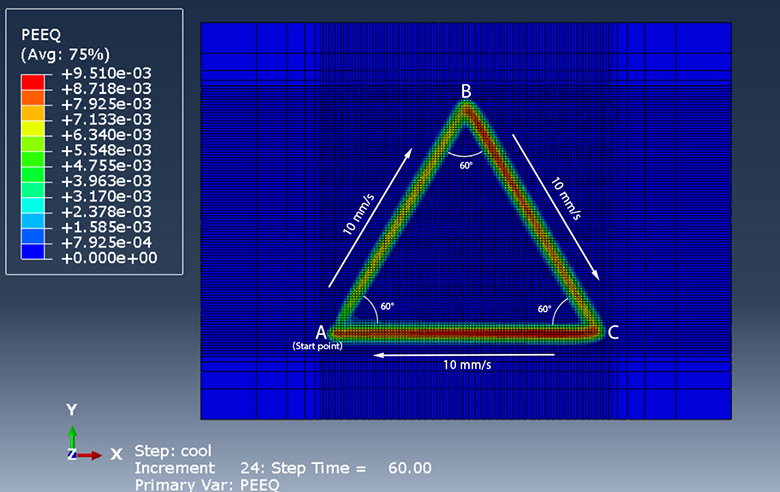
Triangular path of the moving laser beam.
Laser Beam Motion
The laser beam moves along the AB, BC, and CA paths at a constant speed of 10 mm/s.
The angle between the AB and BC lines and the horizontal line is 60 degrees.
The laser beam therefore follows three consecutive paths to complete the triangular motion: two slanting paths and one horizontal path.
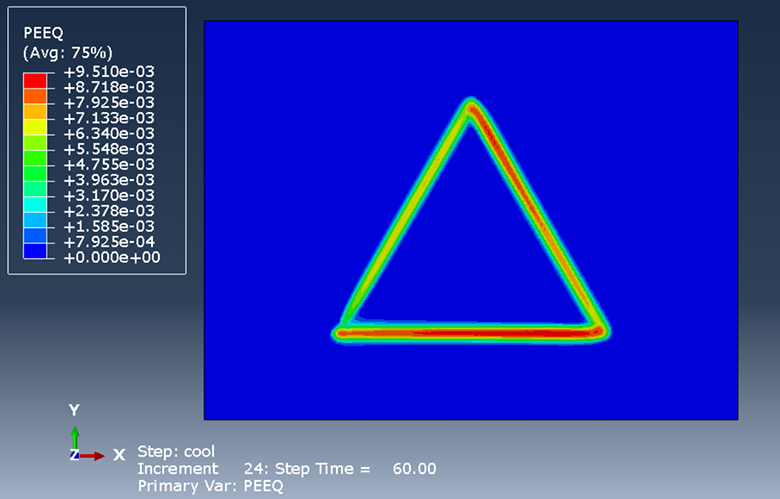
Movement of the laser beam along the AB, BC, and CA paths.
Gaussian Heat Flux
A Gaussian model is used to define the surface heat flux generated by the laser beam. The laser power is considered to be 80 W.
The DFLUX subroutine is used to define the moving heat flux and control the position of the heat source as the laser beam travels along the triangular path.
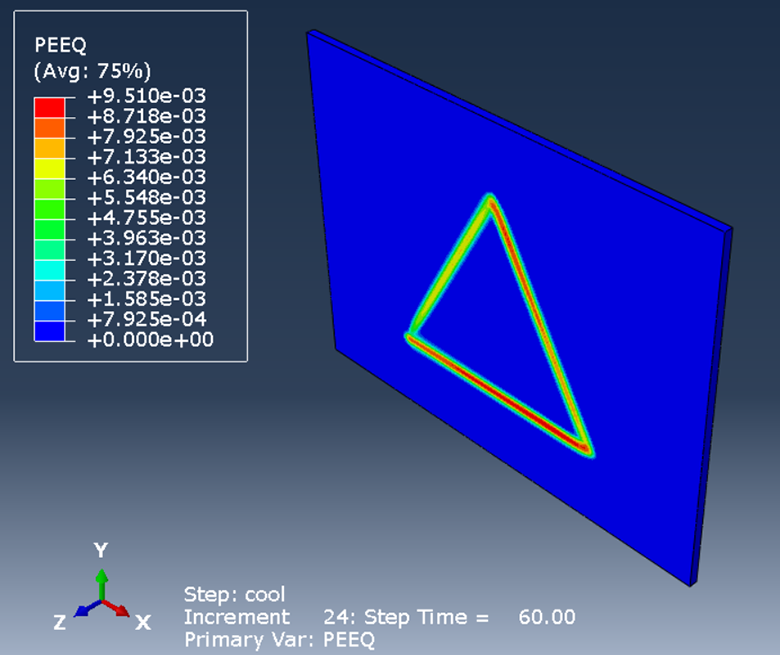
Gaussian model used to define the surface heat flux.
Thermal-Mechanical Analysis
The analysis is performed in two steps. In the first step, the movement of the laser beam along the triangular path is defined and the corresponding heat flux is applied.
In the second step, the cooling process is implemented after the laser beam completes its movement. This allows the thermal and mechanical response of the workpiece to be evaluated during the heating and cooling stages.
Heat Transfer
Three heat transfer mechanisms are considered in this simulation: conduction, convection, and radiation.
These heat transfer mechanisms are used to represent the thermal behavior of the workpiece during the laser heating and subsequent cooling process.
What You Will Learn
- How to simulate a moving laser beam in Abaqus.
- How to define a triangular path for a moving laser beam.
- How to define the AB, BC, and CA paths.
- How to define a laser beam speed of 10 mm/s.
- How to define the 60-degree inclination of the AB and BC paths.
- How to use the DFLUX subroutine for a moving heat source.
- How to define a Gaussian surface heat flux.
- How to define a laser power of 80 W.
- How to simulate laser heating along multiple paths.
- How to implement a Fortran DFLUX subroutine in Abaqus.
- How to simulate the cooling process after laser heating.
- How to consider conduction, convection, and radiation heat transfer.
- How to perform a thermal-mechanical analysis of the workpiece.
Key Features
- Moving laser beam simulation in Abaqus.
- Triangular laser beam path.
- Three laser paths: AB, BC, and CA.
- Laser beam speed of 10 mm/s.
- 60-degree inclination of the AB and BC paths.
- Gaussian surface heat flux.
- Laser power of 80 W.
- DFLUX Fortran subroutine.
- Two-step thermal-mechanical analysis.
- Laser heating followed by a cooling process.
- Conduction, convection, and radiation heat transfer.
- ST37 structural steel material data included.
- Research article included.
Project Information
Important information about this project
Payment & Support
Need help with your purchase?
Secure Payment
Your payment is processed securely through our online payment system.
Need Help?
If you have any questions about this product, please contact us by email.
saeedofmoeini@gmail.com
There are no reviews yet.