
Project Overview
In this Abaqus tutorial, the long-term load capacity of a pile group is calculated and compared with the reference result reported in the Sam Helwany book.
This example is selected from Example 8.6 of the Sam Helwany book. The pile group consists of four concrete piles embedded in saturated soil and subjected to vertical loading.

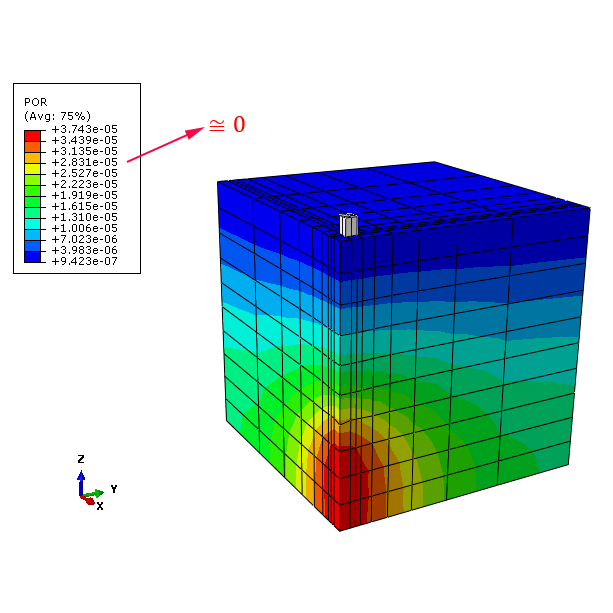
Pile group embedded in the soil and subjected to vertical loading.
Pile Group Model
The pile group consists of four concrete piles. Each pile has a square cross section with a width and length of 0.6 m.
The piles are embedded in a saturated soil layer and work together as a pile group to transfer the applied load to the surrounding soil.
Symmetry of the Model
Since the pile group and loading conditions are symmetric, only one-fourth of the geometry is modeled in Abaqus.
Using symmetry significantly reduces the number of elements and the computational cost while preserving the essential behavior of the pile-soil system.
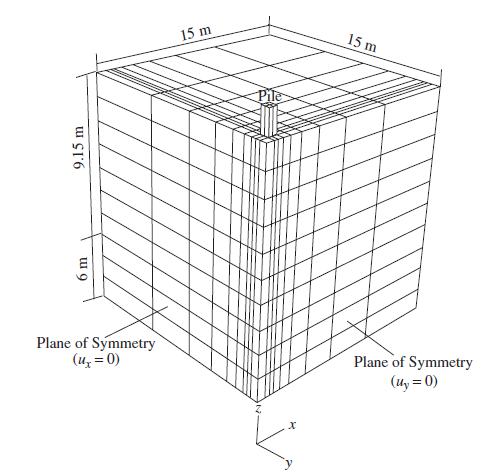
One-fourth of the pile group and soil model used in Abaqus.
Pile-Soil Interaction
The interaction between the piles and the surrounding soil is simulated using a penalty-type interface.
A friction factor of 0.3 is defined between the pile and the soil to represent the frictional behavior along the pile-soil interface.
Soil Material Model
The soil is modeled as an elastoplastic material using the Cap Model with Cap Hardening.
The material definition also includes the initial void ratio and geostatic stress required to represent the initial state of the saturated soil.
Drained Condition
The analysis is performed under drained conditions, which represent a relatively low loading rate.
Under the assumed drained condition, the pore water pressure is considered zero during the analysis.

Pore water pressure=0.
Analysis Steps
The simulation is performed in three analysis steps.
In Step 1, the weight of the soil and the piles is applied to establish the initial gravitational state of the model.
Step 2 is used as an intermediate step to prepare the model for the final loading stage.
In Step 3, a vertical displacement is applied to the top surface of the pile group to investigate its load-carrying capacity and settlement behavior.
Load-Settlement Curve
The response of the pile group is evaluated using the load-settlement curve.
The curve obtained from Abaqus is compared with the corresponding load-settlement curve reported in the Sam Helwany book.
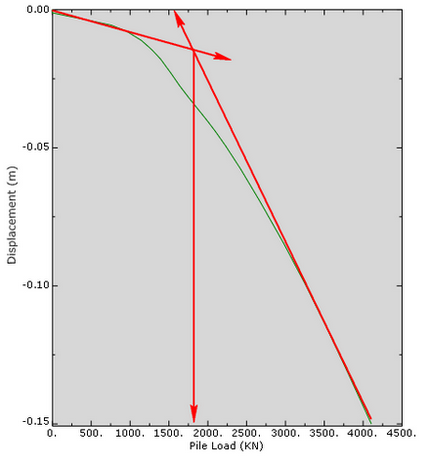
Load versus settlement curve obtained from the Abaqus analysis.
Comparison with the Reference Solution
The Abaqus results are compared with the reference results presented in the Sam Helwany book.
This comparison allows the load-carrying behavior of the pile group obtained from the Abaqus model to be evaluated against the reference solution.

Comparison between the Abaqus results and the Sam Helwany reference results.
What You Will Learn
- How to model a pile group in Abaqus.
- How to model concrete piles embedded in soil.
- How to use symmetry to reduce the size of the model.
- How to model one-fourth of a symmetric pile group.
- How to define pile-soil interaction.
- How to use a penalty-type interface.
- How to define the friction factor between pile and soil.
- How to define elastoplastic soil using the Cap Model.
- How to define Cap Hardening properties.
- How to define the initial void ratio.
- How to define geostatic stress in saturated soil.
- How to perform a drained analysis.
- How to apply the weight of the soil and piles.
- How to apply vertical displacement to the pile group.
- How to obtain the load-settlement curve.
- How to calculate the load capacity of a pile group.
- How to compare Abaqus results with a reference solution.
Key Features
- Long-term load capacity of a pile group.
- Four concrete piles.
- Square pile cross section of 0.6 × 0.6 m.
- Symmetric pile group model.
- One-fourth geometry modeled in Abaqus.
- Penalty-type pile-soil interface.
- Friction factor of 0.3.
- Elastoplastic soil behavior.
- Cap Model with Cap Hardening.
- Initial void ratio.
- Geostatic stress.
- Drained condition.
- Zero pore water pressure.
- Three analysis steps.
- Vertical displacement loading.
- Load-settlement curve.
- Comparison with Sam Helwany book results.
- CAE file.
- INP file.
- Excel file containing the results.
- Step-by-step video tutorial.
Project Information
Important information about this project
Payment & Support
Need help with your purchase?
Secure Payment
Your payment is processed securely through our online payment system.
Need Help?
If you have any questions about this product, please contact us by email.
saeedofmoeini@gmail.com
There are no reviews yet.