
Project Overview
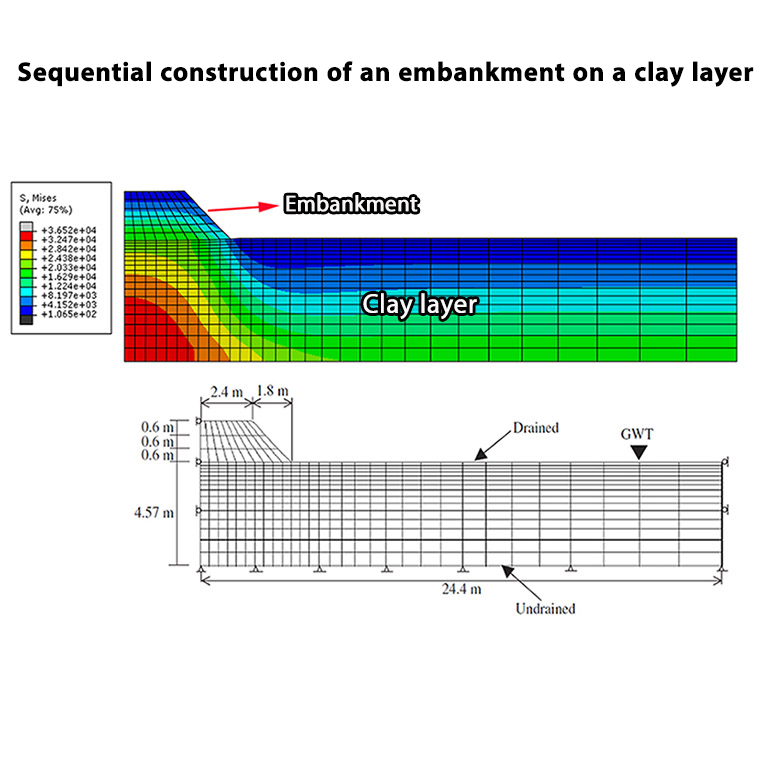
In this Abaqus tutorial, the sequential construction of an embankment on a clay layer is simulated. The model is based on Example 4.7 from the book by Sam Helwany.
The embankment is constructed in three equal layers, with each layer having a thickness of 0.6 m. Consolidation of the clay layer takes place during the construction process.

Sequential construction of the embankment on the clay layer.
Sequential Construction
The embankment is constructed in three stages. Each embankment layer is constructed over a period of two days, resulting in a total construction time of six days.
The construction process is simulated sequentially in Abaqus so that the consolidation behavior of the clay can be considered during and after embankment construction.
Analysis Steps
The analysis consists of five steps. The first step is a geostatic step, which is used to establish equilibrium within the clay layer.
- Step 1: Geostatic step
- Step 2: Construction of the first embankment layer
- Step 3: Construction of the second embankment layer
- Step 4: Construction of the third embankment layer
- Step 5: Consolidation step with a duration of 200 days

Analysis steps used for the sequential construction and consolidation.
Embankment Material
The embankment material is modeled as linear elastic. Its density is 1923 kg/m³, Young's modulus is 478 kPa, and Poisson's ratio is 0.3.
The hydraulic conductivity of the embankment material is 0.1 m/s, and the initial void ratio is 1.5.
Clay Layer
The clay layer is modeled as an elastoplastic material using the Extended Cam Clay model.
The Cam Clay parameters are defined according to the parameters provided for the example in the Sam Helwany reference.
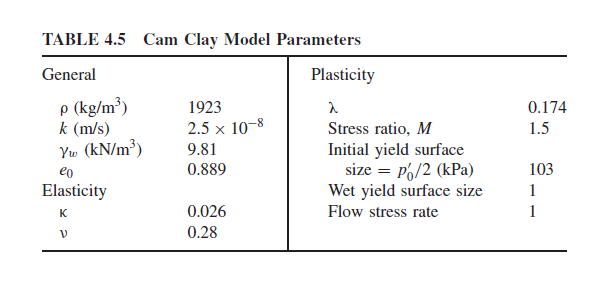
Extended Cam Clay parameters used for the clay layer.
Groundwater Table
The groundwater table is assumed to be coincident with the top surface of the clay layer.
The effective specific weight of each embankment layer is considered using the body force option in Abaqus.
Consolidation Settlement
The consolidation settlement is calculated at the center of the embankment.
The settlement obtained from Abaqus is compared with the corresponding result reported in the Sam Helwany book.

Calculated consolidation settlement under the center of the embankment.
Comparison of Settlement Results
The consolidation settlement obtained from the Abaqus simulation is compared with the result from the Sam Helwany reference to evaluate the accuracy of the numerical model.
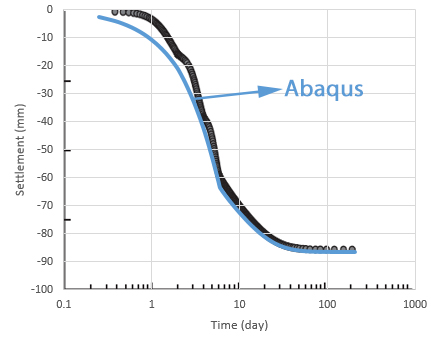
Comparison between Abaqus results and Sam Helwany book results.
Excess Pore Pressure
The excess pore pressure is evaluated at the middle of the clay layer beneath the center of the embankment.
The distribution and variation of pore pressure during the consolidation process are investigated using the Abaqus results.

Distribution of pore pressure in the clay layer.
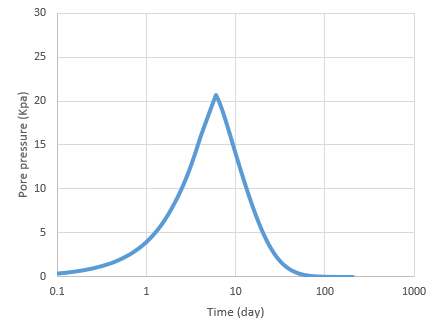
Distribution of pore pressure in the clay layer.
Comparison of Excess Pore Pressure
The excess pore pressure obtained from Abaqus is compared with the corresponding result from the Sam Helwany book.
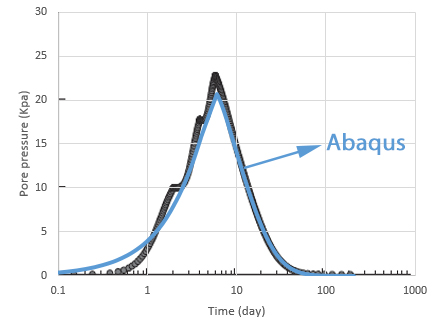
Comparison between Abaqus and Sam Helwany excess pore pressure results.
What You Will Learn
- How to model sequential embankment construction in Abaqus.
- How to divide an embankment into multiple construction layers.
- How to activate each embankment layer sequentially.
- How to define a geostatic step.
- How to model consolidation of a clay layer.
- How to use the Extended Cam Clay model for clay.
- How to define the material properties of the embankment.
- How to define groundwater conditions.
- How to apply the effective specific weight using body force.
- How to calculate consolidation settlement.
- How to obtain excess pore pressure.
- How to create settlement-time results.
- How to create pore-pressure-time results.
- How to compare Abaqus results with reference results.
Key Features
- Sequential construction of an embankment.
- Three embankment layers.
- Layer thickness: 0.6 m.
- Two-day construction period for each layer.
- Total construction time: 6 days.
- Geostatic initial step.
- Extended Cam Clay model for the clay layer.
- 200-day consolidation step.
- Groundwater table at the top of the clay layer.
- Consolidation settlement calculation.
- Excess pore pressure calculation.
- Comparison with Sam Helwany book results.
- CAE file.
- INP file.
- Excel file containing settlement-time results.
- Excel file containing pore-pressure-time results.
Project Information
Important information about this project
Payment & Support
Need help with your purchase?
Secure Payment
Your payment is processed securely through our online payment system.
Need Help?
If you have any questions about this product, please contact us by email.
saeedofmoeini@gmail.com
Jason Park(verified owner)
Great