

Project Overview
In this example, the thermal-electrical behavior of an automotive fuse is simulated in Abaqus. The main objective is to simulate the Joule heating process caused by an electrical current passing through the fuse.
A current of 30 A passes through the fuse, causing the electrical energy to be converted into thermal energy. As a result, the temperature of the fuse increases during the electrical loading process.
Since the middle section of the fuse has a smaller thickness, it reaches a higher temperature and tends to melt sooner when the current exceeds the allowable level. Once this section melts, the electrical current through the fuse is interrupted.
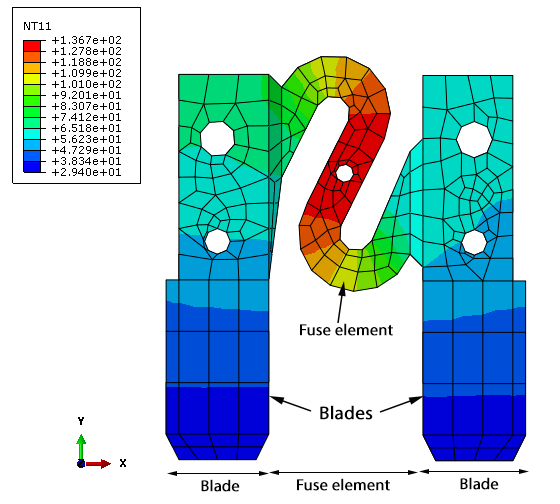
Thermal-electrical simulation of an automotive fuse in Abaqus.
Automotive Fuse Geometry
The fuse consists of two blades and one S-shaped fuse element.
Each blade has a thickness of 0.76 mm, while the S-shaped middle fuse element has a thickness of 0.28 mm.
The smaller thickness of the middle section causes this region to heat up more rapidly and makes it the critical section of the fuse.
Joule Heating Process
In the first step of the analysis, a current of 30 A is passed through the fuse.
The electrical current generates heat inside the fuse through the Joule heating effect. The generated heat causes the temperature of the fuse to increase.
Because the middle section has a smaller thickness, this region reaches a higher temperature than the other parts of the fuse and is therefore more likely to melt first.

Temperature distribution during the Joule heating process.
Cooling Process
The analysis is performed in two main steps. In the first step, the Joule heating process is simulated while the 30 A electrical current passes through the fuse.
In the second step, the electrical current is cut off and the cooling process of the fuse is simulated.
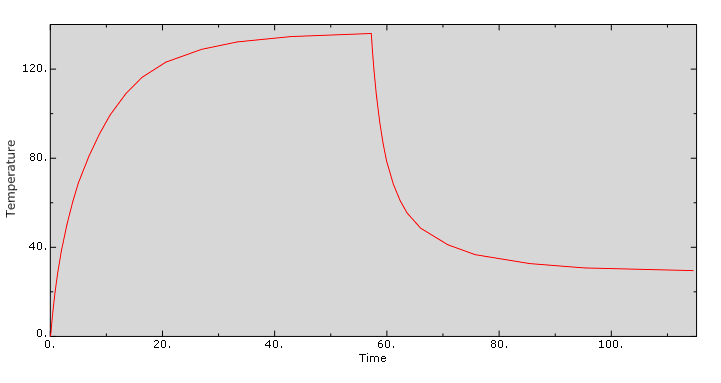
Temperature diagram during analysis .
Electrical Current
The simulation also allows the electrical current entering and leaving the fuse to be monitored. The input current represents the current entering the fuse, while the output current represents the current leaving the fuse.
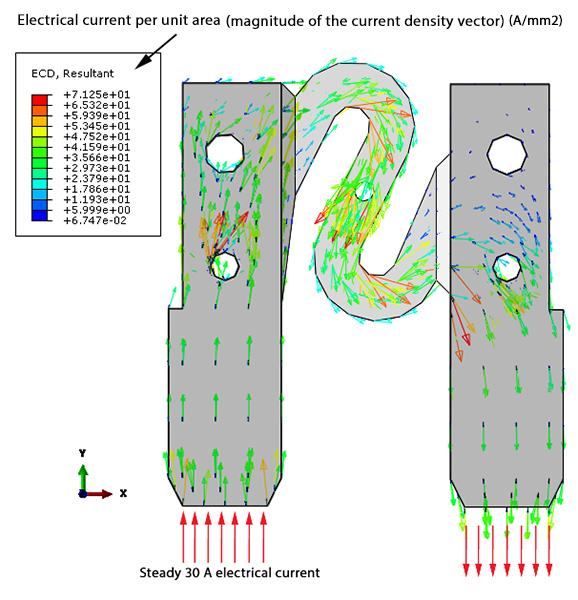
Electrical current per unit area.
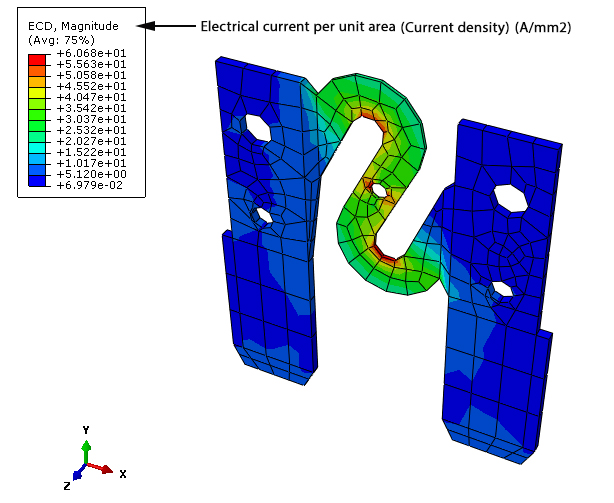
Electrical current per unit area.
Material Properties
The material used for the fuse is Zinc. The material information is provided in an Excel file included with the project files.
What You Will Learn
- How to simulate an automotive fuse in Abaqus.
- How to perform thermal-electrical analysis in Abaqus.
- How to simulate Joule heating in a fuse.
- How to apply an electrical current to the fuse.
- How electrical energy is converted into thermal energy.
- How to evaluate the temperature distribution in the fuse.
- How to identify the critical section of the fuse.
- How to simulate the cooling process after the current is cut off.
- How to monitor the input and output electrical current.
- How to define Zinc material properties.
- How to model the geometry of an automotive fuse.
Key Features
- Thermal-electrical analysis of an automotive fuse.
- Joule heating simulation.
- 30 A electrical current.
- Two-step analysis.
- Heating and cooling processes.
- Two fuse blades with 0.76 mm thickness.
- S-shaped fuse element with 0.28 mm thickness.
- Temperature distribution in the fuse.
- Input and output current monitoring.
- Zinc material.
- Step-by-step training video.
- Abaqus CAE file.
- Abaqus INP file.
- SAT geometry file.
- Excel material file.
- Excel convective heat transfer file.
Project Information
Important information about this project
Payment & Support
Need help with your purchase?
Secure Payment
Your payment is processed securely through our online payment system.
Need Help?
If you have any questions about this product, please contact us by email.
saeedofmoeini@gmail.com
There are no reviews yet.