

Product Overview
GTAW (Gas Tungsten Arc Welding), also known as TIG (Tungsten Inert Gas) welding, is an arc welding process in which a tungsten electrode is used to generate the welding arc and provide the heat required for melting the material.
In this project, the welding process is simulated for a butt-welded SUS304 stainless steel pipe using a moving heat source. The heat input moves along the circumferential weld line to reproduce the welding process.
The welding process consists of two welding passes. Each pass introduces thermal energy into the weld region and produces a transient temperature field in the pipe. The thermal response is then used to investigate the temperature distribution during the welding process.
The numerical model is developed based on the welding configuration reported in the reference research article, which investigates the thermal response of a stainless steel pipe during two-pass TIG welding.

Two-Pass Welding and Cooling Process
The welding process is simulated using a two-pass welding procedure. The first welding pass is applied along the circumferential weld line, followed by a cooling stage to allow the temperature of the pipe to decrease before the second pass.
After the cooling stage, the second welding pass is applied using a moving heat source along the same weld region. The temperature field developed during the first pass therefore affects the thermal response of the pipe during the second welding pass.
The welding and cooling stages are defined as separate analysis steps in Abaqus. The duration of each step is determined according to the welding process and the required cooling period.
This two-pass procedure allows the transient temperature distribution and thermal history of the pipe to be investigated throughout the welding and subsequent cooling stages.
Goldak's Double-Ellipsoid Heat Source
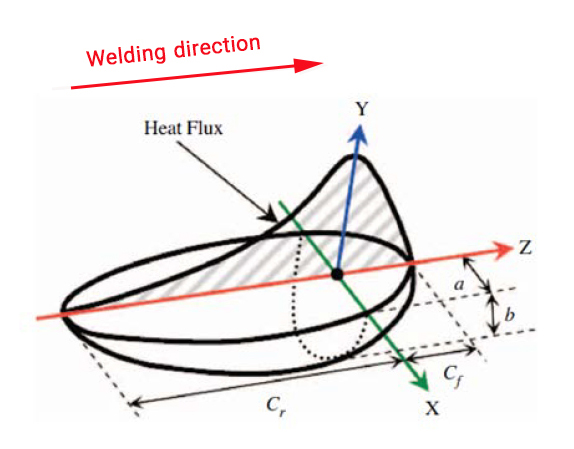
A Goldak's double-ellipsoid heat source is used to represent the heat input from the welding arc in the thermal analysis. The heat source provides a three-dimensional distribution of heat within the weld region.
The heat source moves along the circumferential weld line during each welding pass. Its spatial and temporal position changes continuously as the welding arc travels around the pipe.
The double-ellipsoid formulation allows the heat input to be distributed differently in the front and rear regions of the moving heat source, providing a more realistic representation of the welding heat distribution.
In the Abaqus model, the moving Goldak heat source is implemented through the DFLUX user subroutine. This allows the heat flux to be updated according to the position of the welding heat source throughout the analysis.
The parameters a, b, Cf, and Cr define the size and shape of the two ellipsoids representing the heat source. These heat source parameters are obtained from experimental analysis.
DFLUX Subroutine
The DFLUX user subroutine is used in Abaqus to define the moving heat flux applied during the welding process.
The subroutine determines the magnitude and location of the heat flux as the welding heat source moves along the circumferential weld line. The position of the heat source is updated continuously according to the welding path and analysis time.
The Goldak's double-ellipsoid heat source is implemented through the DFLUX subroutine to represent the spatial distribution of heat generated by the welding arc.
The DFLUX subroutine is applied during both welding passes, allowing the moving heat input to be defined throughout the two-pass thermal analysis.
The temperature field resulting from the applied heat flux is obtained from the Abaqus thermal analysis and is used to evaluate the thermal response of the stainless steel pipe during welding and cooling.
Material Definition
The thermal behavior of the SUS304 stainless steel pipe is defined in Abaqus using temperature-dependent material properties.
The thermal properties include thermal conductivity, specific heat, and density. These properties are defined as functions of temperature to account for the variation of the material's thermal response during the welding process.
The temperature-dependent properties are particularly important in the weld region, where the material experiences a significant temperature increase during the application of the moving heat source.
The defined thermal properties are used in the transient heat transfer analysis to calculate the temperature distribution of the pipe throughout the welding and cooling stages.
Calculation of Analysis Time
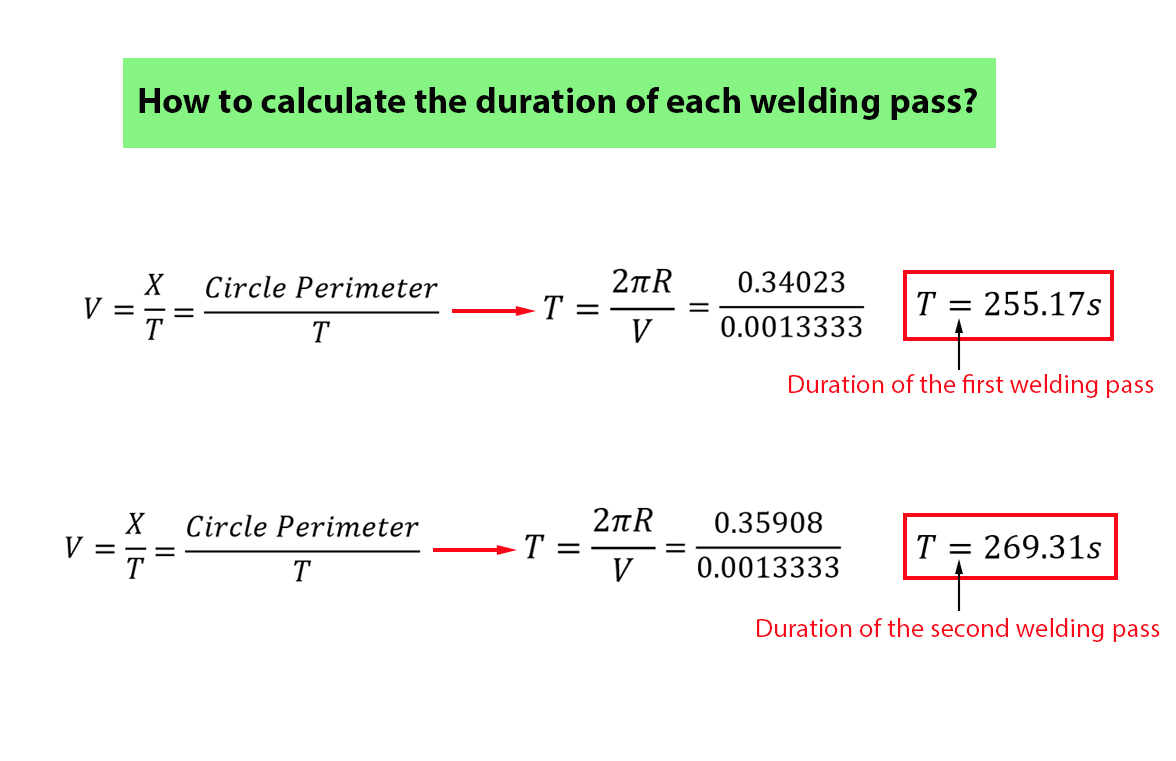
The analysis time for each welding and cooling stage is determined based on the welding path, welding speed, and required cooling period.
For each welding pass, the analysis time is calculated according to the distance traveled by the moving heat source and the specified welding speed. This ensures that the heat source moves along the weld line at the required rate.
The calculated step durations are used in the Abaqus thermal analysis to correctly define the movement of the heat source and the transient temperature response of the pipe.
The calculated analysis times are also provided in the project files for reference.
Convection and Radiation Heat Transfer
Convection and radiation heat transfer are considered as thermal boundary conditions on the exposed surfaces of the stainless steel pipe during the welding and cooling process.
Convection accounts for the heat transferred from the pipe surface to the surrounding environment, while radiation represents the thermal energy emitted from the heated pipe surfaces.
The heat transfer conditions are applied throughout the thermal analysis to account for heat loss from the pipe during both the welding and cooling stages.
The corresponding convection and radiation parameters are defined in the Abaqus model and are used to calculate the transient temperature response of the pipe.
Results-Temperature Distribution
The thermal response during the second welding pass is also investigated. The temperature field generated during the first pass and the subsequent cooling stage affects the thermal response when the second pass is applied.
The temperature results obtained from the Abaqus simulation are collected and presented in an Excel file. The temperature diagram can be used to evaluate the thermal response of the pipe during the welding and cooling stages.

Validation
This project has been validated, which means that the results obtained from the Abaqus software are compared with the results reported in the reference article.
The comparison shows that the numerical results obtained from the Abaqus model are in good agreement with the corresponding results reported in the article.
What You Will Learn
- How to simulate GTAW welding in Abaqus.
- How to simulate TIG (Tungsten Inert Gas) welding.
- How to model a two-pass welding process.
- How to define cooling stages between welding passes.
- How to define the Goldak's double-ellipsoid heat source.
- How to use the DFLUX user subroutine in Abaqus.
- How to define a moving welding heat source.
- How to model SUS304 stainless steel.
- How to calculate the convection heat transfer coefficient.
- How to define the analysis time for each welding and cooling step.
- How to obtain the temperature distribution from Abaqus.
- How to extract temperature results along the weld line.
- How to compare Abaqus results with published research results.
- How to validate a welding simulation using a reference article.
Key Features
- GTAW (Gas Tungsten Arc Welding) simulation in Abaqus.
- TIG (Tungsten Inert Gas) welding simulation.
- Two-pass welding of a pipe.
- Cooling process after each welding pass.
- Goldak's double-ellipsoid heat source.
- DFLUX Fortran subroutine.
- SUS304 stainless steel.
- Temperature distribution during the second welding pass.
- Convection heat transfer calculation.
- Temperature results and diagram.
- Validation against a research article.
- Complete Abaqus CAE file.
- Abaqus INP file.
- Fortran subroutine code.
- Excel file containing SUS304 material properties.
- Excel file containing temperature results.
- Excel file containing convection heat transfer coefficient calculation.
- Picture showing the calculation of time for each analysis step.
- Reference research paper.
- Step-by-step video tutorial.
Reference
This project is based on a research article. The reference paper is included with the project files and can be used to review the numerical model and the reported welding results.

Project Information
Important information about this project
Payment & Support
Need help with your purchase?
Secure Payment
Your payment is processed securely through our online payment system.
Need Help?
If you have any questions about this product, please contact us by email.
saeedofmoeini@gmail.com
There are no reviews yet.