

Project Overview
This tutorial focuses on the impact of a bottle full of water with the ground using the Abaqus software. The main objective is to investigate the behavior of the bottle and the water during the impact process.
The simulation includes the deformation of the bottle, the movement and sloshing of the water, the separation of the bottle cap, and the water flow during and after the impact.
Problem Description
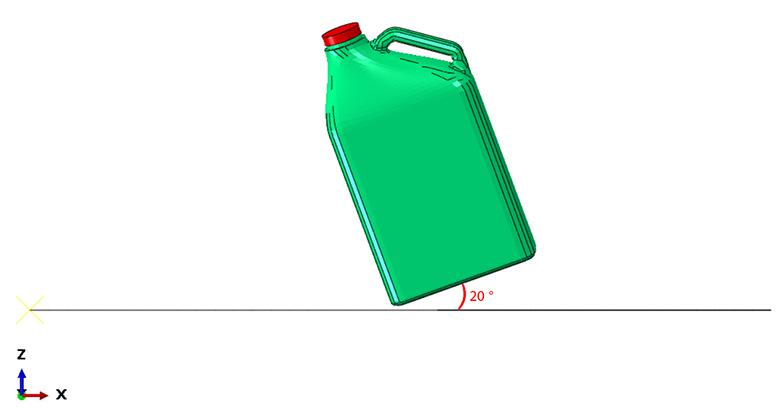
In this example, a water-filled bottle is dropped from a height of 300 mm. As a result, the initial velocity of the bottle at the moment of impact is 2444 mm/s.
The bottle impacts the ground at an angle of 20 degrees. The weight of the bottle, bottle cap, and water is applied using a gravity load.
Bottle Modeling
The bottle is made of high-density polyethylene (HDPE). The elastic, plastic, and damage properties of the polyethylene are defined in Abaqus to simulate the deformation and failure behavior of the bottle during impact.
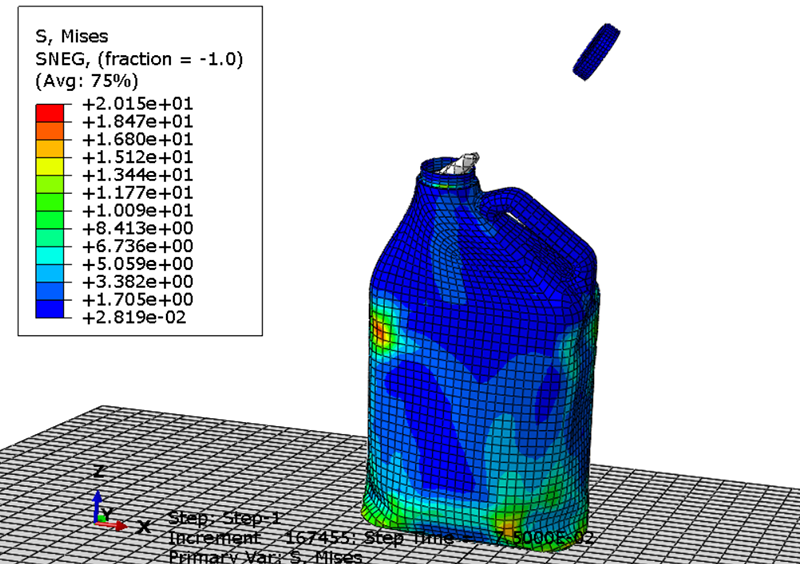
The bottle cap is also included in the model. During the impact, the bottle cap separates from the bottle and moves freely.
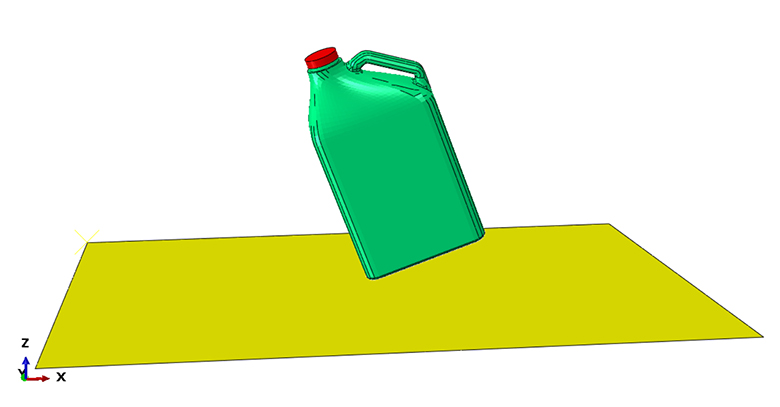
Eulerian Modeling of Water
The water is modeled using the Eulerian method. This approach allows the water to undergo large movement and deformation during the impact.
The interaction between the deformable bottle and the Eulerian water is investigated throughout the analysis. The simulation also captures the sloshing of water inside the bottle.
Impact and Bottle Deformation
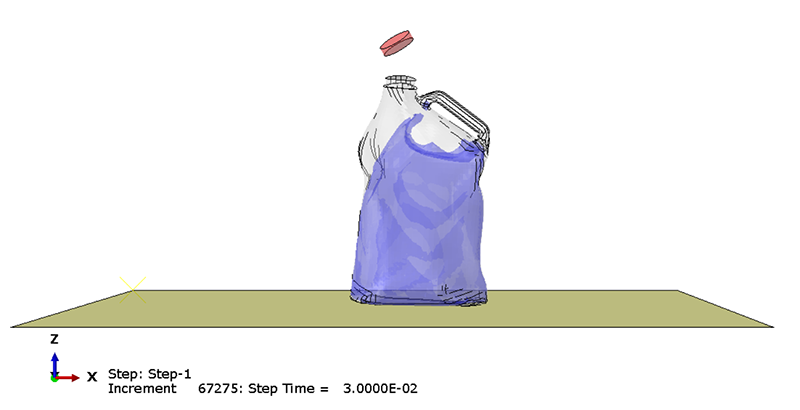
When the bottle hits the ground, the bottle undergoes deformation while the bottle cap separates from the bottle and moves freely.
At the same time, the water inside the bottle moves and undergoes significant deformation due to the impact.
Water Sloshing and Flow
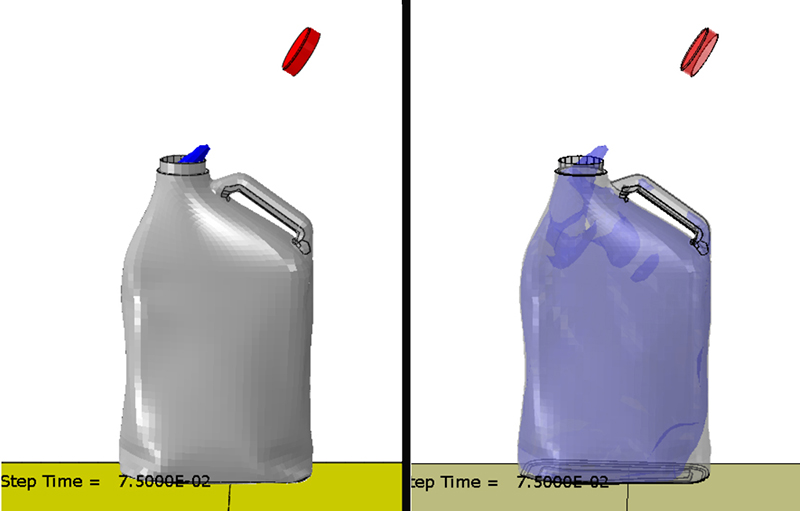
The impact causes significant movement and sloshing of the water inside the bottle. As the analysis progresses, water flows out of the bottle.
At the end of the analysis, a considerable amount of water has gushed out of the bottle.
It is important to note that water can flow inside the Eulerian part. If water exits the Eulerian domain for any reason, it is removed from the computational domain and its deformation can no longer be observed.
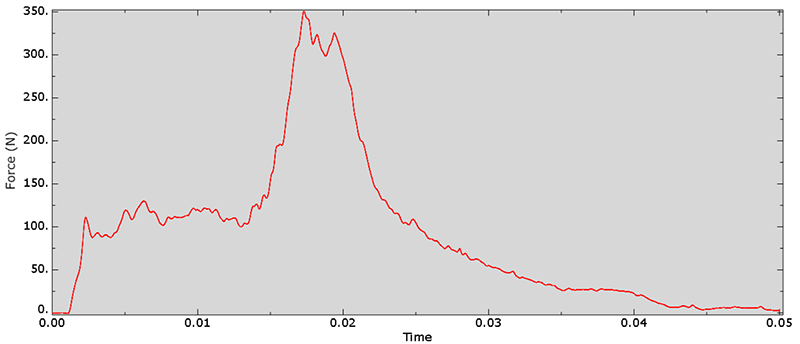
Reaction Force
The reaction force of the ground is also obtained from the Abaqus analysis. The reaction force diagram can be used to investigate the force transmitted to the ground during the impact.
What You Will Learn
- How to model the impact of a water-filled bottle with the ground.
- How to model a bottle made of high-density polyethylene.
- How to define elastic, plastic, and damage properties for the bottle.
- How to model water using the Eulerian method.
- How to model the ground as a rigid part.
- How to define gravity loading for the bottle, cap, and water.
- How to define an initial impact velocity of 2444 mm/s.
- How to simulate bottle deformation during impact.
- How to simulate separation of the bottle cap.
- How to observe water sloshing inside the bottle.
- How to simulate water flowing out of the bottle.
- How to obtain the reaction force of the ground.
Key Features
- Water-filled bottle impact simulation.
- High-density polyethylene (HDPE) bottle.
- Elastic, plastic, and damage behavior of the bottle.
- Eulerian modeling of water.
- Rigid ground.
- Drop height of 300 mm.
- Initial impact velocity of 2444 mm/s.
- Impact angle of 20 degrees.
- Bottle deformation and cap separation.
- Water sloshing and water flow.
- Reaction force of the ground.
- Free Abaqus tutorial.
Project Information
Important information about this project
Payment & Support
Need help with this tutorial?
Free Tutorial
This Abaqus tutorial is available free of charge.
Need Help?
If you have any questions about this tutorial, please contact us by email.
saeedofmoeini@gmail.com
There are no reviews yet.