
Project Overview
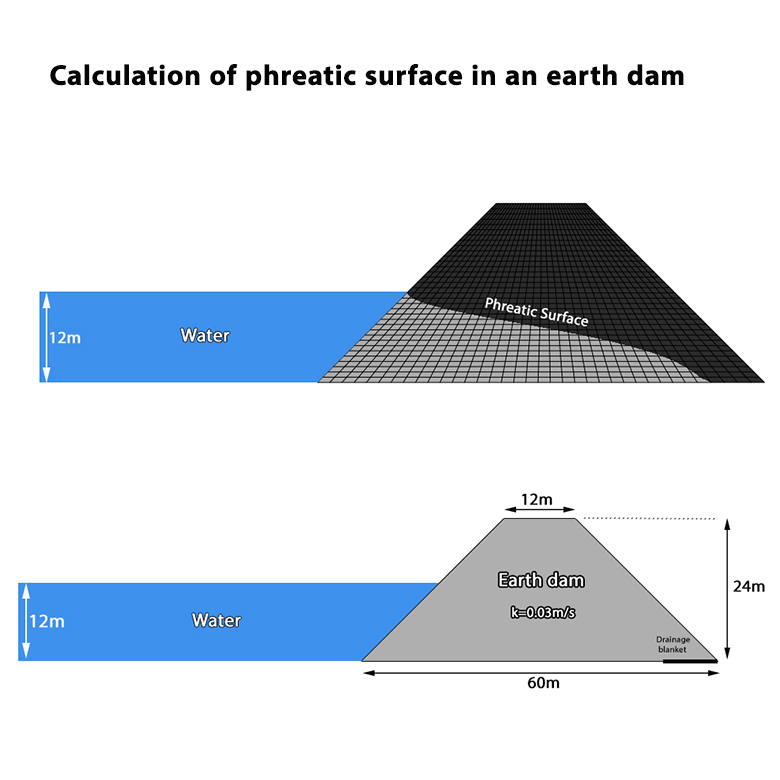
In this tutorial, the phreatic surface inside an earth dam is calculated using Abaqus. The main objective is to simulate the seepage through the earth dam and determine the location of the phreatic surface based on the pore water pressure distribution.
This example is based on Example 9.12 from the Sam Helwany book. The analysis focuses only on the fluid flow through the soil and the deformation of the earth dam is ignored.
Model Description
The model represents an earth dam with a height of 24 m. Water is stored behind the dam with a water height of 12 m.
The permeability coefficient of the earth dam is assumed to be 0.03 m/s. This parameter controls the movement of water through the soil during the seepage analysis.

Drainage Blanket
A drainage blanket is provided at the bottom section of the earth dam. The drainage blanket has a width of 9 m and is used to control the seepage flow through the dam.
The drainage blanket provides a drainage path for the water passing through the earth dam and affects the location of the phreatic surface.
Seepage Analysis
In this analysis, only the fluid flow inside the soil is considered. The deformation of the earth dam is ignored because the objective is to investigate the seepage behavior and determine the phreatic surface.
The permeability of the soil is defined as 0.03 m/s to simulate the movement of water through the earth dam.
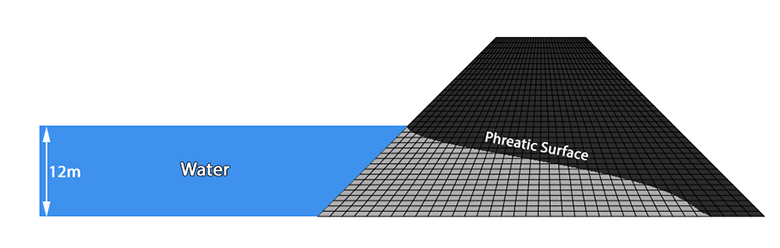
Phreatic Surface
The phreatic surface is the locus of points where the pore water pressure is equal to zero.
Above the phreatic surface, the pore water pressure is negative, while below the phreatic surface, the pore water pressure is positive.
Pore Water Pressure
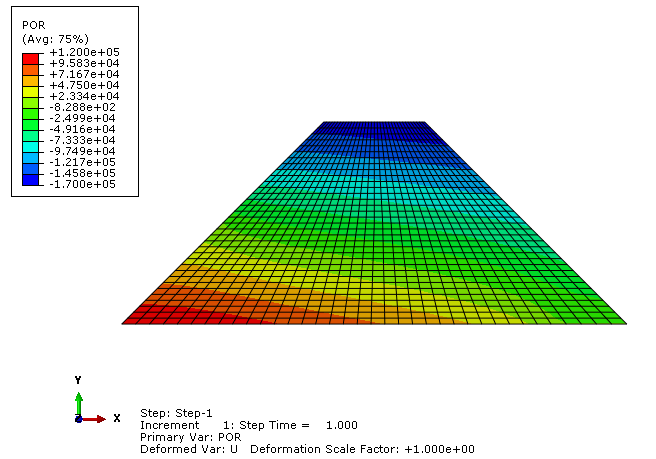
The pore water pressure distribution obtained from Abaqus is used to identify the location of the phreatic surface inside the dam.
The transition from negative to positive pore water pressure provides an indication of the position of the phreatic surface within the earth dam.
Results
The Abaqus results are used to determine the phreatic surface inside the earth dam. The pore water pressure distribution provides a clear representation of the saturated and unsaturated regions of the dam.
The analysis demonstrates how Abaqus can be used to simulate seepage through an earth dam and determine the location of the phreatic surface from the pore water pressure results.
What You Will Learn
- How to model seepage through an earth dam in Abaqus.
- How to define the permeability coefficient of soil.
- How to model a drainage blanket.
- How to analyze fluid flow through soil.
- How to obtain pore water pressure results.
- How to identify the phreatic surface from pore water pressure.
- How to distinguish positive and negative pore water pressure regions.
- How to visualize the phreatic surface in an earth dam.
Key Features
- Seepage analysis of an earth dam.
- Example 9.12 from the Sam Helwany book.
- 24-m-high earth dam.
- 12-m-high water reservoir.
- Soil permeability coefficient of 0.03 m/s.
- 9-m-wide drainage blanket.
- Fluid flow through soil is considered.
- Dam deformation is ignored.
- Phreatic surface calculation.
- Pore water pressure distribution.
- Positive and negative pore water pressure regions.
- Step-by-step Abaqus tutorial.
Project Information
Important information about this project
Payment & Support
Need help with this tutorial?
Free Tutorial
This Abaqus tutorial is available free of charge.
Need Help?
If you have any questions about this tutorial, please contact us by email.
saeedofmoeini@gmail.com
wei zhou(verified owner)
study ,thankyou i neeed