
Project Overview
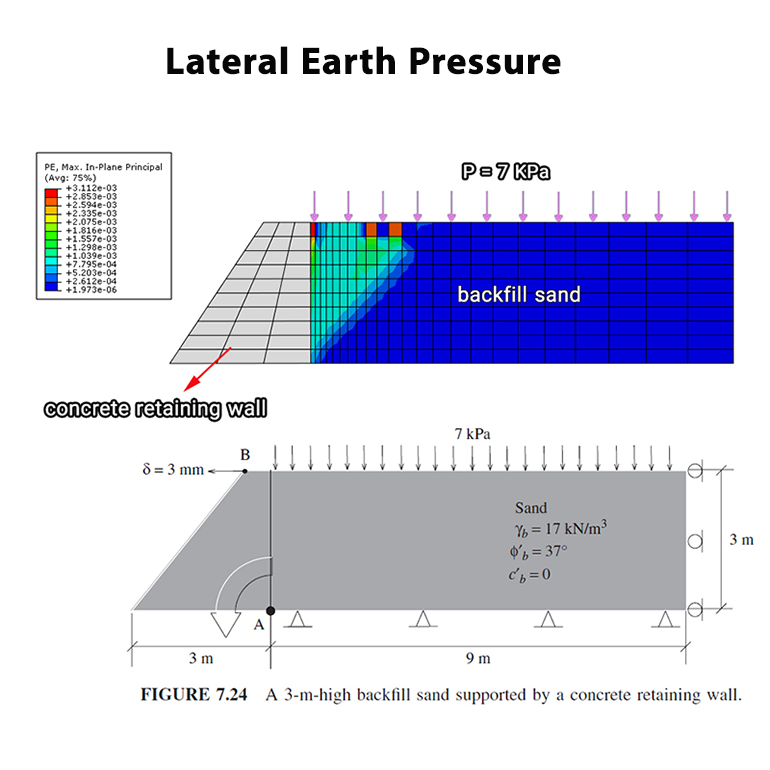
In this Abaqus tutorial, the behavior of a concrete retaining wall supporting a backfill sand layer is simulated and investigated.
The main objective of this analysis is to calculate the lateral earth pressure exerted by the backfill soil on the retaining wall and compare the Abaqus results with the reference results reported in the Sam Helwany book.
This example is selected from Example 7.3 of the Sam Helwany book.
Retaining Wall and Backfill Soil
The backfill consists of a 3-meter-high sand layer supported by a 3-meter-high concrete retaining wall.
The retaining wall provides lateral support to the backfill soil, and the interaction between the wall and the soil is considered during the analysis.

Three-meter-high backfill sand layer supported by the retaining wall.
Concrete Retaining Wall
The concrete retaining wall is assumed to behave as a linear elastic material.
A Young's modulus of 21.3 GPa and a Poisson's ratio of 0.2 are used to define the mechanical behavior of the concrete wall.
Sand Material Model
The backfill sand is modeled as an elastoplastic material using the Cap Model with Cap Hardening.
This constitutive model is used to represent the pressure-dependent behavior of the backfill soil during the analysis.
Initial Loading
The analysis is performed in two analysis steps.
In the first step, a 7 kPa surcharge pressure is applied to the surface of the backfill soil.
The weight of both the backfill soil and the retaining wall is also considered in this step to establish the initial stress state of the model.
Types of Lateral Earth Pressure
Three main types of lateral earth pressure can act on a retaining wall:
- At-rest earth pressure
- Active earth pressure
- Passive earth pressure
At-Rest Earth Pressure
At-rest earth pressure occurs when the retaining wall is not allowed to move either away from or toward the retained soil.
In this analysis, the at-rest lateral earth pressure exerted by the backfill soil on the retaining wall is calculated using Abaqus.
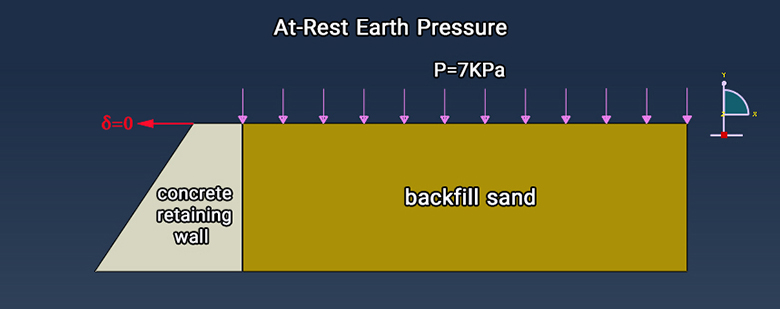
At-rest lateral earth pressure.
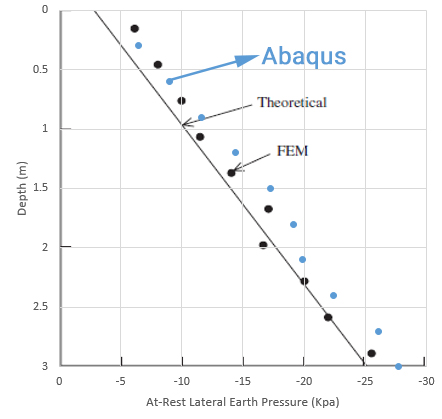
At-rest lateral earth pressure obtained from the Abaqus analysis.
The Abaqus result is then compared with the corresponding result reported in the Sam Helwany book.
Active Earth Pressure
Active earth pressure develops when the retaining wall is permitted to move away from the retained soil.
In this case, the wall movement causes the lateral pressure exerted by the soil to decrease toward the active earth pressure condition.

Active lateral earth pressure.
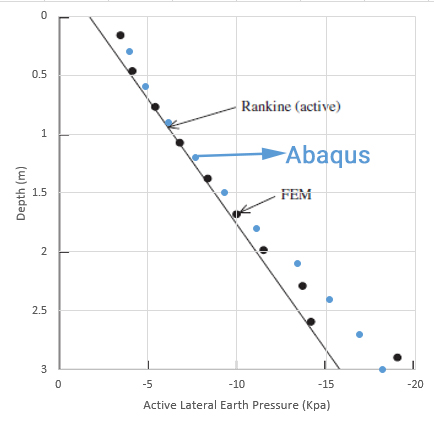
Active lateral earth pressure obtained from the Abaqus analysis.
The active lateral earth pressure calculated in Abaqus is compared with the corresponding result from the Sam Helwany book.
Passive Earth Pressure
Passive earth pressure develops when the retaining wall is forced to move toward the retained soil.
The movement of the wall toward the backfill causes the soil to develop significantly higher lateral resistance.

Passive lateral earth pressure.
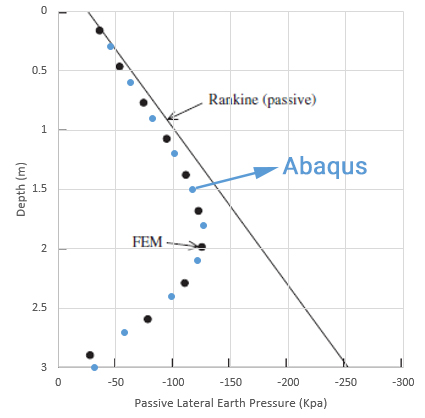
Passive lateral earth pressure obtained from the Abaqus analysis.
The passive lateral earth pressure obtained from Abaqus is compared with the reference result reported in the Sam Helwany book.
Comparison with Reference Results
The lateral earth pressure results obtained from Abaqus are compared with the corresponding results from the Sam Helwany book.
The comparison is performed for the at-rest, active, and passive earth pressure conditions.
Displacement Vectors at Active Failure
The displacement vectors of the retaining wall and the backfill soil are also investigated when the system reaches the active failure condition.
The displacement pattern obtained from Abaqus is compared with the corresponding displacement vectors presented in the Sam Helwany book.

Displacement vectors in the retaining wall and backfill soil at active failure.

Displacement vectors in the retaining wall and backfill soil at active failure.
What You Will Learn
- How to model a concrete retaining wall in Abaqus.
- How to model backfill sand behind a retaining wall.
- How to define linear elastic concrete behavior.
- How to define elastoplastic sand behavior.
- How to use the Cap Model with Cap Hardening.
- How to apply surcharge pressure to backfill soil.
- How to apply gravitational loading to the soil and wall.
- How to calculate at-rest lateral earth pressure.
- How to calculate active lateral earth pressure.
- How to calculate passive lateral earth pressure.
- How to investigate active failure of the retaining wall system.
- How to obtain displacement vectors from Abaqus.
- How to compare Abaqus results with reference results.
Key Features
- Backfill sand supported by a concrete retaining wall.
- Three-meter-high backfill sand layer.
- Three-meter-high retaining wall.
- Linear elastic concrete wall.
- Young's modulus of 21.3 GPa.
- Poisson's ratio of 0.2.
- Elastoplastic sand behavior.
- Cap Model with Cap Hardening.
- 7 kPa surcharge pressure.
- At-rest earth pressure.
- Active earth pressure.
- Passive earth pressure.
- Active failure condition.
- Displacement vector visualization.
- Comparison with Sam Helwany book results.
- CAE file.
- INP file.
- Excel results for at-rest earth pressure.
- Excel results for active earth pressure.
- Excel results for passive earth pressure.
- Step-by-step video tutorial.
Project Information
Important information about this project
Payment & Support
Need help with your purchase?
Secure Payment
Your payment is processed securely through our online payment system.
Need Help?
If you have any questions about this product, please contact us by email.
saeedofmoeini@gmail.com
There are no reviews yet.