
Project Overview
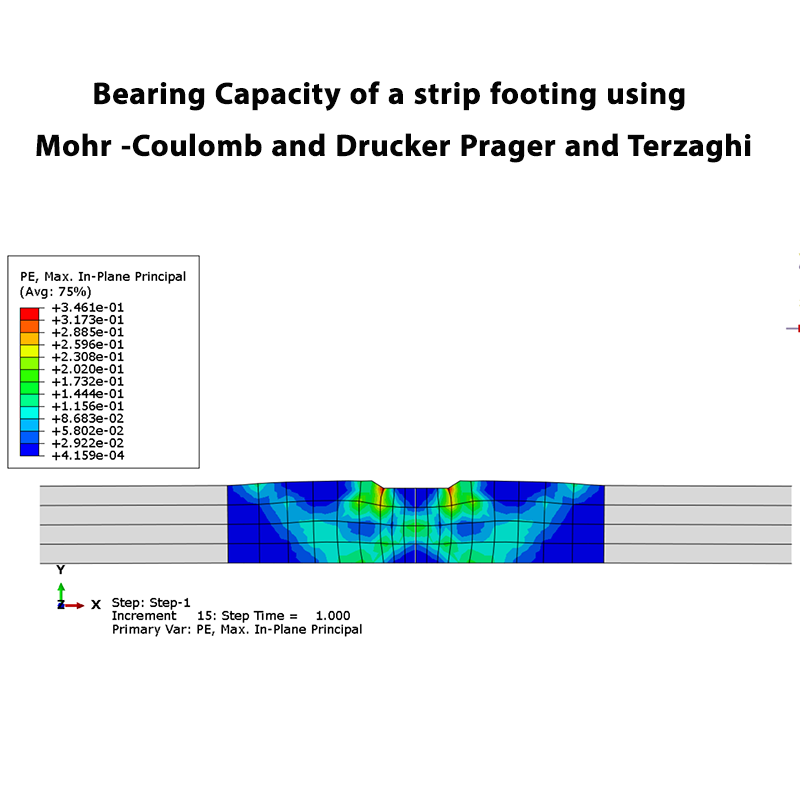
In this project, the bearing capacity of a strip footing is investigated using the Abaqus software. The soil behavior is modeled using two different constitutive models: Mohr-Coulomb and Drucker-Prager.
The strip footing is subjected to vertical loading, and the response of the soil is obtained from the Abaqus analysis. The bearing capacity obtained from the numerical analysis is then compared with the Terzaghi analytical solution.
The project also shows how the required soil parameters are defined in Abaqus for the Mohr-Coulomb and Drucker-Prager models, including the calculation of the required Drucker-Prager parameters.

Model Description
The model represents a strip footing placed on a soil layer and is created using a plane strain formulation. Because of symmetry, only half of the soil and footing are modeled.
The footing is 3.05 m wide, and the soil layer has a depth of 3.66 m. The soil domain extends sufficiently far from the footing to reduce the influence of the model boundaries on the footing response.
The soil is modeled using both the Mohr-Coulomb and Drucker-Prager constitutive models. The footing is treated as rigid and is subjected to vertical displacement to obtain the load required to determine the bearing capacity.
The main soil region is modeled using regular finite elements, while infinite elements are used at the far boundary of the soil domain.

Infinite Elements
The soil extends beyond the region modeled with regular finite elements. To represent this outer part of the soil, infinite elements are used at the far boundary of the model.
In the Abaqus/Standard model, the infinite elements are defined using the CINPE5R element type. These elements are placed away from the footing, beyond the region where significant plastic deformation occurs. In Abaqus, infinite elements are assumed to behave as linear elastic material.
Mohr-Coulomb Soil Model
The Mohr-Coulomb model is used to define the mechanical behavior of the soil in Abaqus. This model is commonly used for geotechnical analysis because it can represent the strength of soil based on its friction and cohesion.
The main soil strength parameters used in the model are the friction angle and cohesion. These parameters control the shear strength of the soil and have a direct effect on the bearing capacity of the strip footing.
In this tutorial, the Mohr-Coulomb material is defined in Abaqus and used to calculate the response of the soil under the applied footing load. The resulting bearing capacity is then used for comparison with the Terzaghi analytical solution.
Drucker-Prager Soil Model
The Drucker-Prager model is also used to describe the mechanical behavior of the soil in Abaqus. The results obtained with this model are compared with those from the Mohr-Coulomb model.
The Drucker-Prager parameters are defined based on the soil properties and the required relationship between the Drucker-Prager and Mohr-Coulomb models. In this process, the main soil strength properties, including the friction angle and cohesion, are used to determine the required parameters.
In this tutorial, the calculation and definition of the Drucker-Prager parameters in Abaqus are explained. The model is then used to obtain the footing response and bearing capacity for comparison with the analytical solution.


Comparison with Terzaghi
The bearing capacity obtained from the Abaqus analysis is compared with the Terzaghi analytical solution.
The comparison is performed for the soil models defined using Mohr-Coulomb and Drucker-Prager plasticity. This allows the numerical results from Abaqus to be evaluated against the analytical bearing capacity.
The comparison also shows how the choice of the soil model affects the predicted bearing capacity of the strip footing.

What You Will Learn
- How to model a strip footing and surrounding soil in Abaqus.
- How to calculate the bearing capacity of a strip footing.
- How to define soil properties using the Mohr-Coulomb model.
- How to define soil properties using the Drucker-Prager model.
- How to calculate the friction angle for the Drucker-Prager model.
- How to calculate material cohesion for the Drucker-Prager model.
- How to calculate Drucker-Prager hardening.
- How to use infinite elements in a soil model.
- How to obtain the bearing capacity using Abaqus.
- How to compare Abaqus results with the Terzaghi solution.
Key Features
- Bearing capacity analysis of a strip footing.
- Mohr-Coulomb soil model.
- Drucker-Prager soil model.
- Infinite elements.
- Calculation of Drucker-Prager parameters.
- Friction angle calculation.
- Material cohesion calculation.
- Drucker-Prager hardening.
- Terzaghi analytical solution.
- Comparison between numerical and analytical results.
- Free Abaqus tutorial.
Project Information
Important information about this project
Payment & Support
Need help with this tutorial?
Free Tutorial
This Abaqus tutorial is available free of charge.
Need Help?
If you have any questions about this tutorial, please contact us by email.
saeedofmoeini@gmail.com
Rimac
Excellent
One of the best tutorials on Mohr Coulomb and Drucker Prager, Thanks for providing the formulas and relationships of the Mohr Coulomb and Drucker Prager models, which were very useful.
Please post more tutorials about Drucker Prager and Mohr Coulomb
Thank you.
Admin
Thank you very much
Ehsan
Very good
Maicol Martin
Excelente explicación. Estoy iniciando en el mundo de la geotecnia con elementos finitos utilizando el programa Abaqus. Aún me siento un poco perdido en algunos aspectos, pero estoy motivado por aprender y profundizar en el tema.