
Project Overview
This tutorial focuses on the consolidation settlement of a multi-layer soil under strip loading using the Abaqus software.
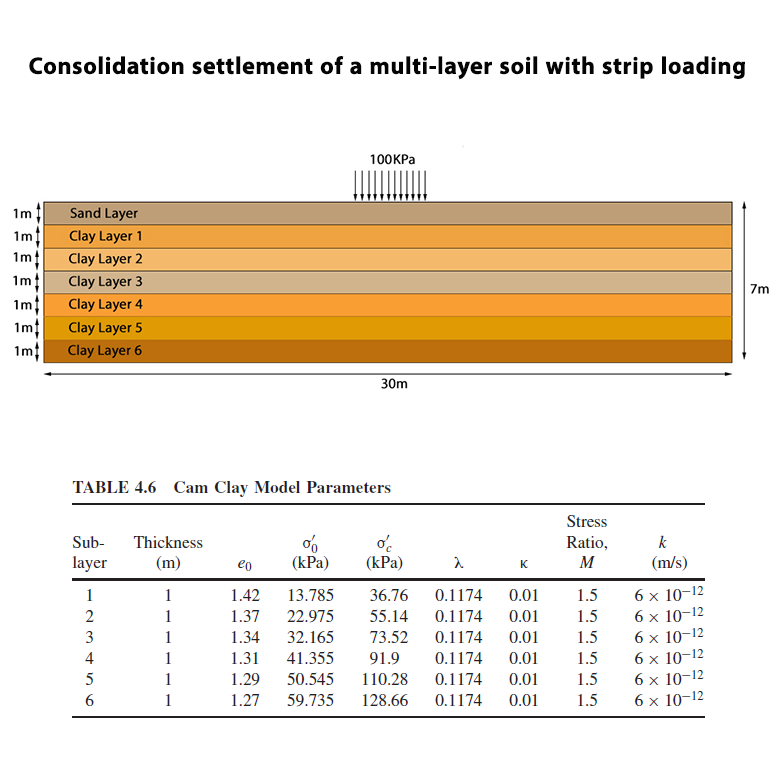
The model is based on Example 4.8 from the Sam Helwany book. A 3 m wide strip load with an intensity of 100 kPa is applied suddenly to the soil surface.
The soil profile consists of a 1 m thick sand layer over a 6 m thick clay layer. The clay is divided into six sublayers, with different material parameters for each sublayer. The clay behavior is modeled using the Extended Cam-Clay model.
The analysis includes the initial geostatic stress state, sudden strip loading, and subsequent consolidation with drainage. The resulting settlement at the center of the loaded area is obtained from the Abaqus analysis and compared with the reference results.
The model is created as a two-dimensional plane strain finite element model. The soil profile has a total thickness of 7 m, consisting of a 1 m thick sand layer on top of a 6 m thick clay layer.

Cam-Clay Model for Clay
The Extended Cam-Clay model is used to define the elastoplastic behavior of the clay in Abaqus.
The clay layer is divided into six 1 m thick sublayers. Each sublayer has its own set of Cam-Clay parameters, including the initial void ratio, in-situ effective stress, and pre-consolidation pressure.
The main parameters include the initial void ratio, in-situ effective stress, pre-consolidation pressure, and the Cam-Clay parameters λ, κ, and M. The same values of λ, κ, and M are used for the clay sublayers, while the initial stress, pre-consolidation pressure, and void ratio vary with depth.

Analysis Steps
The analysis is performed in three steps to establish the initial soil condition, apply the strip load, and evaluate the consolidation behavior.
Step 1: Geostatic
In the first step, the effective self-weight of the soil is applied using a Body Force. The initial stress conditions are also defined for the clay sublayers according to their depth.
The Geostatic procedure is used to establish the initial equilibrium of the soil and ensure that the initial stresses are consistent with the initial Cam-Clay yield surfaces. No drainage is allowed through the top and bottom surfaces during this step.
Step 2: Strip Loading
In the second step, a 100 kPa strip load with a width of 3 m is applied suddenly to the top surface of the soil.
During load application, the top and bottom boundaries are impervious, so no drainage occurs. The sudden loading generates excess pore pressure within the clay layer.
Step 3: Consolidation
In the third step, the top and bottom boundaries are changed to pervious boundaries with zero excess pore pressure. The excess pore pressure generated during loading gradually dissipates through these boundaries.
As the pore pressure decreases, the load is gradually transferred to the soil skeleton, resulting in additional soil deformation and consolidation settlement.
The consolidation analysis is performed using automatic time stepping to obtain the settlement response over time.

Over-Consolidated Clay
The initial stress condition of each clay sublayer is evaluated by comparing its in-situ vertical effective stress with its pre-consolidation pressure.
If the in-situ effective stress is lower than the pre-consolidation pressure, the soil is considered over-consolidated (OC).
According to the reference example, all six clay sublayers are initially over-consolidated.
Settlement Results
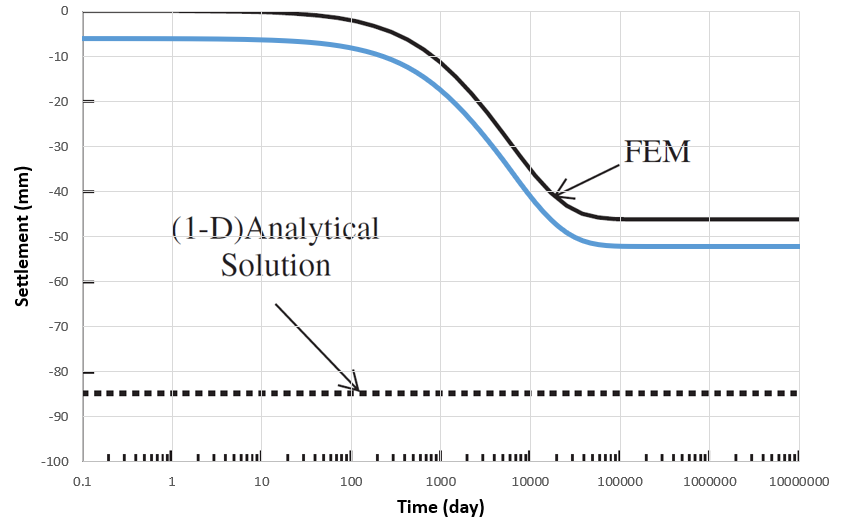
The consolidation settlement of the multi-layer soil is obtained from the Abaqus analysis. The numerical results are then compared with the corresponding results from the Sam Helwany book.

Comparison with Sam Helwany Book
The final settlement results obtained from Abaqus are compared with the results reported in the Sam Helwany book. This comparison provides a useful verification of the numerical model and the consolidation analysis.
What You Will Learn
- How to model a multi-layer soil profile in Abaqus.
- How to define different properties for individual soil layers.
- How to define sand and clay layers.
- How to use the Cam-Clay model for clay plasticity.
- How to divide a clay layer into sublayers.
- How to define geostatic stresses for each soil layer.
- How to perform a Geostatic analysis.
- How to apply soil self-weight using Body Force.
- How to apply a strip loading of 100 kPa.
- How to perform a consolidation analysis.
- How to investigate over-consolidated clay.
- How to calculate consolidation settlement using Abaqus.
- How to compare Abaqus results with reference results.
Key Features
- Seven-layer soil profile.
- Sand top layer.
- Six underlying clay layers.
- 1 m thickness for each soil layer.
- Different properties for each soil layer.
- 100 kPa strip loading.
- Cam-Clay model for clay plasticity.
- Geostatic stress initialization.
- Body Force for soil self-weight.
- Three-step analysis.
- Geostatic step.
- Strip loading step.
- Consolidation step.
- Consolidation settlement calculation.
- Comparison with Sam Helwany book results.
- Free Abaqus tutorial.
Project Information
Important information about this project
Payment & Support
Need help with this tutorial?
Free Tutorial
This Abaqus tutorial is available free of charge.
Need Help?
If you have any questions about this tutorial, please contact us by email.
saeedofmoeini@gmail.com
There are no reviews yet.