

Product Overview
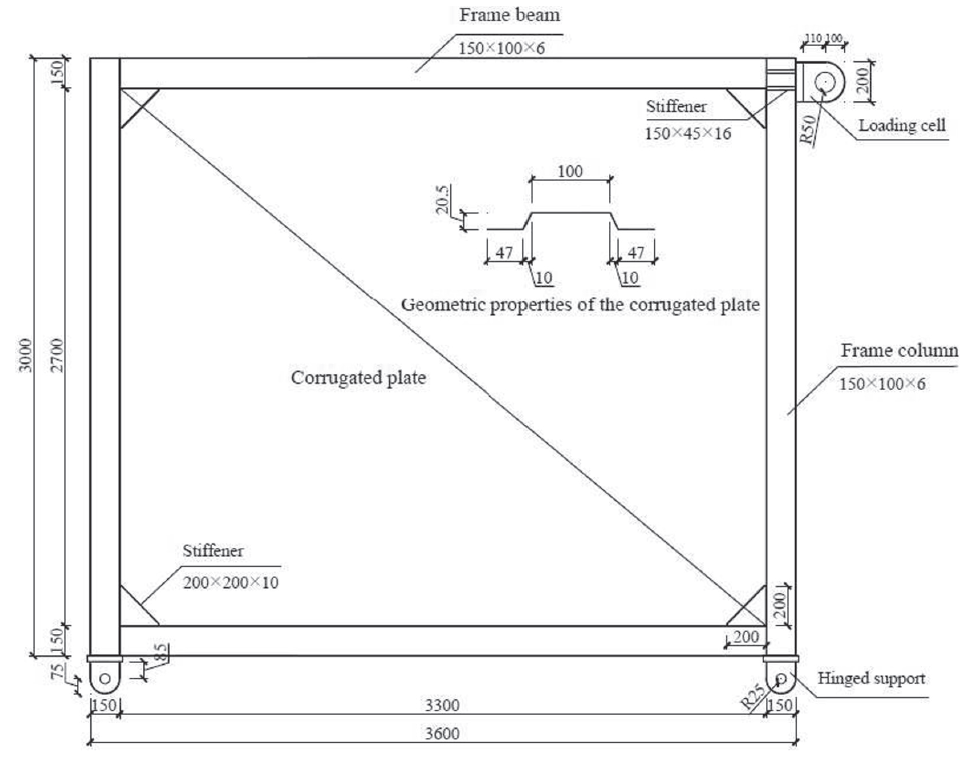
The numerical model represents the corrugated steel plate shear wall without an opening, based on the configuration reported in the reference experimental study.
The model consists of a corrugated steel infill plate surrounded by a steel boundary frame composed of frame beams and frame columns. The corrugated plate is connected to the surrounding frame to reproduce the structural configuration of the experimental specimen.
The Abaqus results are compared with the results reported in the reference paper to evaluate the accuracy of the numerical model.
Model Description
The model represents a corrugated steel plate shear wall based on the configuration described in the reference research paper.
The main load-resisting component of the model is the corrugated steel plate. The corrugated geometry is modeled according to the configuration of the CSPSW-1 specimen reported in the reference study.
The required material properties, interactions, boundary conditions, and analysis settings are defined in Abaqus to reproduce the structural behavior observed in the reference study.

Corrugated Steel Plate
The main component of the model is the corrugated steel plate. The corrugation geometry is defined according to the configuration used in the reference study.
The corrugated geometry provides a different structural response compared with a conventional flat steel plate shear wall and is considered in the numerical analysis.
Buckling Analysis and Initial Imperfection
A buckling analysis is performed to determine the buckling mode of the corrugated steel plate shear wall.
The obtained buckling mode is then used to introduce an initial geometric imperfection into the model.
This procedure helps the numerical model reproduce the initial imperfections considered in the structural analysis.

Cyclic Loading
The corrugated steel plate shear wall is subjected to cyclic loading according to the loading protocol used in the reference study.
The loading history is defined using the Amplitude option in Abaqus.
The structure is analyzed under repeated loading and unloading cycles to investigate its nonlinear hysteretic response.
Hysteresis Results
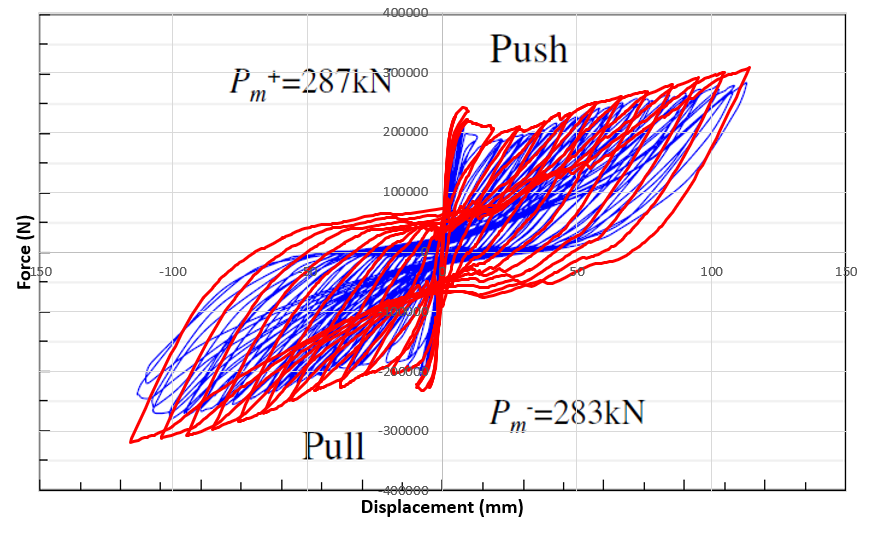
The force-displacement hysteresis response of the CSPSW-1 specimen is obtained from the Abaqus analysis and plotted to evaluate the wall's cyclic behavior under repeated lateral loading.
The numerical hysteresis response is then compared with the results reported in the reference paper.
Validation
The numerical results obtained from Abaqus are compared with the results reported in the reference research paper.
The comparison focuses on the force–displacement hysteresis response and the overall structural behavior under cyclic loading.
The corrugated steel plate initially undergoes global buckling as the lateral displacement increases. After buckling, tension strips develop within the corrugated plate, allowing the wall to continue carrying lateral loads beyond the initial buckling stage.

Key Features
- Corrugated steel plate shear wall model.
- Detailed corrugated steel plate geometry.
- Buckling analysis.
- Initial geometric imperfection based on buckling mode.
- Cyclic loading using the Amplitude option.
- Nonlinear analysis under cyclic loading.
- Force–displacement hysteresis response.
- Processing of Abaqus results using Excel.
- Comparison with reference results.
- Complete Abaqus model files.
- Excel files for cyclic loading and numerical results.
- Reference research paper.
- Step-by-step video tutorial.
What You Will Learn
- How to model a corrugated steel plate shear wall in Abaqus.
- How to define the geometry of the corrugated steel plate.
- How to define the material properties of the structural components.
- How to define the required interactions and constraints.
- How to define the boundary conditions of the model.
- How to perform a buckling analysis.
- How to obtain buckling modes from Abaqus.
- How to define an initial geometric imperfection using a buckling mode.
- How to define cyclic loading using the Amplitude option in Abaqus.
- How to perform nonlinear analysis under cyclic loading.
- How to obtain a force–displacement hysteresis curve.
- How to extract and process Abaqus results using Excel.
- How to compare numerical and reference results.
Reference
This project is based on the research study provided in the reference paper.
The paper is included with the project files and can be used to review the experimental configuration, loading protocol, and reported results.

Project Information
Important information about this project
Payment & Support
Need help with your purchase?
Secure Payment
Your payment is processed securely through our online payment system.
Need Help?
If you have any questions about this product, please contact us by email.
saeedofmoeini@gmail.com
There are no reviews yet.