

Project Overview
In this example, we simulate the Mode II interlaminar fracture of a Glass/Epoxy multidirectional composite laminate using the Abaqus software.
The Virtual Crack Closure Technique (VCCT) is used to calculate the strain energy release rate components associated with the interlaminar crack. The analysis focuses on the Mode II fracture response of the composite specimen under ENF loading.
The numerical results obtained from Abaqus are compared with the corresponding results reported in the reference research article. This comparison is used to evaluate the numerical model and investigate its ability to reproduce the reported interlaminar fracture behavior of the Glass/Epoxy laminate.

Model Description
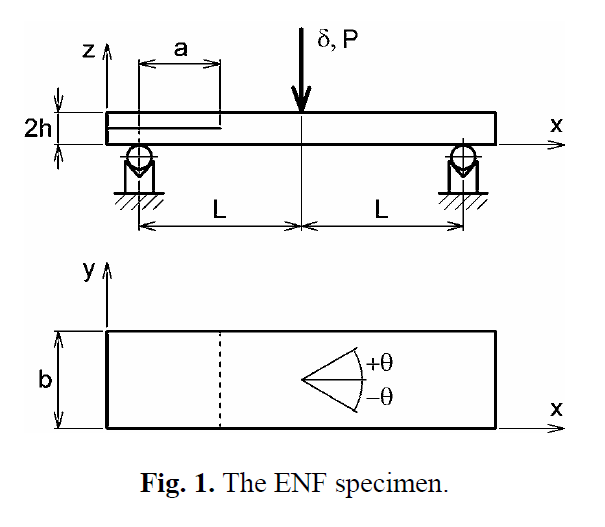
The model represents an End-Notched Flexure (ENF) specimen subjected to three-point bending. The composite specimen consists of two bonded sections, with each section containing 20 composite layers. Each layer has a thickness of 0.15 mm. An initial delamination with a length of 25 mm is introduced between the two composite sections to represent the starter crack.
The composite material is a woven fabric Glass/Epoxy laminate with a multidirectional stacking sequence. The specimen has a total length of 160 mm and a width of 20 mm.
VCCT Method
The Virtual Crack Closure Technique (VCCT) is used to evaluate the interlaminar fracture behavior of the Glass/Epoxy composite under Mode II loading.
During the End-Notched Flexure (ENF) analysis, the strain energy release rate associated with the crack tip is evaluated using the VCCT method. The technique provides the energy release rate components corresponding to Mode I, Mode II, and Mode III fracture.
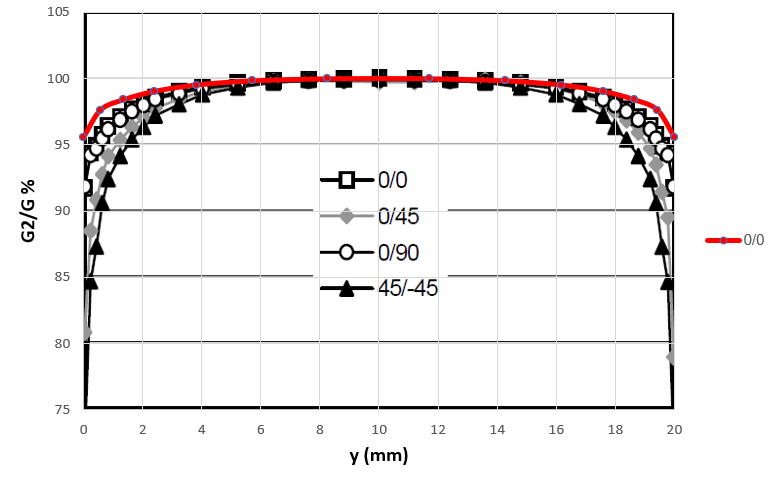
For the ENF configuration considered in this study, the Mode II component is dominant. According to the reference study, the Mode II contribution is greater than 97% of the total strain energy release rate for the investigated configurations, confirming the predominantly Mode II nature of the fracture loading.
The calculated Mode II strain energy release rate, GII, is used to evaluate the interlaminar fracture response of the Glass/Epoxy laminate and to compare the numerical results with the corresponding results reported in the reference research article.
The VCCT results provide an important basis for evaluating the interlaminar crack behavior and the fracture response of the composite specimen during the ENF test.
Validation of the Abaqus Model
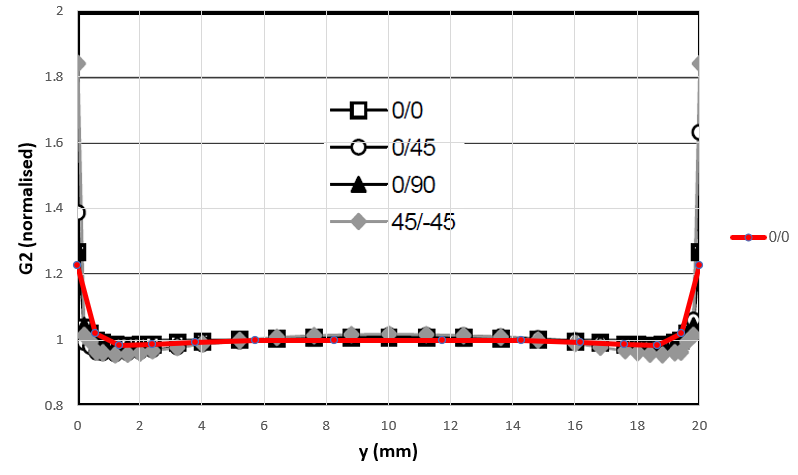
This project has been validated against the reference article. The results obtained from the Abaqus simulation are compared with the corresponding results reported in the article.
The comparison demonstrates that the Abaqus model provides results that are in good agreement with the reference study.
Mode II Loading
The End-Notched Flexure (ENF) configuration is used to generate predominantly Mode II interlaminar loading in the Glass/Epoxy composite specimen.
During the three-point bending test, the two arms of the specimen are subjected to relative sliding near the delamination front. This produces an interlaminar shear loading condition at the crack tip and promotes Mode II delamination.
The crack tip response is evaluated using the Virtual Crack Closure Technique (VCCT). The resulting strain energy release rate components are used to determine the contribution of each fracture mode.
The numerical analysis shows that the Mode II strain energy release rate (GII) is the dominant component of the total strain energy release rate. This confirms that the ENF configuration provides a predominantly Mode II fracture condition for the investigated Glass/Epoxy laminate.
What You Will Learn
- How to model a multidirectional Glass/Epoxy composite plate in Abaqus.
- How to define multiple composite layers.
- How to model delamination between composite layers.
- How to use the Virtual Crack Closure Technique (VCCT).
- How to perform a three-point bending analysis.
- How to investigate Mode II interlaminar fracture behavior.
- How to compare Abaqus results with results from a research article.
- How to validate a composite delamination model in Abaqus.
Key Features
- Glass/Epoxy multidirectional composite.
- 20 layers in each composite plate.
- Three-point bending analysis.
- Initial delamination crack.
- VCCT method.
- Mode II interlaminar fracture.
- Validation against a research article.
- Abaqus CAE file.
- Abaqus INP file.
- Excel file containing the results.
- Reference research paper.
- Step-by-step video tutorial.
Reference
This project is based on the experimental study provided in the reference research paper. The paper is included with the project files and can be used to review the experimental setup, loading protocol, and reported results.

Project Information
Important information about this project
Payment & Support
Need help with your purchase?
Payment Methods
You can purchase this product online using Visa or MasterCard. PayPal payment is also available by contacting us by email.
Need Help?
If you have any questions about this product or purchasing process, please contact us by email.
saeedofmoeini@gmail.com
There are no reviews yet.