
Product Overview
In this project, a high-strength steel eccentrically braced frame with a vertical shear link is simulated using Abaqus to investigate its structural behavior under cyclic loading.
The numerical model is developed based on the configuration of the experimental specimen reported in the reference study. The vertical shear link is designed to undergo inelastic deformation and dissipate energy during cyclic loading, while the other structural members provide the required strength and stiffness.
The Abaqus results are compared with the experimental results reported in the reference study to evaluate the ability of the numerical model to reproduce the main characteristics of the cyclic response of the specimen.
Model Description
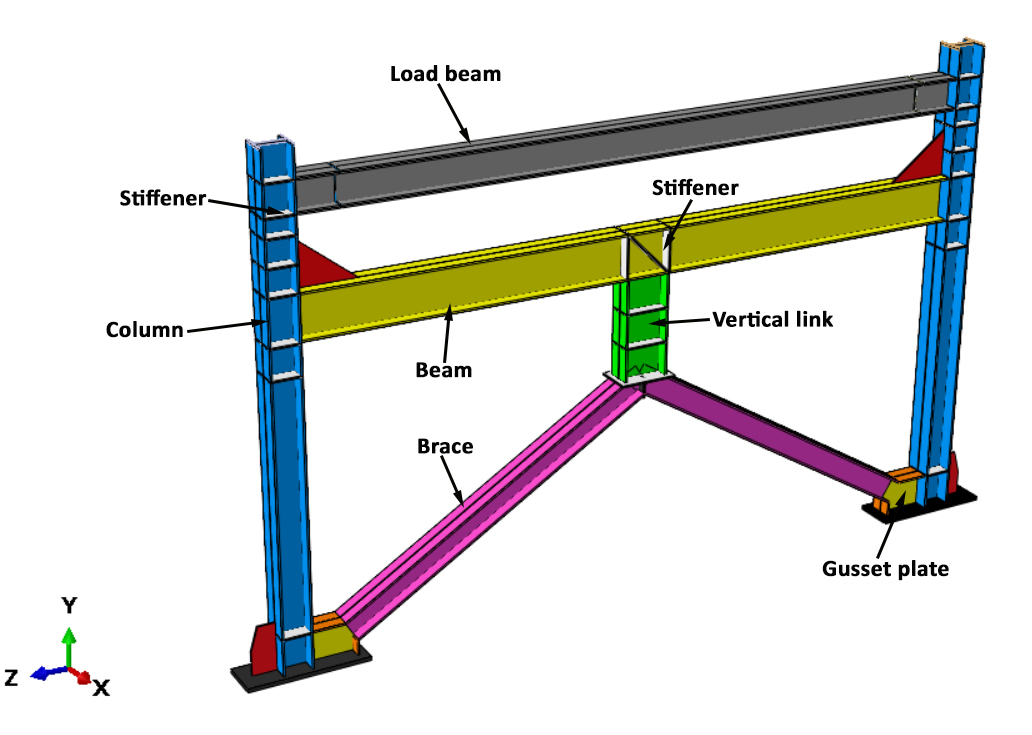
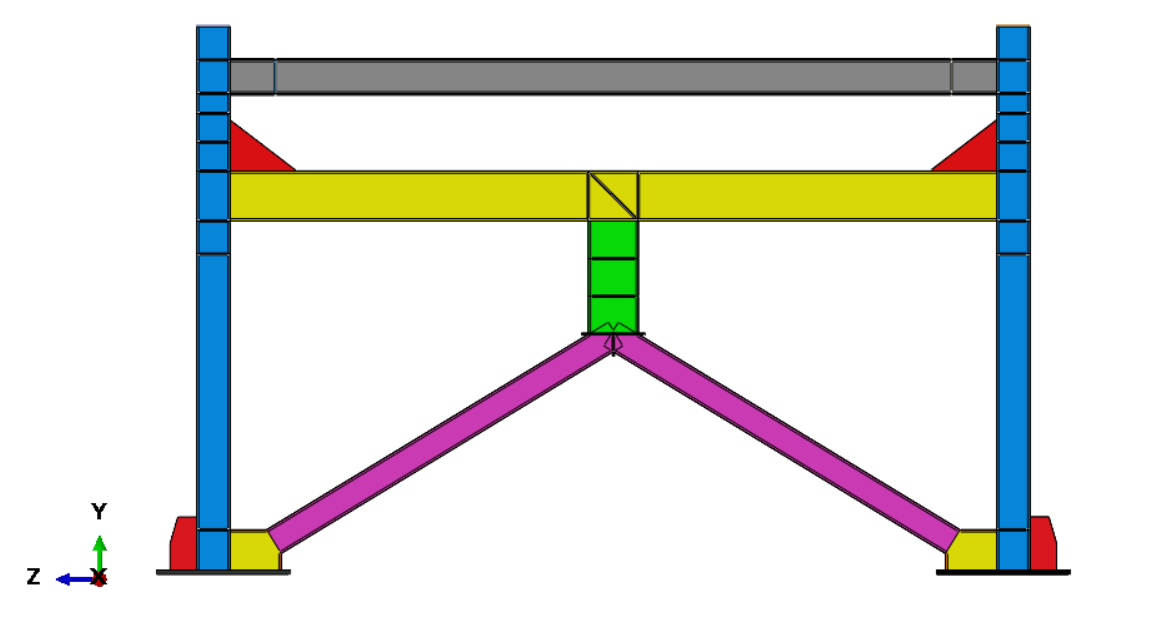
As you observe in the picture, this model is composed of beam, column, brace, vertical shear link, gusset plate, stiffener, and load beam.
The vertical shear link is made of conventional-strength steel (Q345), while the beam, columns, and braces are made of high-strength steel (Q460).
The numerical model has been developed according to the configuration of the experimental specimen reported in the reference article.
Experimental Model
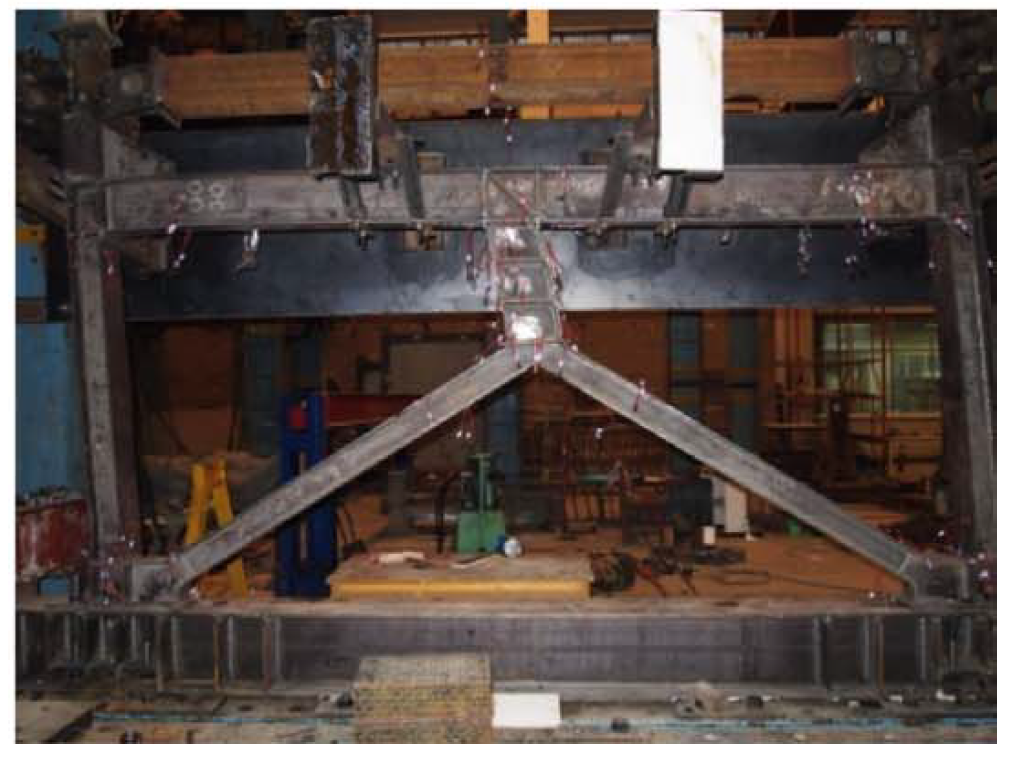
The experimental model was constructed in the laboratory with a story height of 1.8 m, a span of 3.6 m, and a 500 mm vertical shear link.
The same experimental configuration is simulated in the Abaqus software to reproduce the structural response observed during the laboratory test.
Cyclic Loading
Before applying the lateral cyclic loading, a 400 kN axial load is applied to the columns to represent the vertical load and consider the P-Delta effect in the numerical analysis.
After applying the axial load, cyclic lateral loading is applied to the model according to the loading protocol reported in the reference study.
The cyclic loading amplitude is defined in Abaqus to reproduce the loading history applied to the experimental specimen.
Comparison of Abaqus and Experimental Results
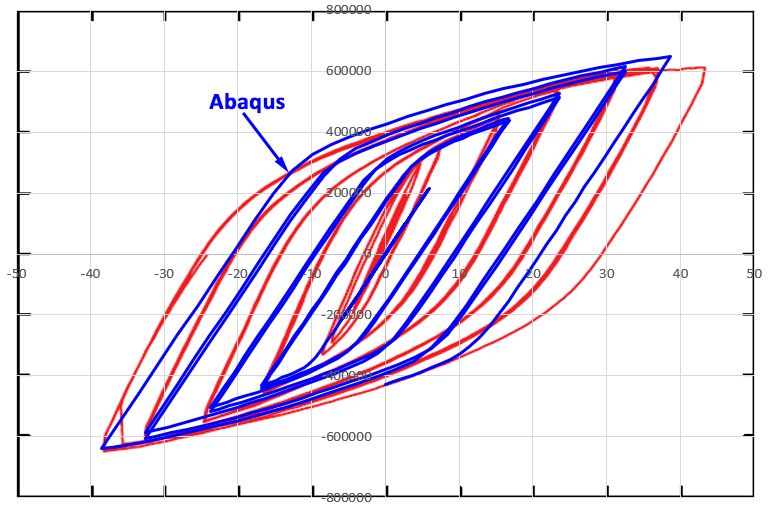
In this picture, the hysteresis force-displacement diagram obtained from the Abaqus software is compared with the experimental results.
This comparison is used to evaluate the accuracy of the numerical model in reproducing the cyclic behavior of the experimental specimen.
Deformation of the Eccentrically Braced Frame
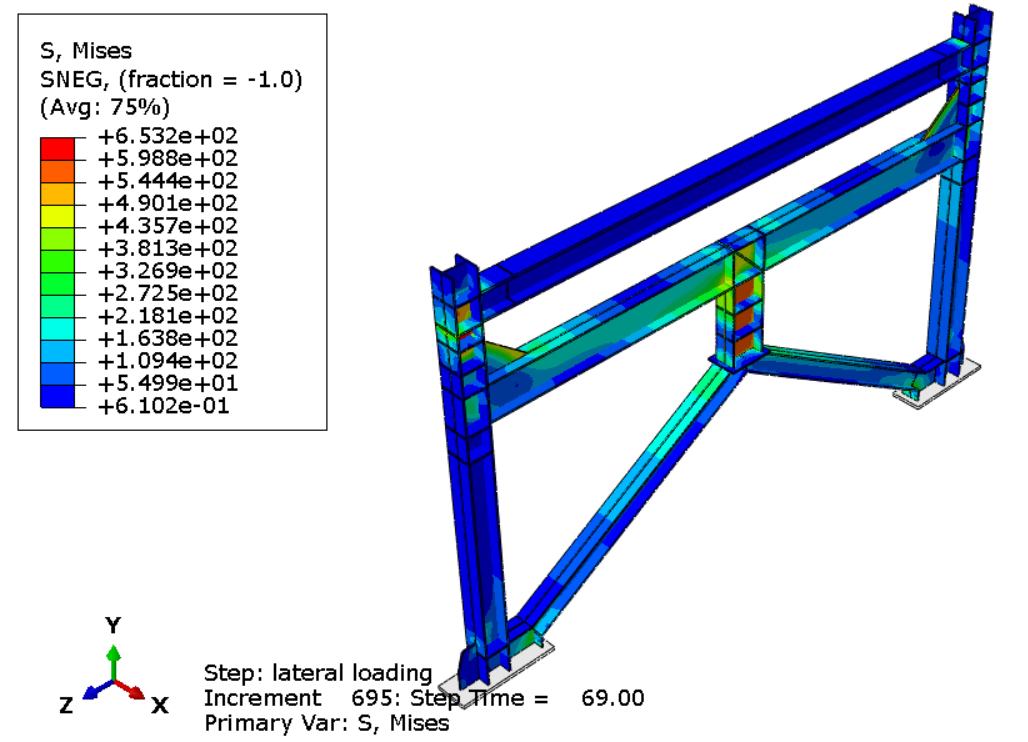
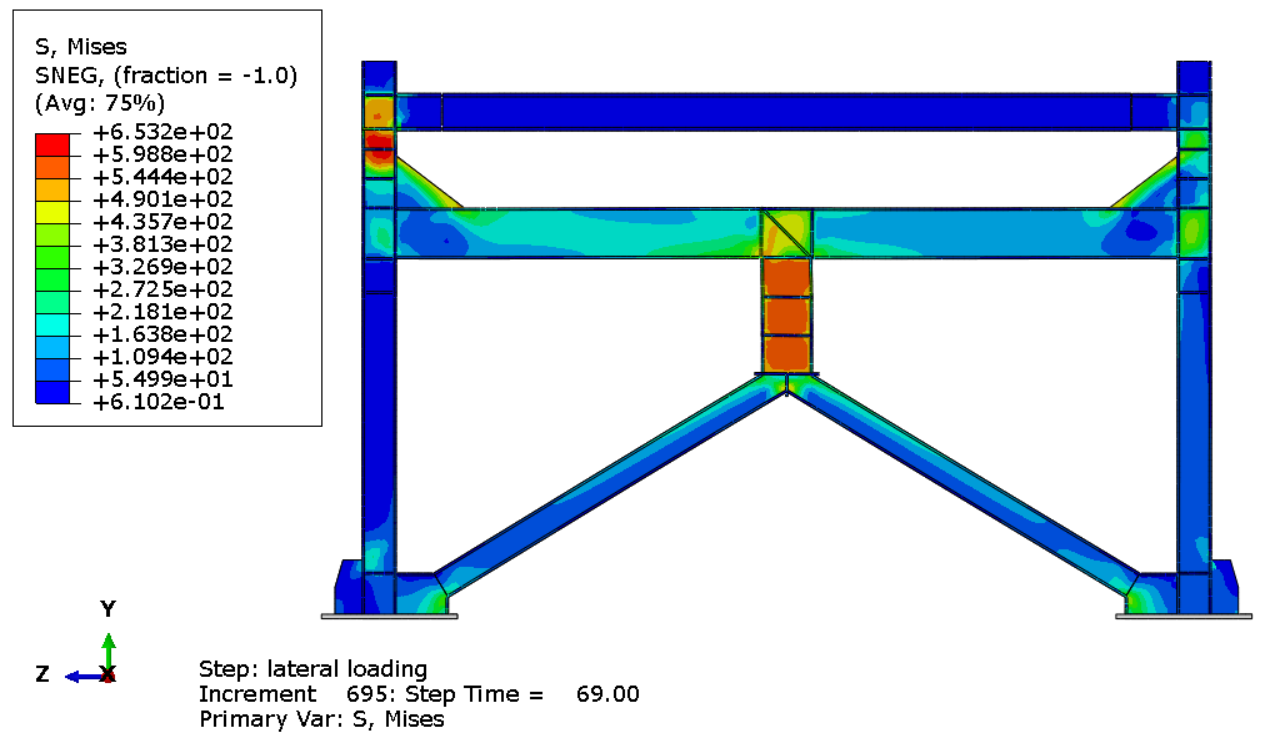
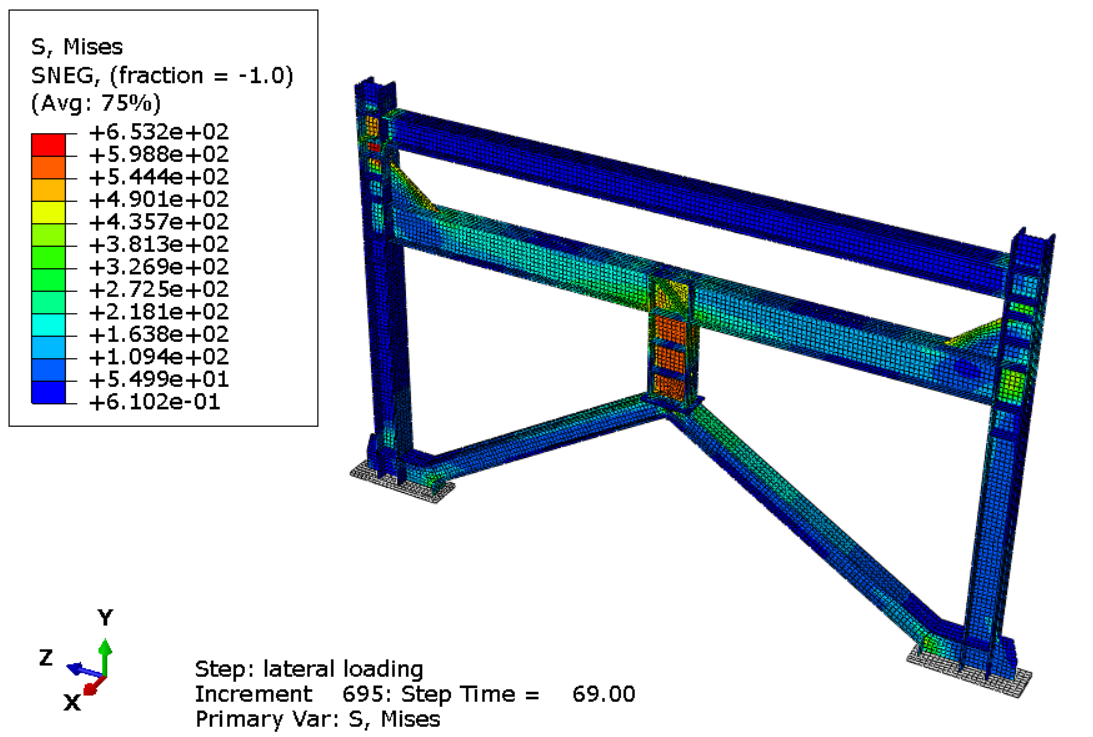
The vertical shear link enters the inelastic range during cyclic loading, and the main deformation of the frame is concentrated in the link.
Significant inelastic shear deformation develops in the link web, while the beam, columns, and braces remain mainly elastic or experience only limited plastic deformation.
The Abaqus results show that the web of the vertical shear link develops significant strain during cyclic loading, consistent with the shear-dominated behavior observed in the experimental specimen.
Comparison of Abaqus and Experimental Results
The force–displacement hysteresis diagram obtained from the Abaqus software is compared with the experimental results reported in the reference study.
The numerical model reproduces the main characteristics of the experimental cyclic response, including the formation of stable hysteresis loops and significant energy dissipation during cyclic loading.
The comparison also shows that the model maintains its load-carrying capacity during repeated loading cycles, with no significant degradation before the final damage develops.
Validation
This project has been validated, which means that the results obtained from the Abaqus software are similar to the results reported in the article.
In other words, this project is based on the reference article and the numerical model has been developed to reproduce the cyclic behavior reported in the study.
Key Features
- Eccentrically braced frame (EBF) modeling in Abaqus.
- Vertical shear link modeling.
- Beam, column, brace, gusset plate, stiffener, and load beam.
- Cyclic loading analysis.
- Hysteresis diagram obtained from Abaqus.
- Comparison between Abaqus and experimental hysteresis results.
- Investigation of EBF deformation under cyclic loading.
- Validation against the reference article.
- Complete Abaqus CAE file.
- Abaqus INP file.
- Excel amplitude loading file.
- Excel results file.
- Reference research paper.
- Step-by-step video tutorial.
What You Will Learn
- How to model an eccentrically braced frame (EBF) in Abaqus.
- How to model the beam and column.
- How to model the brace and vertical shear link.
- How to define the gusset plate and stiffener.
- How to define the load beam.
- How to define the material properties of the steel components.
- How to assemble the complete EBF model.
- How to define the required boundary conditions.
- How to apply cyclic loading to the model.
- How to define the cyclic loading amplitude.
- How to obtain the hysteresis diagram from the Abaqus results.
- How to compare the Abaqus hysteresis diagram with experimental results.
- How to investigate the deformation of the EBF under cyclic loading.
- How to validate the numerical model using the reference article.
Reference
This project is based on the reference research article. The paper is included with the project files and can be used to review the experimental model, loading protocol, and reported results.
Project Information
Important information about this project
Payment & Support
Need help with your purchase?
Secure Payment
Your payment is processed securely through our online payment system.
Need Help?
If you have any questions about this product, please contact us by email.
saeedofmoeini@gmail.com
There are no reviews yet.