
Project Overview
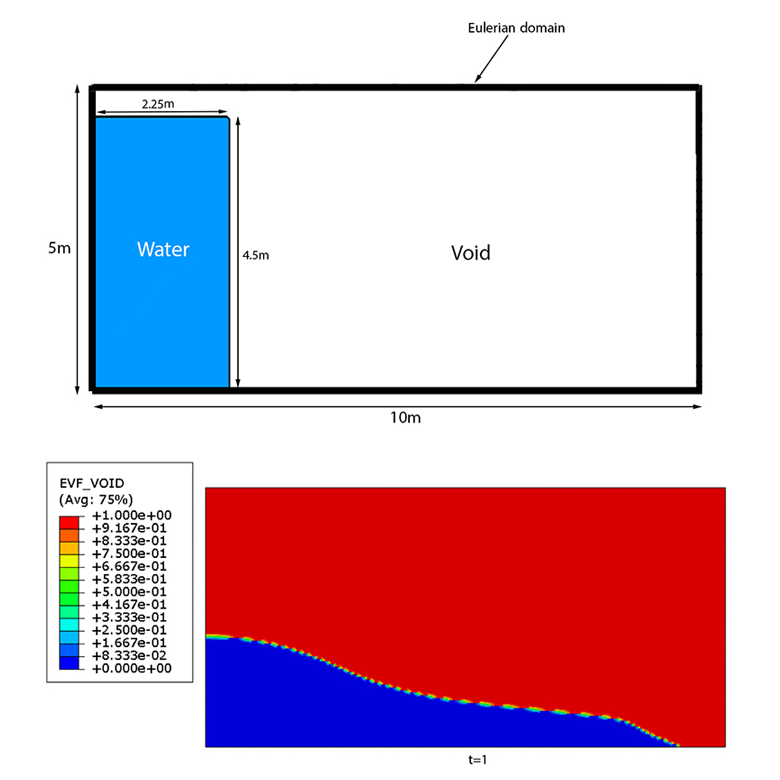
This tutorial focuses on the Eulerian analysis of a collapsing water column using the Abaqus software.
The objective of this simulation is to investigate the movement and deformation of a water column after it is released inside an Eulerian domain.
Problem Description
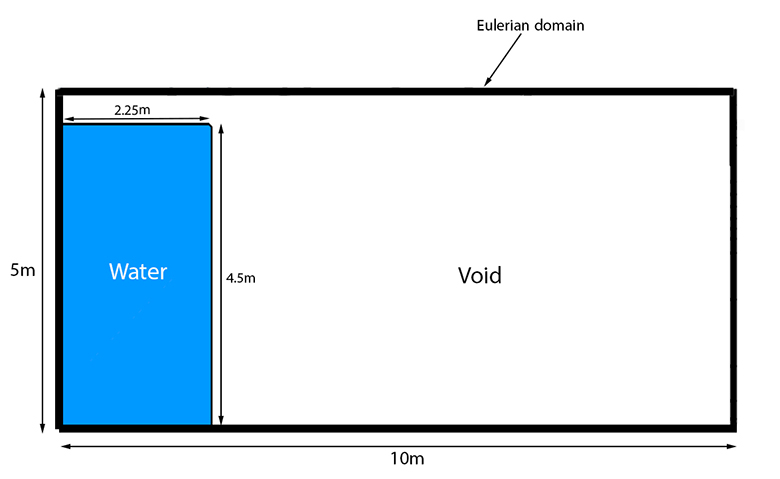
In this example, a rectangular Eulerian domain with dimensions of 10 m in length and 5 m in height is considered.
Initially, water occupies a rectangular region with a width of 2.25 m and a height of 4.5 m. The remaining part of the Eulerian domain is defined as Void.
Eulerian Modeling of Water
The water is modeled using the Eulerian method. This approach is particularly suitable for problems involving large deformation and significant movement of fluids.
After the initial configuration, the water column collapses and spreads through the available Eulerian domain.
Water Properties
The water is defined using the required physical properties for the Eulerian fluid simulation.
- Density: 1000 kg/m³
- Viscosity: 0.001 Pa·s
- Speed of sound: 1500 m/s
Collapse of the Water Column
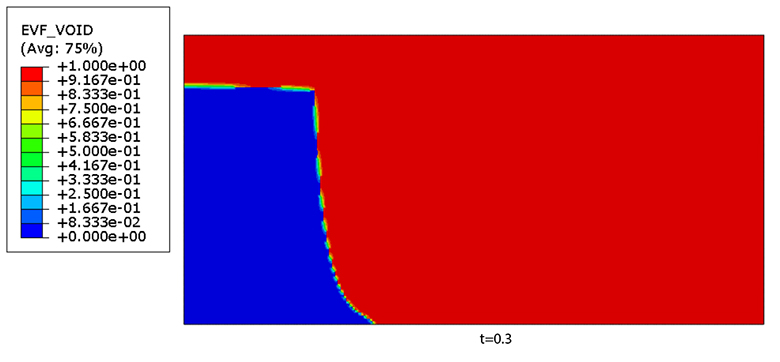
Once the water column is released, it begins to move under the effect of gravity. The water flows from the initial column toward the empty region of the Eulerian domain.
The simulation allows the complete evolution of the water column to be observed, including its collapse, spreading, and free-surface movement.
Water Movement and Free Surface
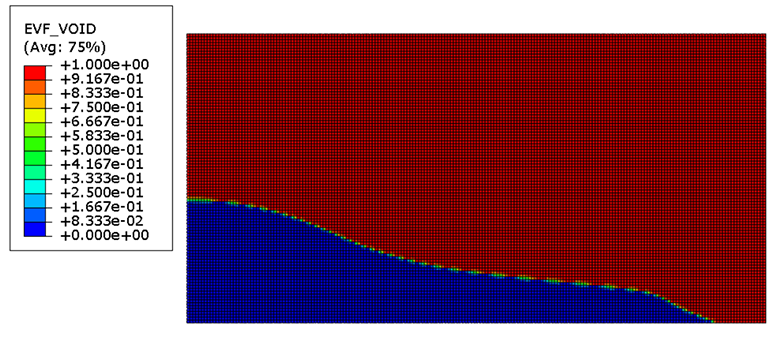
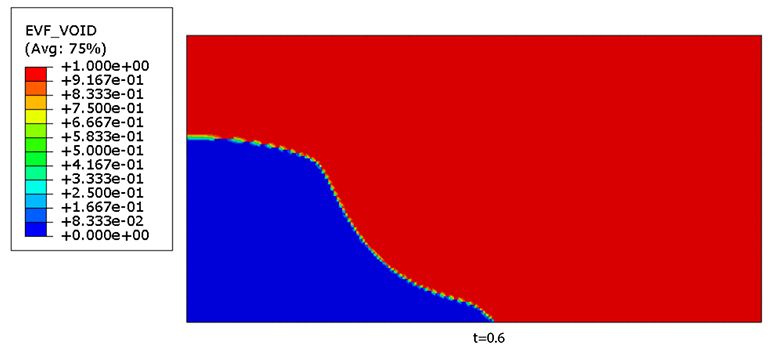
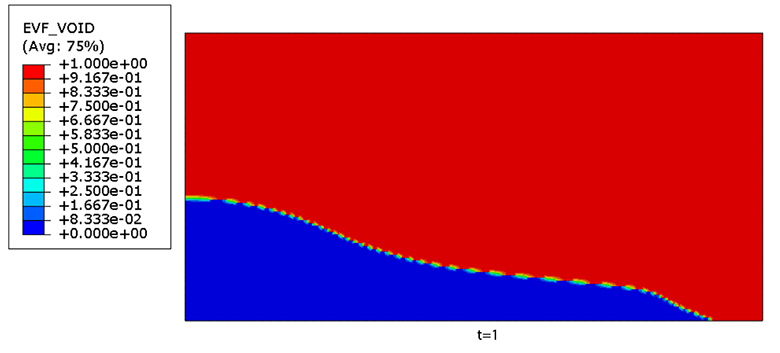
The movement of the water and the evolution of its free surface can be observed throughout the analysis. As the water moves into the initially empty region, its shape continuously changes.
The Eulerian formulation makes it possible to simulate these large fluid deformations without requiring the water mesh to follow the material deformation.
Simulation Results
The Abaqus results provide a clear visualization of the collapse of the water column and its subsequent movement through the Eulerian domain.
The simulation demonstrates how the water initially stored in the left portion of the domain flows toward the void region and progressively spreads throughout the domain.

What You Will Learn
- How to create an Eulerian domain for a fluid problem.
- How to define water inside an Eulerian domain.
- How to define an initial void region.
- How to simulate the collapse of a water column.
- How to apply gravity to the water.
- How to simulate large deformation and movement of water.
- How to observe the evolution of the water free surface.
- How to visualize the spreading of water inside the Eulerian domain.
Key Features
- Eulerian analysis of a collapsing water column.
- Eulerian domain of 10 m × 5 m.
- Initial water width of 2.25 m.
- Initial water height of 4.5 m.
- Void region inside the Eulerian domain.
- Gravity-driven water flow.
- Large deformation of the water.
- Free-surface movement.
- Visualization of water spreading.
- Abaqus Eulerian simulation.
- Free Abaqus tutorial.
Project Information
Important information about this project
Payment & Support
Need help with this tutorial?
Free Tutorial
This Abaqus tutorial is available free of charge.
Need Help?
If you have any questions about this tutorial, please contact us by email.
saeedofmoeini@gmail.com
There are no reviews yet.