
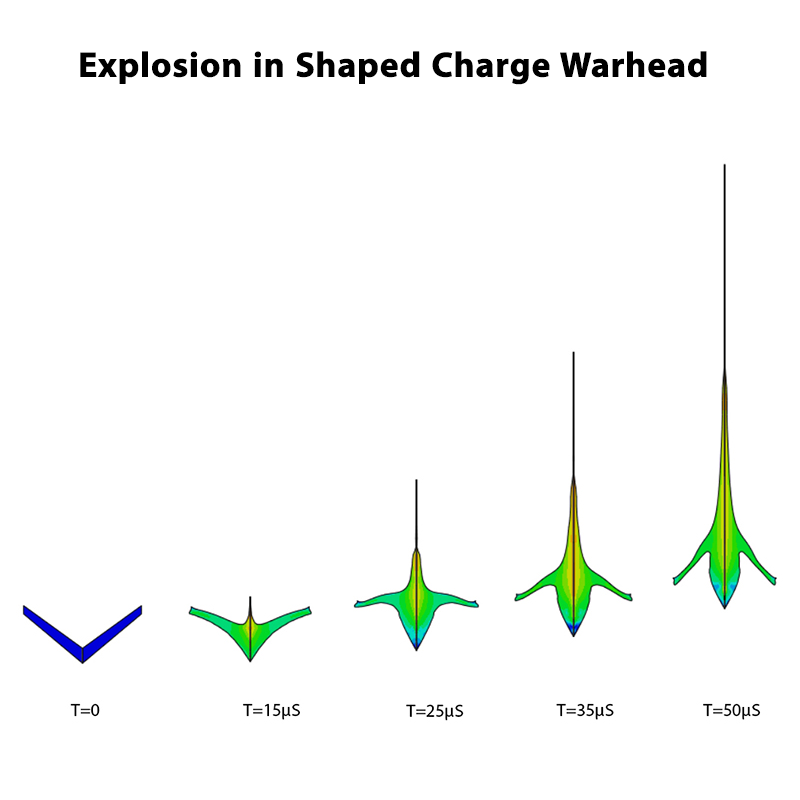
Project Overview
In this Abaqus project, the behavior of a shaped charge system during detonation is investigated using numerical simulation.
The warhead consists of an explosive material, a liner, and a detonator. The detonator is indicated in red in the model. The simulation demonstrates how the liner undergoes severe deformation during the detonation process and how its shape changes as the analysis progresses.
In this model, the explosive material is Composition B, which is a mixture of RDX and TNT.
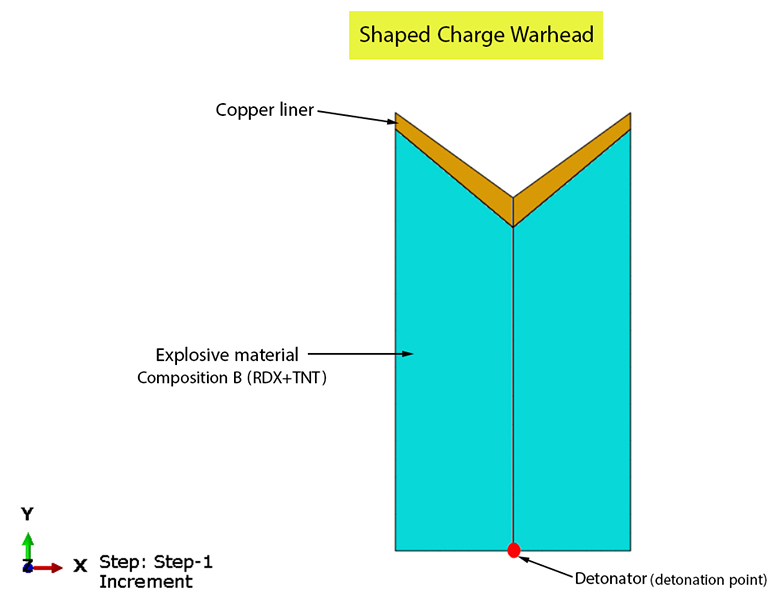
Shaped charge model used for the Abaqus simulation.
Shaped Charge Configuration
The liner is initially shaped as a hollow cone, with a cone tip angle of 100 degrees. In this model, the liner is made of copper. During the explosion, the liner undergoes severe deformation and is transformed into a long, slender metallic jet traveling at very high velocity. This process is the main physical phenomenon investigated in the simulation and demonstrates the significant deformation of the copper liner under extremely high-rate loading conditions.
The simulation is used to visualize the interaction between the detonation process and the deformation of the liner.
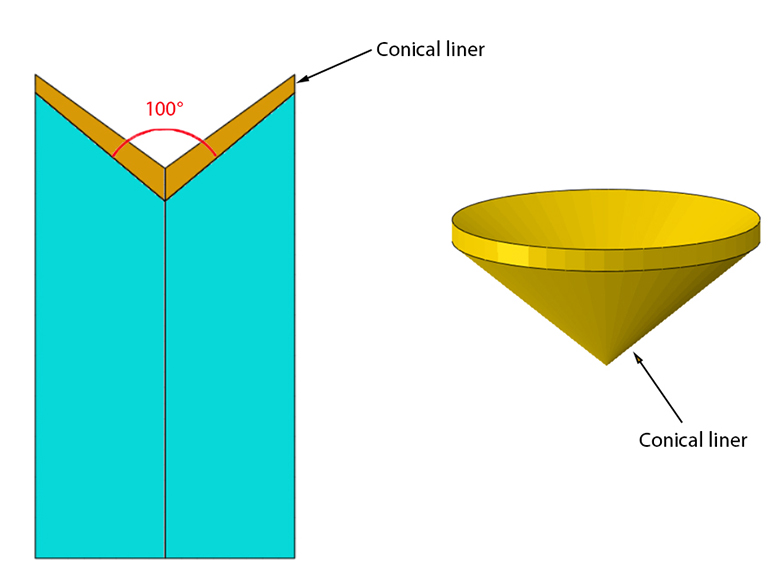
Initial configuration of the shaped charge and liner.
Detonation and Liner Deformation
During the analysis, the detonation process generates a rapidly changing pressure field that causes significant deformation of the liner.
The initially conical liner progressively changes its shape during the simulation. The deformation history can be observed throughout the Abaqus analysis.

Deformation of the liner during the detonation process.
Numerical Simulation Results
When the explosive detonates, a high-pressure wave acts on the rear surface of the liner, causing it to accelerate rapidly and deform forward. As observed in the simulation, the liner reaches a maximum velocity of approximately 5,000 m/s.
This very high velocity demonstrates the highly dynamic behavior of the liner during the detonation process and highlights the significant acceleration that occurs within a very short period of time.
Different stages of the simulation demonstrate the progressive deformation of the liner and the development of the final configuration.

Velocity of liner.
Effect of Liner Geometry
The final shape and velocity of the liner are strongly influenced by its initial geometry. In particular, changes in the cone tip angle can significantly affect the deformation behavior of the liner during the analysis, resulting in noticeable differences in its final shape and velocity.
The results provide an example of how changes in the initial geometry of a deformable component can affect its response under extremely dynamic loading conditions.
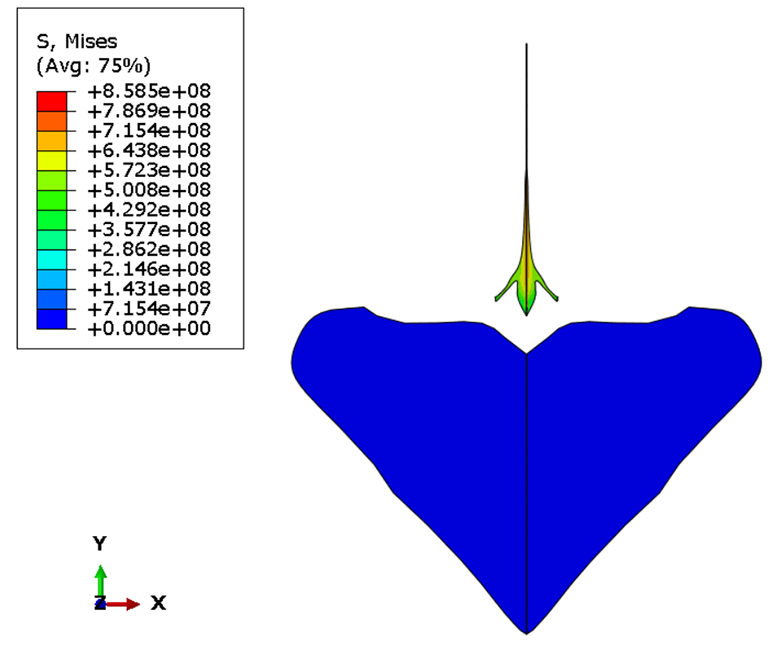
Deformation of the model.
What You Will Learn
- How to set up a highly dynamic Abaqus analysis.
- How to model a shaped charge configuration at a conceptual level.
- How to investigate severe deformation during detonation.
- How to monitor the deformation history of a metallic liner.
- How to visualize the evolution of a highly dynamic simulation.
- How to interpret numerical results from an explicit dynamic analysis.
Key Features
- Highly dynamic numerical simulation.
- Shaped charge configuration.
- Metallic liner deformation.
- Detonation process visualization.
- Severe deformation analysis.
- Abaqus CAE file.
- Abaqus INP file.
- Text file containing the model code.
- Step-by-step training video.
Project Information
Important information about this project
Payment & Support
Need help with your purchase?
Secure Payment
Your payment is processed securely through our online payment system.
Need Help?
If you have any questions about this product, please contact us by email.
saeedofmoeini@gmail.com
There are no reviews yet.