
Project Overview
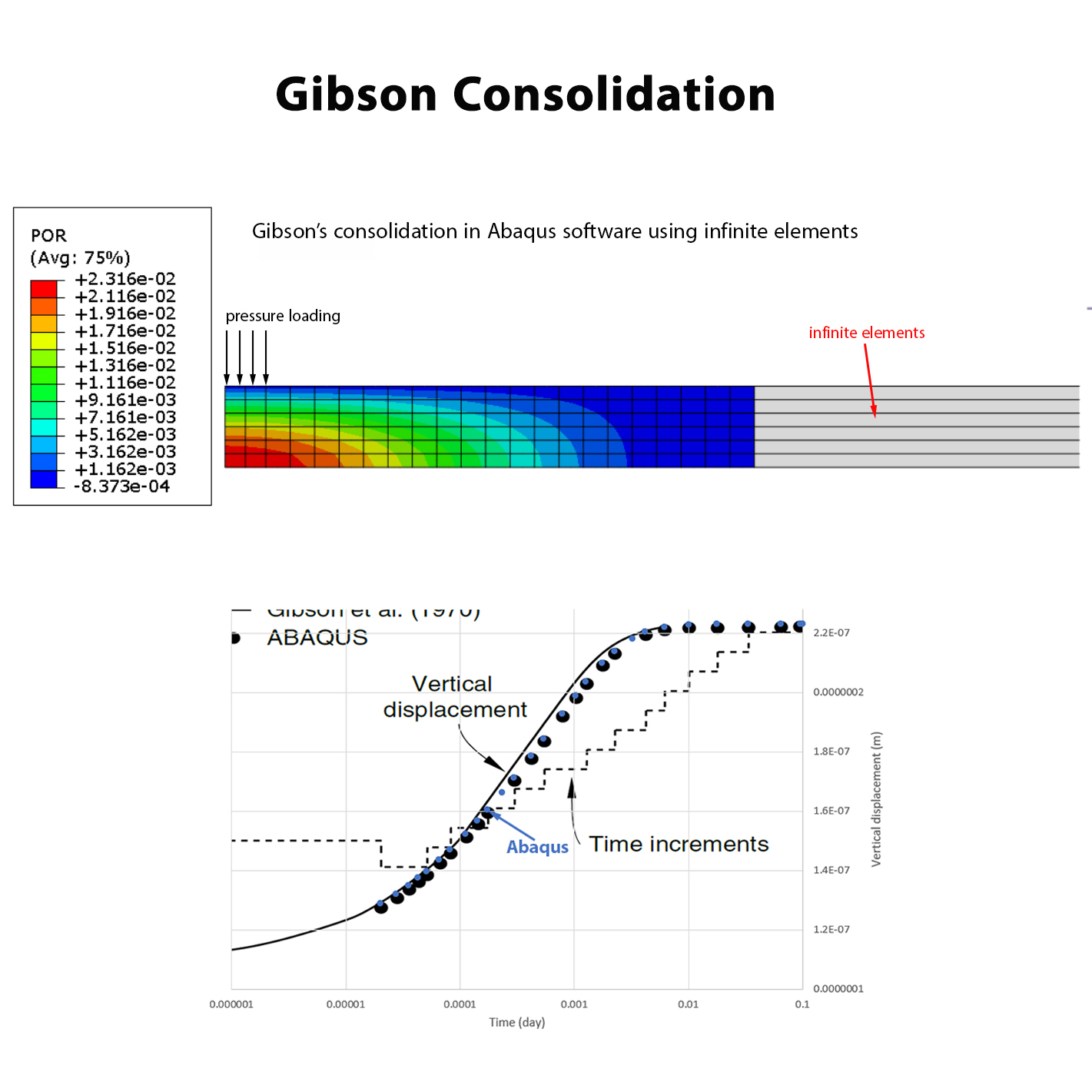
In this Abaqus tutorial, the Gibson consolidation problem is simulated using infinite elements.
The main objective is to compare the exact Gibson solution with the results obtained from the Abaqus software. The consolidation settlement of the soil is investigated throughout the analysis.
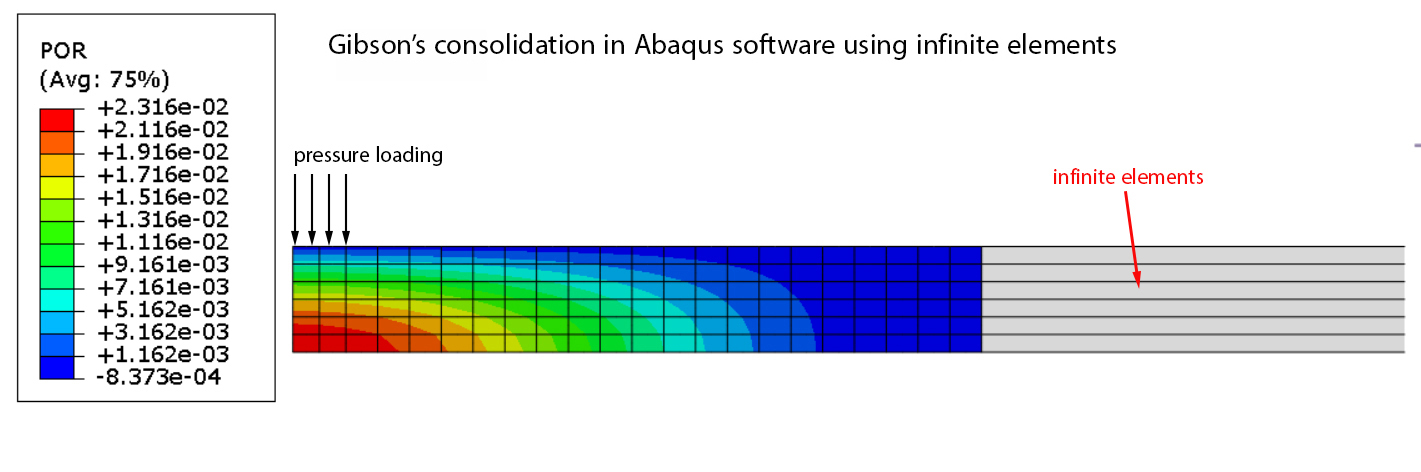
Gibson consolidation model simulated in Abaqus.
Gibson Consolidation
Gibson consolidation is a two-dimensional consolidation problem used to investigate the settlement behavior of soil under loading.
In this simulation, the vertical displacement of the soil is obtained during the consolidation process and is compared with the corresponding Gibson analytical solution.
Analysis Steps
The simulation is performed in two analysis steps.
In the first step, a pressure load is applied to the soil. This loading establishes the initial response of the soil before the consolidation stage.
In the second step, the consolidation process is simulated and the resulting vertical displacement of the soil is obtained.
Infinite Elements
Infinite elements are used in the model to represent the behavior of an unbounded domain.
They allow waves to propagate away from the main finite element region and help prevent unwanted wave reflections from returning into the model.
This approach allows the surrounding soil domain to be represented more realistically without requiring an excessively large finite element model.
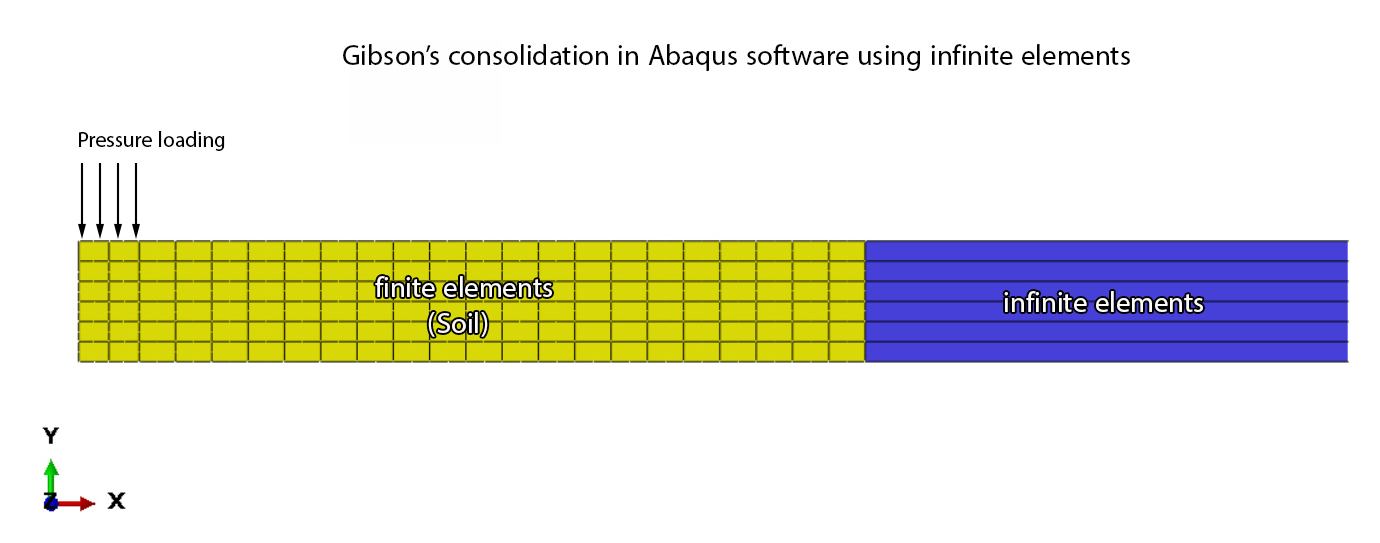
Infinite elements used to represent the unbounded soil domain.
Vertical Displacement from Gibson Solution
The exact Gibson solution is used to obtain the vertical displacement of the soil during the consolidation process.
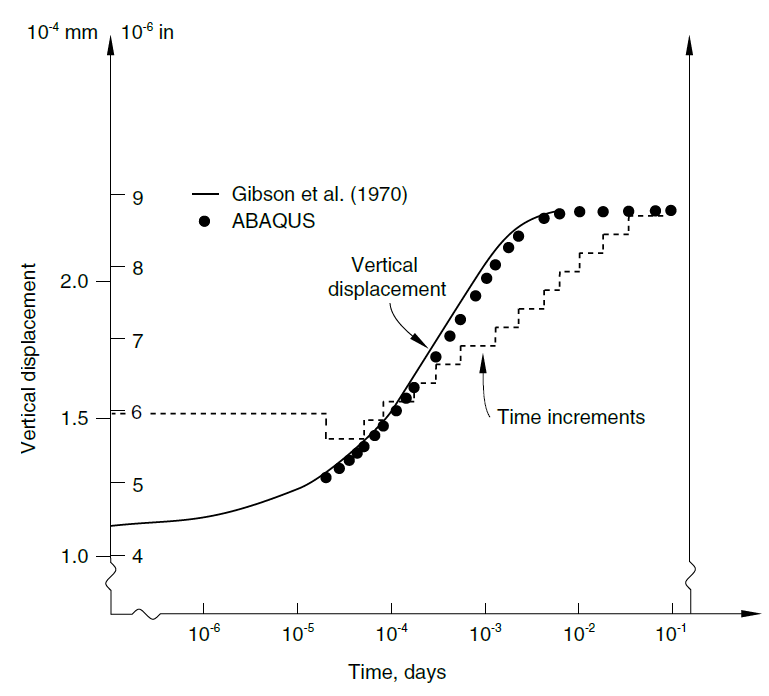
Vertical displacement obtained from the Gibson solution.
Vertical Displacement from Abaqus
The corresponding vertical displacement is obtained from the Abaqus analysis.
The Abaqus results are extracted throughout the consolidation process and used to generate the vertical displacement diagram.

Vertical displacement obtained from the Abaqus simulation.
Comparison of Gibson and Abaqus Results
Finally, the vertical displacement obtained from Abaqus is compared with the exact Gibson solution.
This comparison provides a useful verification of the numerical model and shows how accurately Abaqus can reproduce the consolidation behavior predicted by the analytical solution.
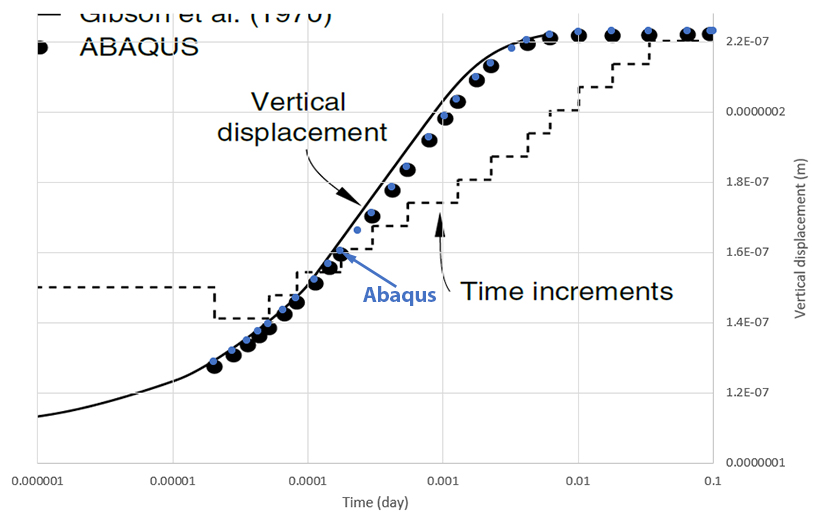
Comparison between the Gibson solution and Abaqus results.
What You Will Learn
- How to simulate the Gibson consolidation problem in Abaqus.
- How to model a two-dimensional consolidation problem.
- How to apply pressure loading to the soil.
- How to define the consolidation analysis step.
- How to use infinite elements in Abaqus.
- How infinite elements can represent an unbounded domain.
- How to obtain vertical displacement from Abaqus.
- How to draw the consolidation settlement diagram.
- How to compare Abaqus results with the exact Gibson solution.
- How to verify a numerical consolidation model using an analytical solution.
Key Features
- Gibson consolidation problem.
- Two-dimensional consolidation analysis.
- Infinite elements.
- Two analysis steps.
- Pressure loading.
- Consolidation process.
- Vertical displacement calculation.
- Consolidation settlement diagram.
- Exact Gibson solution.
- Comparison between analytical and Abaqus results.
- CAE file.
- INP file.
- Excel file containing the results and vertical displacement diagram.
- Step-by-step video tutorial.
Project Information
Important information about this project
Payment & Support
Need help with your purchase?
Secure Payment
Your payment is processed securely through our online payment system.
Need Help?
If you have any questions about this product, please contact us by email.
saeedofmoeini@gmail.com
There are no reviews yet.