

Product Overview
Two beam-to-column moment connection models are investigated in this project. The first model represents a conventional moment connection without a Reduced Beam Section (WRBS), while the second model incorporates a Reduced Beam Section (RBS) in the beam.
The connection models represent an exterior beam-to-column connection. In the RBS model, a portion of the beam flange is reduced near the beam-to-column connection to control the location of inelastic deformation.
Both models are developed in Abaqus and subjected to displacement-controlled cyclic loading. The models are used to investigate the deformation, stress distribution, and hysteretic response of the connections.

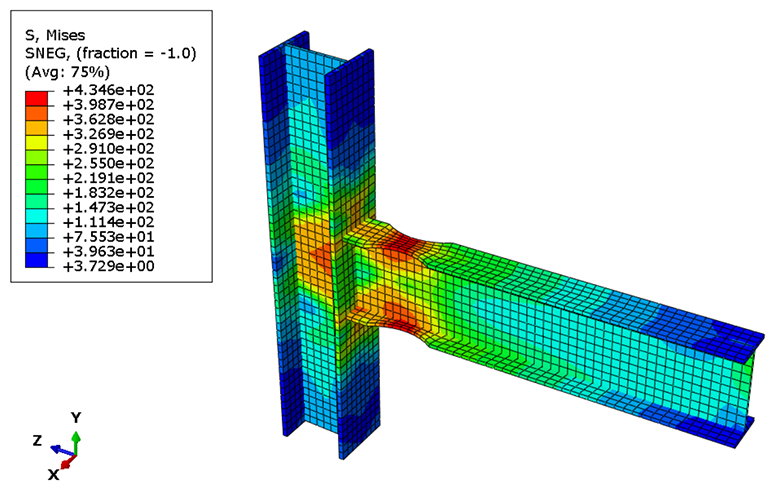
Moment Connection Without RBS
In the first model, the beam is connected directly to the column without using a Reduced Beam Section. The connection is subjected to cyclic loading and its hysteresis response (force-displacement) is obtained from the Abaqus results.

Moment Connection With RBS
In the second model, a Reduced Beam Section (RBS) is introduced into the beam. The connection is then subjected to the same type of cyclic loading and its hysteresis response (force-displacement) is obtained.

Cyclic Loading
Both connection models are subjected to cyclic loading to investigate their nonlinear behavior.
The loading history is defined using the Amplitude option in Abaqus. The force and displacement response of each model are recorded throughout the loading cycles.
Hysteresis Analysis
The Abaqus results are processed to obtain the hysteresis diagrams of both the conventional moment connection and the RBS connection.
The two hysteresis responses are then compared to evaluate the effect of the Reduced Beam Section on the cyclic behavior of the connection.

Plastic Hinge Location
The plastic hinge location is investigated for both moment connection models based on the Abaqus results obtained under cyclic loading.
In the connection without RBS (WRBS), plastic deformation develops in the region close to the beam-column connection, with significant inelastic behavior occurring in the panel zone and beam flange regions.
In the RBS connection, the reduction of the beam section creates a weaker region away from the column face. As the cyclic loading increases, plastic deformation becomes concentrated in this Reduced Beam Section (RBS), resulting in the formation of the plastic hinge within the reduced region.

Validation
The hysteresis diagrams obtained from the Abaqus simulations are compared with the results reported in the reference research paper.
The comparison demonstrates that the Abaqus results are in good agreement with the published results, providing validation for the numerical models.
Key Features
- Moment connection modeling in Abaqus.
- Comparison of connections with and without RBS.
- Reduced Beam Section (RBS) modeling.
- Nonlinear cyclic analysis.
- Hysteresis analysis.
- Investigation of plastic hinge location.
- Comparison with published results.
- Validated Abaqus model.
- Complete Abaqus CAE and INP files.
- Excel files for amplitude loading and results.
- Reference research paper.
- Step-by-step video tutorial.
What You Will Learn
- How to model a beam-to-column moment connection in Abaqus.
- How to model a Reduced Beam Section (RBS) connection.
- How to define the geometry and material properties of the models.
- How to define interactions between the structural components.
- How to define appropriate boundary conditions.
- How to apply cyclic loading in Abaqus.
- How to define cyclic loading using the Amplitude option.
- How to perform nonlinear analysis under cyclic loading.
- How to obtain the hysteresis diagram of the connection.
- How to compare the hysteresis responses of connections with and without RBS.
- How to investigate the location of the plastic hinge.
- How to compare Abaqus results with the results reported in the research paper.
- How to validate an Abaqus model using experimental or published results.
Reference
This project has been validated based on the reference research paper. The article is included with the project files and can be used to review the connection configuration, loading procedure, and published hysteresis results.

Project Information
Important information about this project
Payment & Support
Need help with your purchase?
Secure Payment
Your payment is processed securely through our online payment system.
Need Help?
If you have any questions about this product, please contact us by email.
saeedofmoeini@gmail.com
There are no reviews yet.