Price 12

Product Overview

In this project, a steel plate shear wall is modeled in Abaqus and its hysteretic behavior under cyclic loading is investigated.

The numerical model is developed based on an experimental study reported in the reference article. The Abaqus results are compared with the experimental results to evaluate the accuracy of the numerical model and its ability to reproduce the structural response observed in the experiment.

Model Description

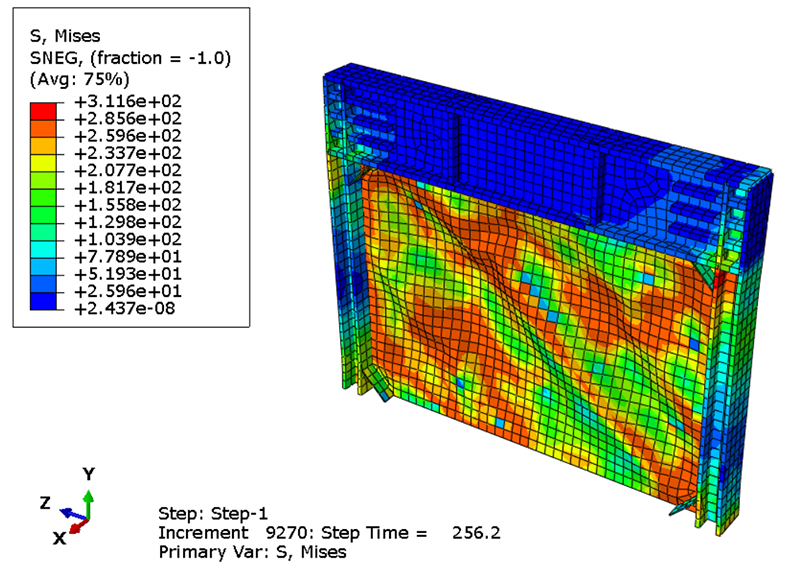
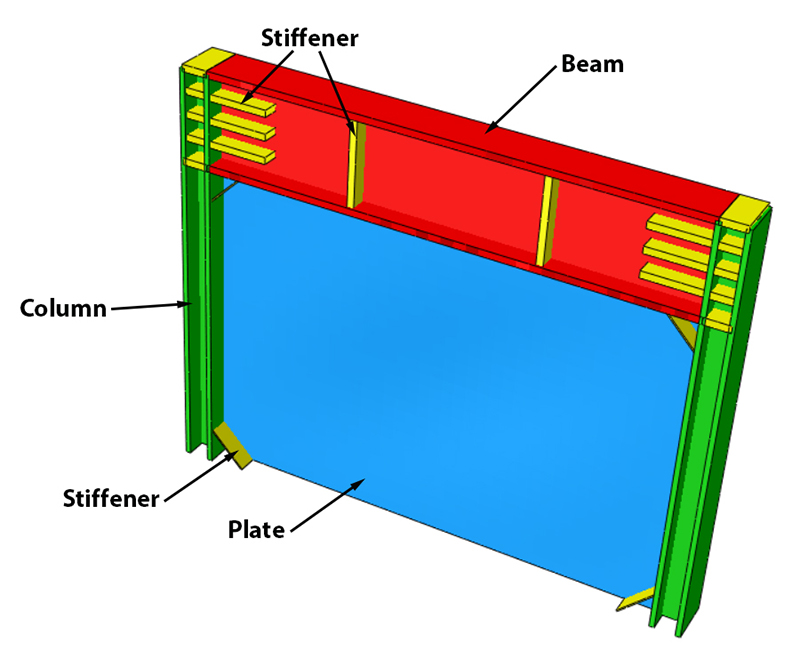
The model represents a steel plate shear wall consisting of two columns, one steel plate, one beam, and several stiffeners.

The main structural components are modeled according to the configuration used in the reference experimental study.

The geometry, material properties, interactions, boundary conditions, and analysis settings are defined in Abaqus to reproduce the behavior of the experimental specimen.

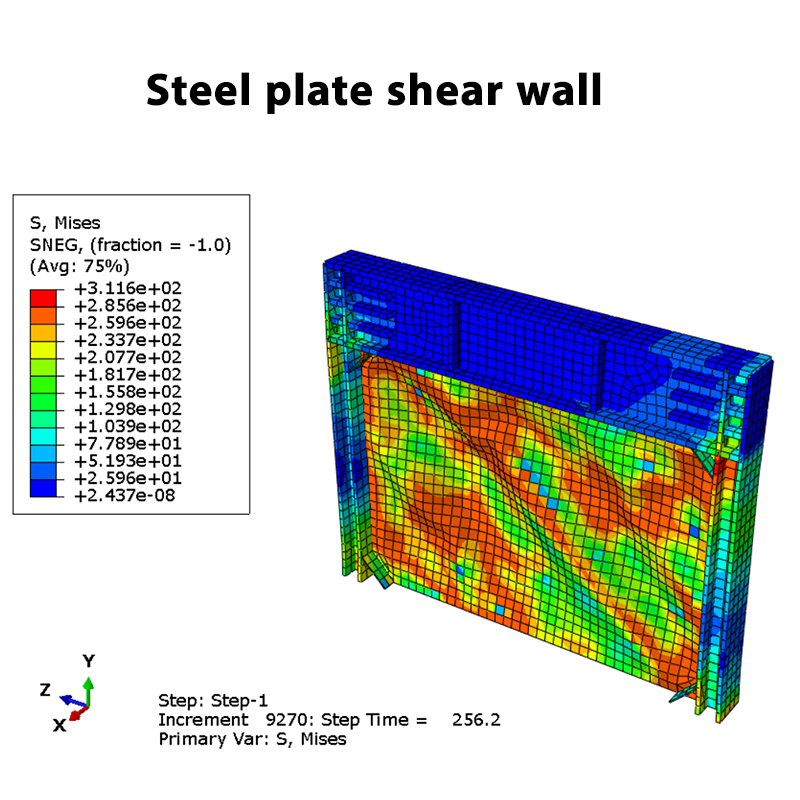
Steel plate shear wall model in Abaqus
Steel plate shear wall modeled in Abaqus.

Buckling Analysis and Initial Imperfection

The analysis consists of two main parts: buckling analysis and hysteresis analysis.

First, a buckling analysis is performed to determine the buckling modes of the steel plate shear wall.

The obtained buckling modes are then used to define an initial geometric imperfection in the model. This approach helps the numerical model better represent the initial imperfections of the experimental specimen.

Cyclic Loading

A cyclic loading is applied to the top part of the shear wall according to the loading protocol used in the experimental study.

The loading history is defined using the Amplitude option in Abaqus. The structure is then subjected to repeated loading and unloading cycles.

The resulting force–displacement response is used to obtain the hysteresis diagram of the steel plate shear wall.

Cyclic loading of steel plate shear wall in Abaqus
Cyclic loading applied to the steel plate shear wall.

Results and Hysteresis Response

The Abaqus results are extracted and processed to evaluate the structural response of the model under cyclic loading.

The force–displacement hysteresis diagram obtained from the Abaqus analysis is compared with the experimental results reported in the reference article.

The comparison demonstrates how accurately the numerical model reproduces the hysteretic behavior of the experimental specimen.

Hysteresis diagram of steel plate shear wall
Comparison between the Abaqus and experimental hysteresis responses.

Experimental Validation

The numerical results obtained from Abaqus are compared with the experimental results reported in the reference research article.

The comparison focuses on the hysteresis response and overall structural behavior of the steel plate shear wall under cyclic loading.

The Abaqus results show close agreement with the experimental results, demonstrating that the developed numerical model can accurately reproduce the behavior reported in the article.

Key Features

  • Steel plate shear wall modeled in Abaqus.
  • Two columns, one beam, steel plate, and stiffeners.
  • Buckling analysis and extraction of buckling modes.
  • Initial geometric imperfection based on buckling modes.
  • Nonlinear cyclic analysis.
  • Force–displacement hysteresis response.
  • Comparison with experimental results.
  • Complete Abaqus model files.
  • Excel file for amplitude loading.
  • Excel file containing numerical results.
  • Reference research paper.
  • Step-by-step video tutorial.

What You Will Learn

  • How to model a steel plate shear wall in Abaqus.
  • How to define the geometry of the columns, beam, steel plate, and stiffeners.
  • How to define the required material properties.
  • How to define interactions and boundary conditions.
  • How to perform a buckling analysis.
  • How to extract buckling modes from Abaqus.
  • How to define an initial geometric imperfection using buckling modes.
  • How to define cyclic loading using the Amplitude option in Abaqus.
  • How to perform nonlinear analysis under cyclic loading.
  • How to obtain a force–displacement hysteresis diagram.
  • How to extract and process Abaqus results using Excel.
  • How to compare numerical and experimental results.

Reference

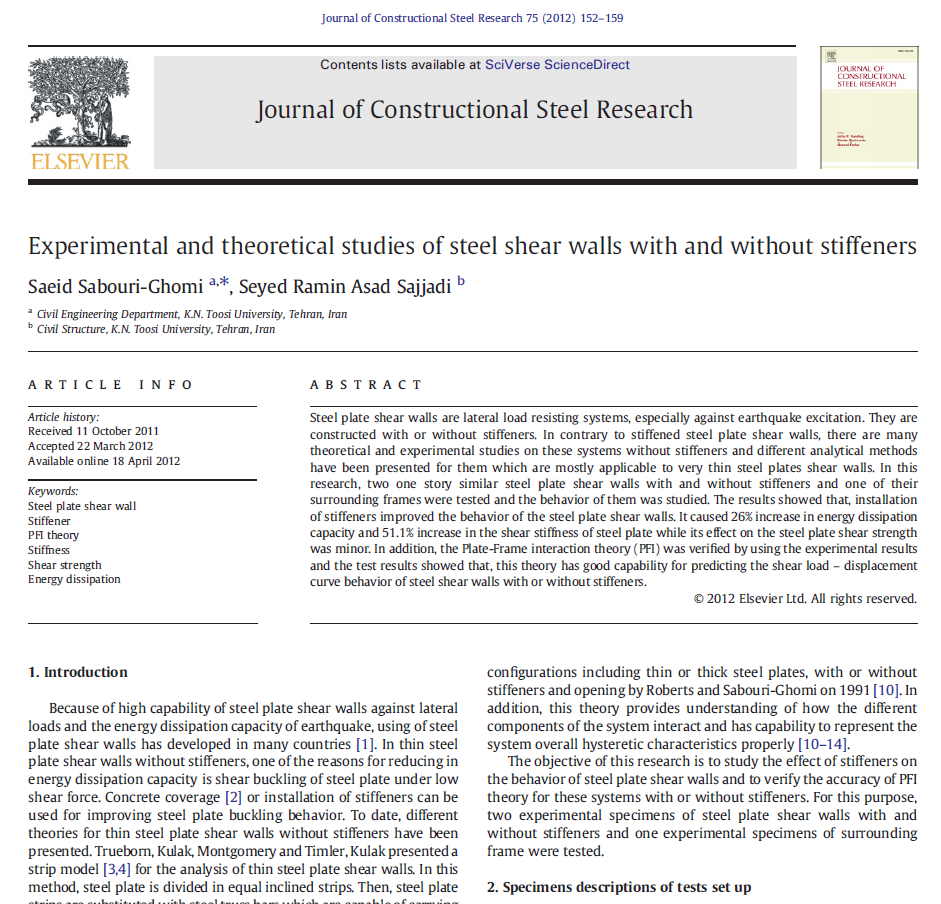
This project is based on the experimental study titled “Experimental and Theoretical Studies of Steel Shear Walls with and without Stiffeners.”

The reference paper is included with the project files and can be used to review the experimental configuration, loading protocol, and reported results.

Reference research paper
Reference research paper.
Files Included
What you will receive after purchase
File Type
Content
Description
🧩 Abaqus
CAE File
Complete Abaqus model
📄 Abaqus
INP File
Abaqus input file
📊 Excel
Amplitude Loading Data
Data used to define the cyclic loading
📊 Excel
Numerical Results
Results extracted from the Abaqus analysis
📑 Document
Research Paper
Reference paper used for the project
🎥 Video
Video Tutorial
Step-by-step explanation of the project

Project Information

Important information about this project

🎥
Video Duration 55 Minutes
📦
Total File Size 420 MB
🔧
Abaqus Version Abaqus 2017
🌐
Language English
📥
File Delivery Instant Download

Payment & Support

Need help with your purchase?

💳

Secure Payment

Your payment is processed securely through our online payment system.

✉️

Need Help?

If you have any questions about this product, please contact us by email.

saeedofmoeini@gmail.com

chat_bubble_outlineReviews

  • nefya

    Hysteresis analysis of the steel plate shear wall in the Abaqus software I want to buy this video

    • Admin

      Hello
      You can purchase this product from this page using a credit card.

Add a review

Your email address will not be published. Required fields are marked *