Price Free!

Product Overview

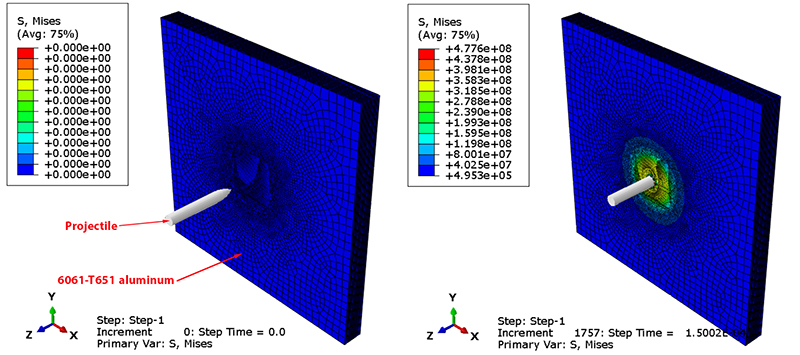
In this example, we intend to simulate the impact of a projectile on an aluminum plate in the Abaqus software.

The projectile impacts the aluminum target with a high velocity and penetrates into the plate. The deformation, damage, and penetration behavior of the aluminum plate are investigated for different projectile striking velocities.

Projectile impact and penetration into aluminum plate in Abaqus
Projectile impact and penetration into the aluminum plate modeled in Abaqus.

Aluminum 6061-T651

The target plate is made of Aluminum 6061-T651. The required material properties are defined in Abaqus to simulate the mechanical response of the aluminum during high-velocity impact and penetration.

Johnson-Cook Damage Model

The Johnson-Cook damage model is used to simulate the damage and failure behavior of the aluminum plate during the high-velocity impact.

The Johnson-Cook model is particularly suitable for materials subjected to large plastic deformation, high strain rates, and elevated temperatures, which makes it appropriate for projectile impact and penetration problems.

In this simulation, the Johnson-Cook damage formulation is used to describe the initiation and evolution of material damage as the projectile penetrates the aluminum plate. The damage model accounts for the effects of equivalent plastic strain, strain rate, stress triaxiality, and temperature on the failure behavior of the material.

Using the Johnson-Cook damage model allows the numerical model to represent the progressive degradation of the aluminum material and its failure during the impact event.

Projectile Impact and Penetration

The projectile strikes the aluminum plate at high velocity and penetrates into the target.

The simulation is performed for different striking velocities in order to investigate the effect of impact velocity on the penetration behavior and the resulting residual velocity of the projectile.

Effect of Temperature

The effect of the temperature parameter on the deformation and damage behavior of the aluminum plate is considered in the simulation.

The temperature-dependent behavior is particularly important in high-velocity impact problems because significant plastic deformation and high strain rates can produce considerable temperature changes in the target material.

Different Projectile Striking Velocities

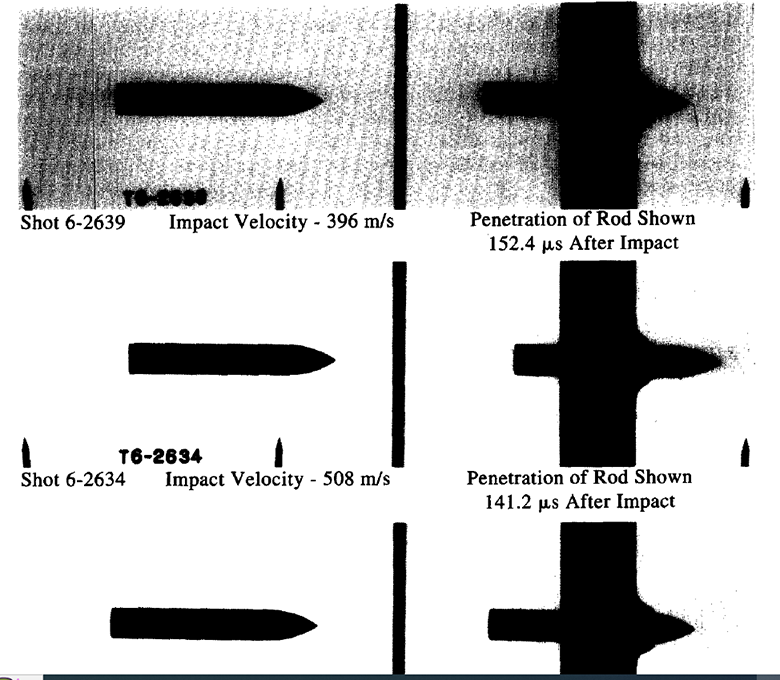
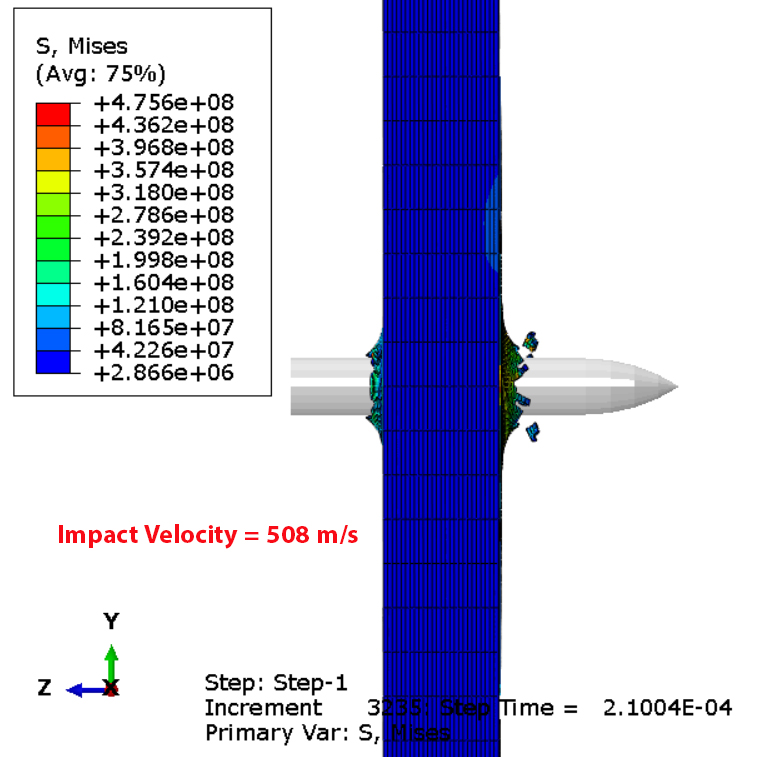
The impact problem is solved for different projectile striking velocities. Four different cases are investigated with striking velocities of 396 m/s, 508 m/s, 730 m/s, and 863 m/s.

The deformation, damage, and penetration behavior of the aluminum plate are obtained for each impact velocity.

Projectile impact at 396 m/s in Abaqus
Projectile impact with a striking velocity of 396 m/s.
Projectile impact at 508 m/s in Abaqus
Projectile impact with a striking velocity of 508 m/s.
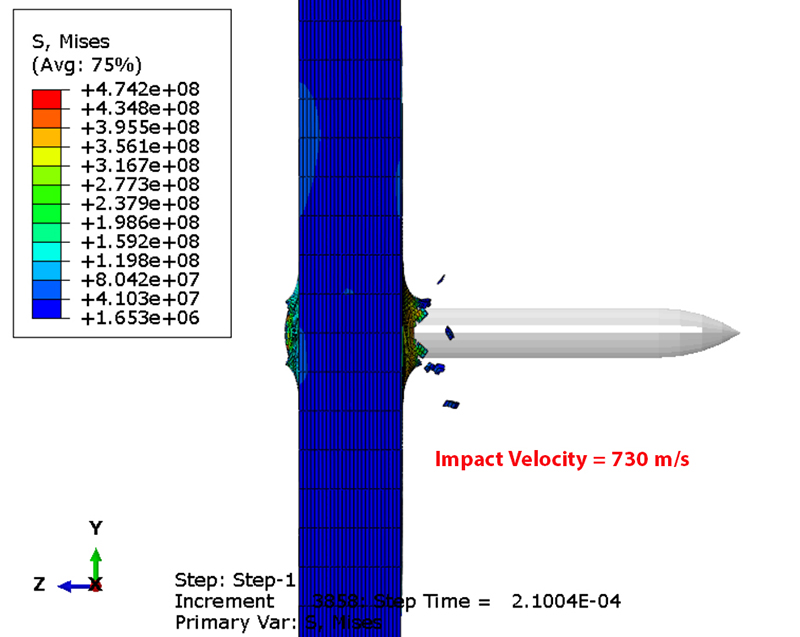
Projectile impact at 730 m/s in Abaqus
Projectile impact with a striking velocity of 730 m/s.
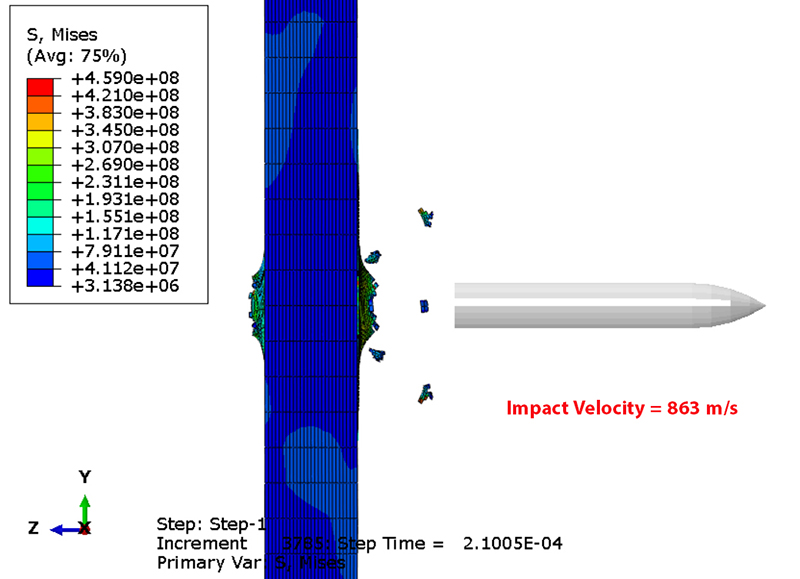
Projectile impact at 863 m/s in Abaqus
Projectile impact with a striking velocity of 863 m/s.

Damage and Failure of the Aluminum Plate

The damage evolution of the aluminum plate is investigated during projectile penetration. The Johnson-Cook damage formulation allows the failure behavior of the material to be represented under the severe loading conditions generated by the impact.

Residual Velocity

The residual velocity of the projectile is calculated after it penetrates through the aluminum plate.

The residual velocity is evaluated for different striking velocities to investigate the relationship between the initial impact velocity and the velocity of the projectile after penetration.

Residual Velocity versus Striking Velocity

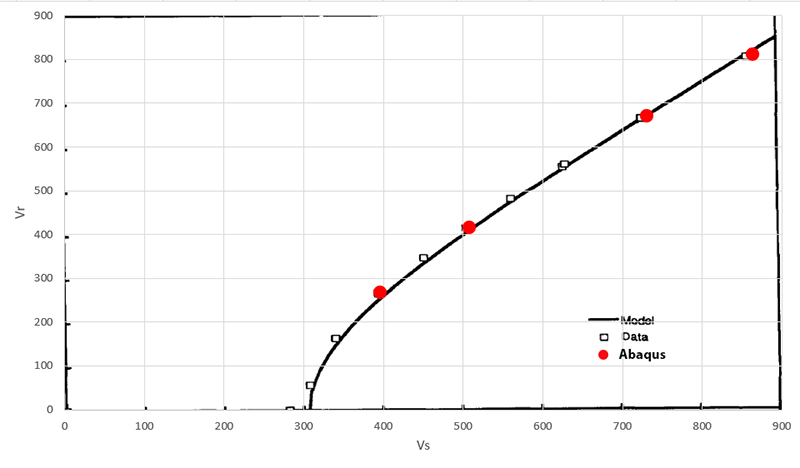
A diagram of the residual velocity (Vr) versus the striking velocity (Vs) of the projectile is plotted based on the results obtained from the simulations.

This diagram provides a comparison between the projectile's initial striking velocity and its residual velocity after penetration into the aluminum plate.

Residual velocity versus striking velocity diagram for projectile impact
Residual velocity (Vr) versus striking velocity (Vs).

Reference

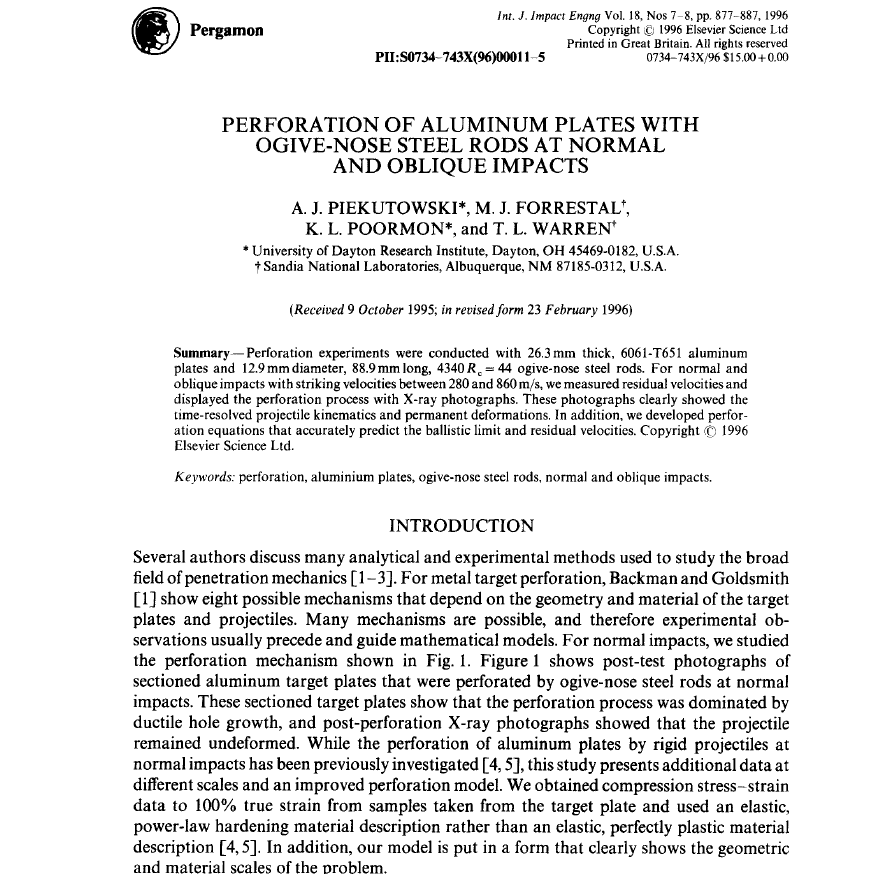
This project is based on a research article. The reference article is included with the project and can be used to review the impact problem and the results used for validation.

Research article used for validation of projectile impact simulation
Reference research article used for the numerical study and validation.
Research article used for validation of projectile impact simulation
Reference research article used for the numerical study and validation.

What You Will Learn

  • How to simulate projectile impact on an aluminum plate in Abaqus.
  • How to model high-velocity projectile penetration.
  • How to model Aluminum 6061-T651.
  • How to define the Johnson-Cook damage model in Abaqus.
  • How to simulate material damage and failure during impact.
  • How to investigate the effect of temperature on plate deformation.
  • How to perform simulations for different projectile velocities.
  • How to analyze projectile penetration into an aluminum plate.
  • How to calculate the residual velocity of a projectile.
  • How to plot residual velocity versus striking velocity.
  • How to compare Abaqus results with published research results.
  • How to validate an impact simulation using a research article.

Key Features

  • High-velocity projectile impact simulation in Abaqus.
  • Projectile penetration into an aluminum plate.
  • Aluminum 6061-T651 material.
  • Johnson-Cook damage model.
  • Damage and failure simulation.
  • Investigation of temperature effects.
  • Four projectile striking velocities.
  • 396 m/s impact case.
  • 508 m/s impact case.
  • 730 m/s impact case.
  • 863 m/s impact case.
  • Residual velocity calculation.
  • Residual velocity versus striking velocity diagram.
  • Comparison with research article results.
  • Validation of the Abaqus model.
  • Complete Abaqus model files.
  • Step-by-step video tutorial.
Files Included
What you will receive after purchase
File Type
Content
Description
🧩 Abaqus
CAE File
Complete Abaqus model
📄 Abaqus
INP File
Abaqus input file
📊 Excel
Results
Simulation results and residual velocity data
📑 Document
Research Paper
Reference article used for validation
🎥 Video
Full Video
Step-by-step explanation of the project

Project Information

Important information about this project

🎥
Video Tutorial Available
📦
Project Type Free Tutorial
💻
Abaqus Version Abaqus 2017
🌐
Language English
📥
Access Free

Payment & Support

Need help with this tutorial?

🎓

Free Tutorial

This Abaqus tutorial is available free of charge.

✉️

Need Help?

If you have any questions about this tutorial, please contact us by email.

saeedofmoeini@gmail.com

chat_bubble_outlineReviews

Add a review

Your email address will not be published. Required fields are marked *