
Project Overview
In this Abaqus tutorial, the interaction between soil and a foundation is investigated using the Abaqus software.
The main objective of this simulation is to study the behavior of the foundation under vertical loading and investigate the resulting vertical displacement and settlement.
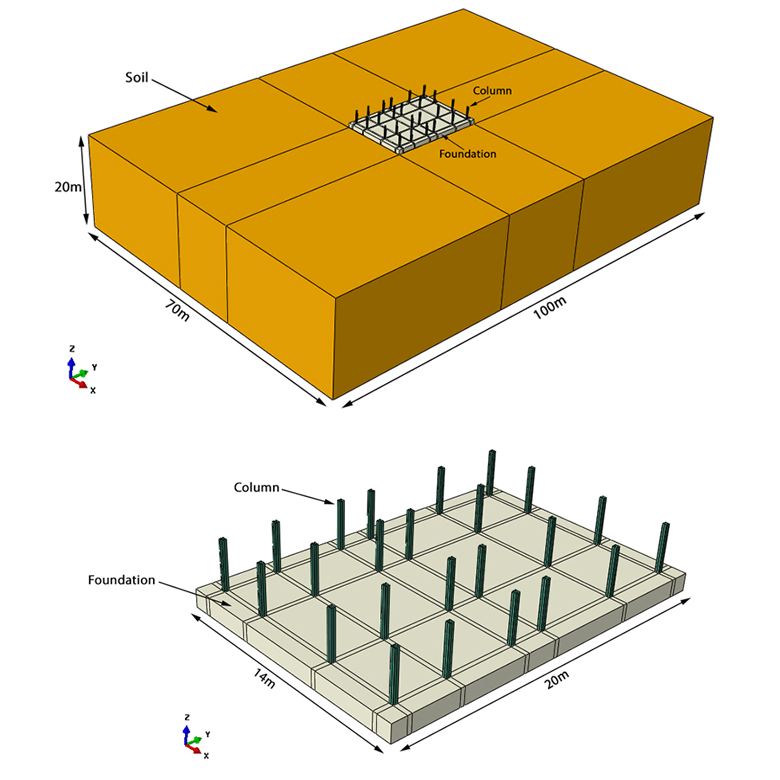
The model consists of soil, a concrete foundation, and steel columns. The columns are arranged in a one-story frame and are used to apply the loading to the foundation.
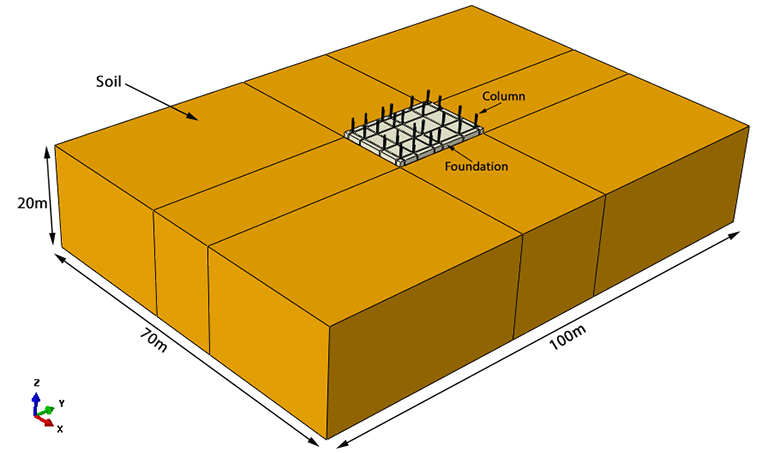
Soil, foundation, and one-story frame modeled in Abaqus.
Soil Model
The soil domain has a length of 100 m, a width of 70 m, and a height of 20 m.
The Mohr-Coulomb plasticity model is used to define the mechanical behavior and plasticity of the soil.
Concrete Foundation
The foundation is modeled using concrete and has a length of 20 m and a width of 14 m.
The foundation is placed on the soil surface, and the interaction between the soil and foundation is defined using a coefficient of friction.
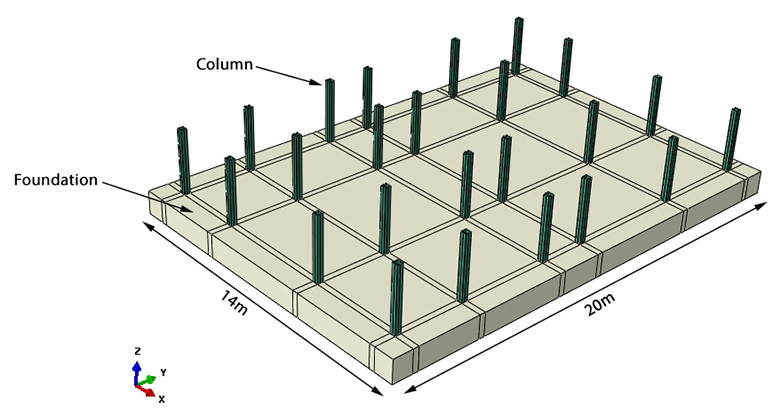
Concrete foundation placed on the soil domain.
Steel Columns and One-Story Frame
The model includes 24 steel columns arranged in a one-story frame.
The columns are connected to the foundation using a tie constraint, allowing the applied loads to be transferred from the columns to the foundation.
The arrangement of the columns on the foundation is defined according to the plan of the one-story frame.
Soil–Foundation Interaction
In Soil-Structure Interaction (SSI), the interaction between the soil and foundation is defined using a coefficient of friction.
This interaction allows relative movement between the soil and the foundation while accounting for the frictional behavior at their interface.
The interaction between the foundation and columns is defined using a tie constraint.
Loading Process
The steel columns of the one-story frame are used to apply the loading to the foundation.
In other words, the applied loads are first introduced through the columns and are then transferred from the columns to the concrete foundation and finally to the surrounding soil.
Vertical Displacement and Settlement
The vertical displacement of the foundation is obtained from the Abaqus analysis to evaluate the settlement caused by the applied loading.
The deformation of the foundation and the surrounding soil can be visualized using the displacement contours in Abaqus.
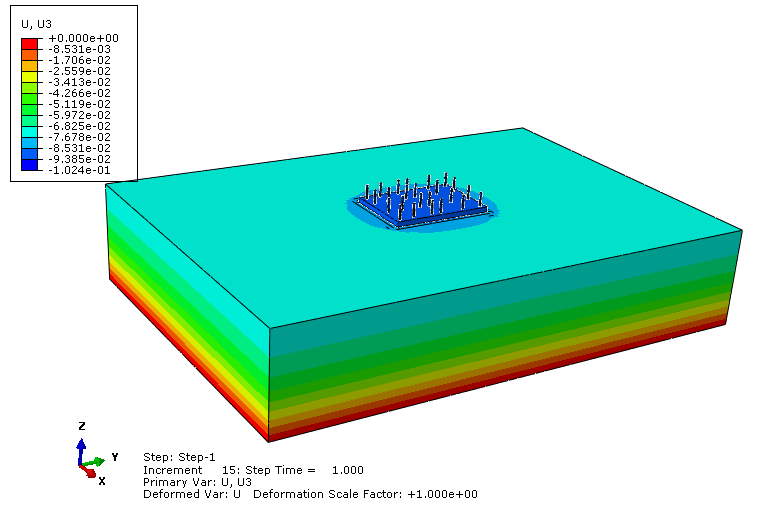
Vertical displacement and settlement of the foundation.
Foundation Settlement
The settlement behavior of the foundation is investigated by evaluating the vertical displacement resulting from the applied loading.
The displacement results provide useful information about the interaction between the foundation and the supporting soil.

Foundation settlement obtained from the Abaqus simulation.
What You Will Learn
- How to model soil–structure interaction in Abaqus.
- How to create a large soil domain for foundation analysis.
- How to define Mohr-Coulomb plasticity for soil.
- How to model a concrete foundation.
- How to model steel columns and a one-story frame.
- How to define soil–foundation frictional interaction.
- How to define a tie constraint between the foundation and columns.
- How to apply loads through the columns.
- How to transfer the applied loads from the columns to the foundation.
- How to investigate foundation settlement.
- How to obtain vertical displacement from Abaqus.
- How to visualize foundation deformation and settlement.
Key Features
- Soil–foundation interaction.
- Soil–Structure Interaction (SSI).
- Mohr-Coulomb soil plasticity.
- Soil domain: 100 m × 70 m × 20 m.
- Concrete foundation.
- Foundation dimensions: 20 m × 14 m.
- 24 steel columns.
- One-story steel frame.
- Frictional interaction between soil and foundation.
- Tie constraint between foundation and columns.
- Loading applied through the columns.
- Vertical displacement analysis.
- Foundation settlement evaluation.
- CAE file.
- INP file.
- Excel files containing ETABS outputs.
- Excel file containing simplified ETABS outputs.
- Word file containing the applied load calculation for each column.
- Picture showing the plan of the model.
- Picture showing the calculation of the friction coefficient between soil and foundation.
Project Information
Important information about this project
Payment & Support
Need help with your purchase?
Secure Payment
Your payment is processed securely through our online payment system.
Need Help?
If you have any questions about this product, please contact us by email.
saeedofmoeini@gmail.com
There are no reviews yet.