
Project Overview
In this Abaqus tutorial, the long-term load capacity of a single pile embedded in multi-layered soil under vertical loading is investigated using the Abaqus software.
The main objective of this simulation is to determine the vertical load capacity of the pile and compare the numerical result obtained from Abaqus with the result calculated using the Beta method.
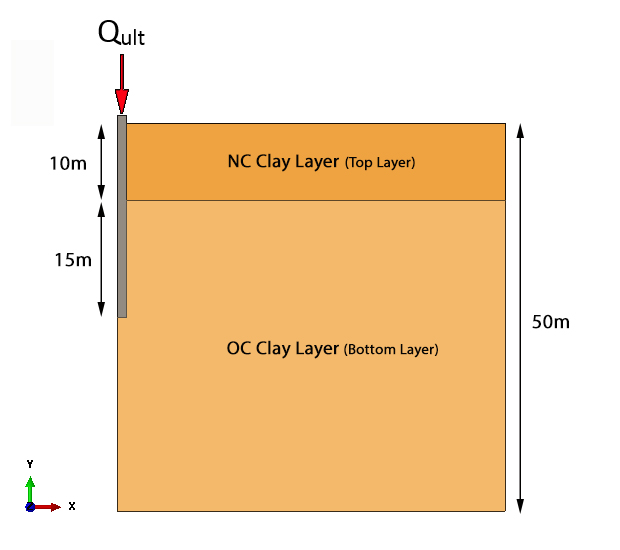
Single concrete pile embedded in multi-layered soil.
Multi-Layered Soil
The soil profile consists of two different clay layers. The upper layer is Normally Consolidated (NC) Clay with a thickness of 10 m, while the underlying layer consists of Over-Consolidated (OC) Clay.
Since the two soil layers have different mechanical properties, their material properties are defined separately in the Abaqus model.

Multi-layered soil consisting of NC Clay and OC Clay.
Single Concrete Pile
The pile is modeled as a concrete pile with an embedded length of 25 m and a diameter of 0.8 m.
The pile passes through both soil layers, allowing the contribution of each soil layer to the overall vertical load capacity of the pile to be considered.
Groundwater Table
The groundwater table (GWT) is located at the ground surface.
The analysis is performed under drained conditions, which represent a relatively low loading rate. Under this condition, the pore water pressure is assumed to be zero during the analysis.
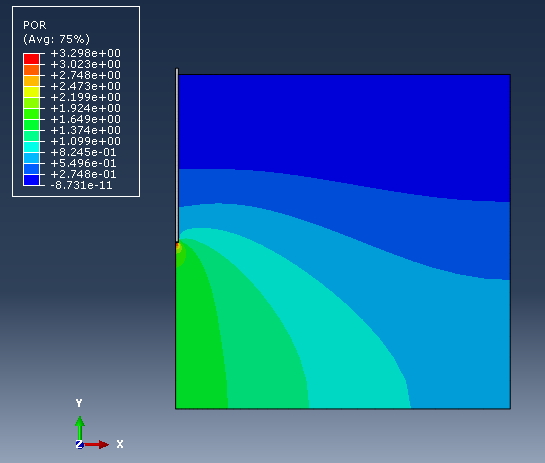
Pore water pressure= 0.
Pile–Soil Interaction
Different interaction properties are defined between the pile and the surrounding soil layers.
The coefficient of friction between the pile and the upper soil layer is different from the coefficient of friction between the pile and the lower soil layer.
In addition, the coefficient of lateral earth pressure, K0, is defined separately for the two soil layers.
Analysis Steps
The simulation is performed in three main steps.
- Step 1 – Initial Loading: The specific weight of the pile and soil is applied.
- Step 2 – Pile–Soil Interaction: The interaction properties between the pile and surrounding soil are modified.
- Step 3 – Vertical Loading: A vertical load is applied to the pile to determine its load capacity.
Load Capacity of the Single Pile
The vertical load capacity of the single pile is calculated using the Abaqus simulation and is then compared with the theoretical result obtained using the Beta method.
The load capacity obtained using the Beta method is 1325 kN.
The load capacity obtained from the Abaqus simulation is 2100 kN.
Comparison with the Beta Method
The numerical result obtained from Abaqus is compared with the theoretical result calculated using the Beta method.
The comparison shows that the load capacity obtained from the Abaqus simulation is higher than the value calculated using the Beta method.

Comparison of the pile load capacity obtained from Abaqus and the Beta method.
What You Will Learn
- How to model a single pile in multi-layered soil using Abaqus.
- How to define different properties for multiple soil layers.
- How to model Normally Consolidated and Over-Consolidated clay.
- How to model a concrete pile embedded in soil.
- How to define pile–soil interaction properties.
- How to define different friction coefficients for different soil layers.
- How to define the coefficient of lateral earth pressure, K0.
- How to define the groundwater table.
- How to perform a drained analysis.
- How to apply the specific weight of the soil and pile.
- How to apply vertical loading to a pile.
- How to determine the vertical load capacity of a single pile.
- How to calculate pile capacity using the Beta method.
- How to compare Abaqus results with the Beta method.
Key Features
- Single concrete pile.
- Multi-layered soil profile.
- Normally Consolidated (NC) Clay.
- Over-Consolidated (OC) Clay.
- NC Clay thickness of 10 m.
- Pile diameter of 0.8 m.
- Pile embedded length of 25 m.
- Groundwater table at the ground surface.
- Drained analysis condition.
- Different pile–soil friction coefficients.
- Different K0 values for the two soil layers.
- Three analysis steps.
- Vertical loading of the pile.
- Load capacity calculation.
- Comparison with the Beta method.
- Beta method result: 1325 kN.
- Abaqus result: 2100 kN.
- CAE file.
- INP file.
- Excel file containing the results.
- Step-by-step video tutorial.
Project Information
Important information about this project
Payment & Support
Need help with your purchase?
Secure Payment
Your payment is processed securely through our online payment system.
Need Help?
If you have any questions about this product, please contact us by email.
saeedofmoeini@gmail.com
There are no reviews yet.