

Product Overview
In this project, a low-yield-strength (LYS) steel plate shear wall is modeled in Abaqus and its behavior under cyclic loading is investigated.
The low-yield-strength steel plate is designed to yield earlier than other structural members and absorb energy under cyclic loading. Its low yield strength allows the plate to develop stable hysteretic behavior and helps reduce the forces and deformations in the surrounding structural members.
The Abaqus results are compared with the experimental results to evaluate the accuracy of the numerical model and its ability to reproduce the structural response observed in the experiment.
Model Description
The model represents a low-yield-strength steel plate shear wall based on the configuration of the experimental specimen reported in the reference article.
The structural model consists of the steel plate, columns, top beam, middle beam, bottom beam, and stiffeners.
The SPSW model is developed using the S4R shell element, and a nonlinear quasi-static analysis with implicit solution technique is performed to capture the cyclic response, large deformation, and post-buckling behavior of the system.
The required material properties, interactions, boundary conditions, and analysis settings are defined in Abaqus to reproduce the behavior of the experimental specimen.

Cyclic Loading
The steel plate shear wall is subjected to cyclic loading applied to the top of the model.
The loading history is defined according to the experimental loading protocol used in the reference study.
The resulting force and displacement response is used to evaluate the nonlinear behavior of the steel plate shear wall under repeated loading and unloading cycles.

Buckling Analysis and Initial Imperfection
The first part of the project consists of a buckling analysis of the steel plate shear wall.
Buckling modes are extracted from the Abaqus analysis and are then used to define the initial geometric imperfection of the numerical model.
This approach allows the numerical model to better represent the initial geometric condition of the experimental specimen.
Hysteresis Analysis
The second part of the project consists of the hysteresis analysis of the steel plate shear wall under cyclic loading.
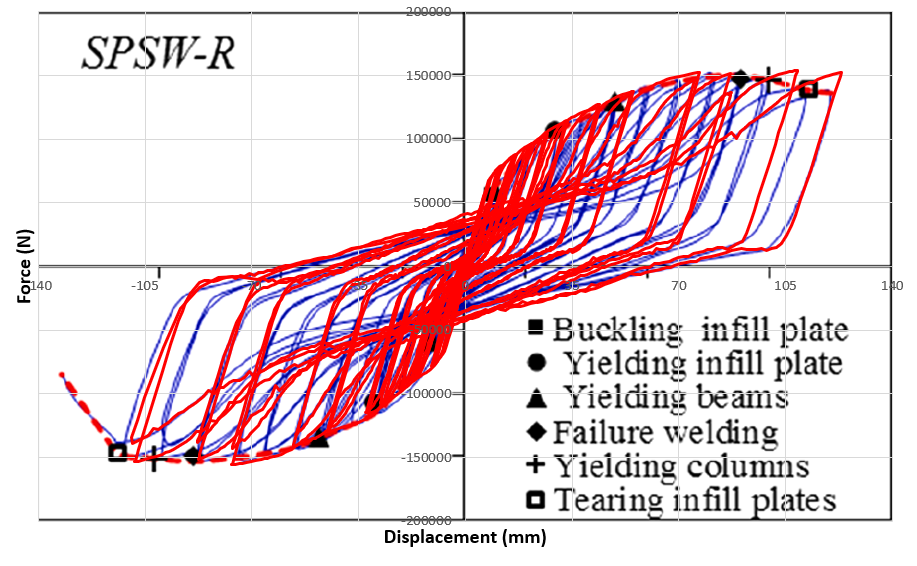
The force and displacement data obtained from the Abaqus analysis are extracted and processed to generate the force–displacement hysteresis diagram.
The numerical hysteresis response is then compared with the experimental response reported in the reference article.
Deformation Under Cyclic Loading
Under cyclic loading, the thin steel infill plate initially experiences out-of-plane buckling due to its low thickness. However, this deformation does not indicate failure, as the plate continues to resist lateral loads through the development of diagonal tension fields.
With increasing displacement cycles, plastic deformation develops throughout the infill plate, resulting in effective energy dissipation and stable hysteretic behavior. The finite element model considers geometric nonlinearity, large deformation effects, and initial geometric imperfections to accurately simulate the deformation response.
The numerical results provide information about the deformation pattern and structural response of the steel plate throughout the loading cycles.

Experimental Validation
This project has been validated against the experimental results reported in the reference article.
The numerical results obtained from Abaqus are compared with the experimental results to evaluate the accuracy of the numerical model.
The comparison shows that the Abaqus results are similar to the results reported in the reference study.

Key Features
- Numerical simulation of a low-yield-strength steel plate shear wall.
- Steel plate, columns, top beam, middle beam, bottom beam, and stiffeners.
- Buckling analysis.
- Extraction of buckling modes.
- Initial geometric imperfection based on buckling modes.
- Nonlinear analysis under cyclic loading.
- Force–displacement hysteresis response.
- Comparison with experimental results.
- Validated Abaqus model.
- Complete Abaqus model files.
- Excel file for amplitude loading.
- Excel file containing numerical results.
- Reference research paper.
- Step-by-step video tutorial.
What You Will Learn
- How to model a low-yield-strength steel plate shear wall in Abaqus.
- How to define the steel plate, columns, beams, and stiffeners.
- How to define the geometry and material properties of the model.
- How to define the required interactions and boundary conditions.
- How to perform a buckling analysis.
- How to extract buckling modes from Abaqus.
- How to use buckling modes to define an initial geometric imperfection.
- How to apply cyclic loading to the top of the model.
- How to perform nonlinear analysis under cyclic loading.
- How to obtain a force–displacement hysteresis diagram.
- How to extract and process Abaqus results using Excel.
- How to compare numerical and experimental results.
Reference
This project is based on the experimental study reported in the reference research article.
The reference paper is included with the project files and can be used to review the experimental model, loading protocol, structural configuration, and reported results.

Project Information
Important information about this project
Payment & Support
Need help with your purchase?
Secure Payment
Your payment is processed securely through our online payment system.
Need Help?
If you have any questions about this product, please contact us by email.
saeedofmoeini@gmail.com
There are no reviews yet.