
Project Overview
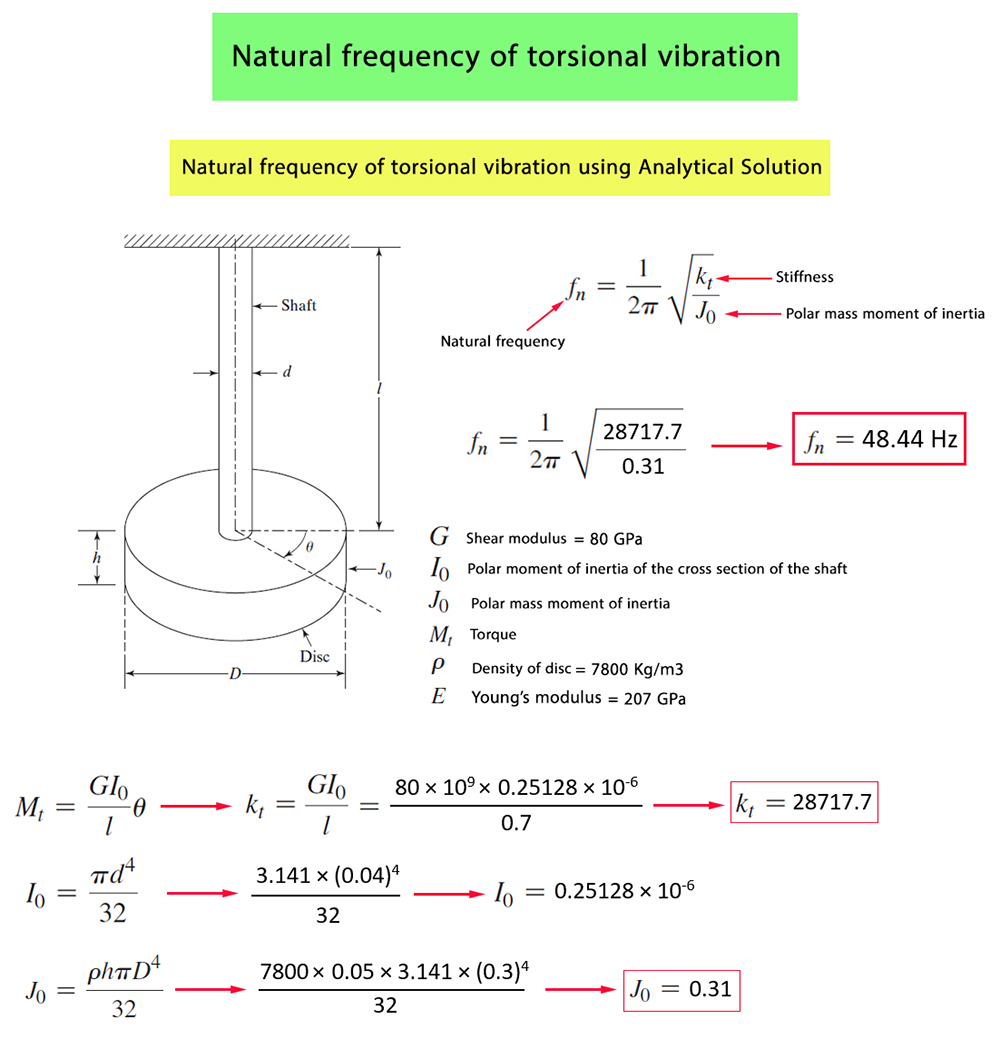
In this training, we first calculate the natural frequency of torsional vibration using the Analytical Solution. Then, the same problem is analyzed using the Abaqus software. Finally, the results obtained from Abaqus are compared with those obtained from the Analytical Solution.

Model Description
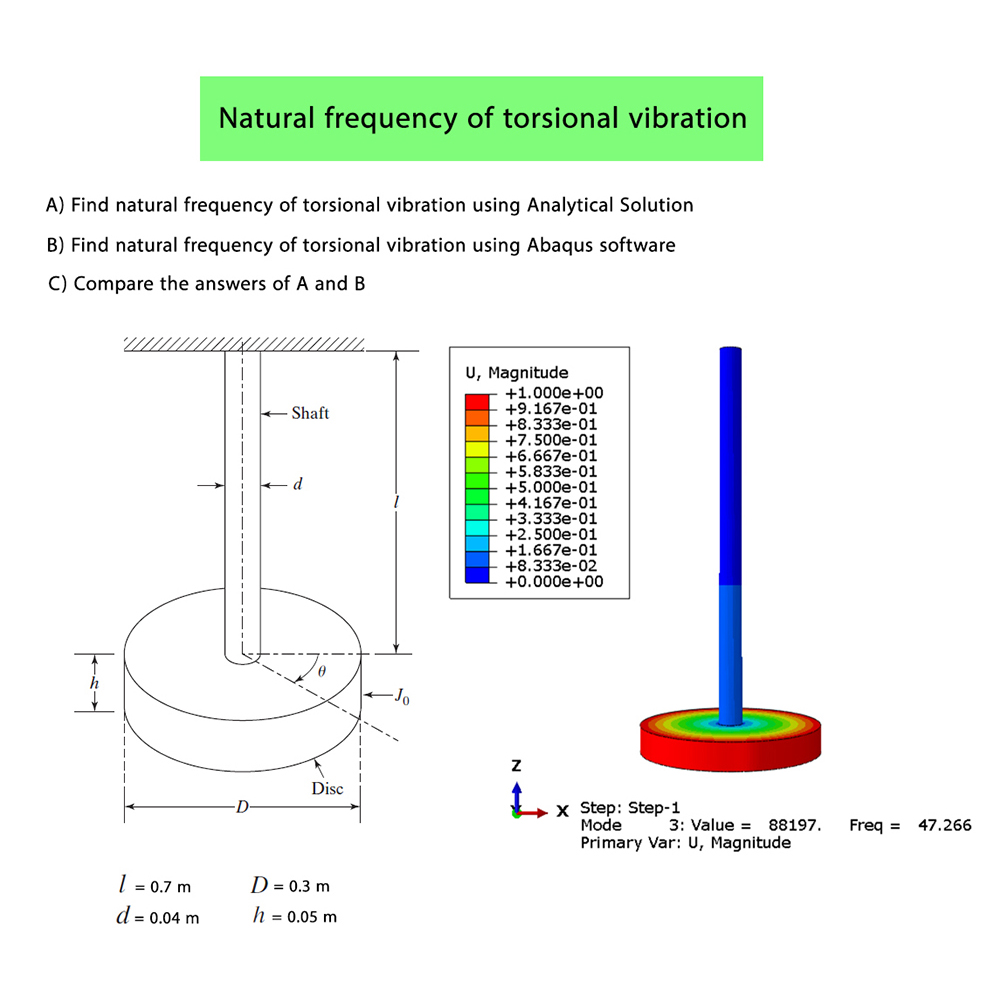
The model consists of a steel shaft connected to a steel disc. The shaft has a length of 0.7 m and a diameter of 0.04 m. The disc has a diameter of 0.3 m and a thickness of 0.05 m.
The shaft provides the torsional stiffness of the system, while the disc provides the rotational inertia. The model is used to determine the natural frequency of torsional vibration and to verify the numerical results obtained from the Abaqus simulation.
Analytical Solution
First, the natural frequency of torsional vibration is calculated using the Analytical Solution.
The natural frequency of torsional vibration obtained from the Analytical Solution is equal to 48.44 Hertz.
Abaqus Simulation
In the next step, the same model is simulated using the Abaqus software to obtain the natural frequency of torsional vibration.
The natural frequency of torsional vibration obtained from the Abaqus software is equal to 47.25 Hertz.

Identification of the Torsional Mode
In the Abaqus results, the torsional vibration frequency is identified from the mode shape. The third mode corresponds to the torsional vibration of the system.
The mode shape is used to identify which mode is associated with the torsional frequency.
Comparison of Results
The results obtained from the Abaqus software are compared with those obtained from the Analytical Solution.
As observed from the results, the natural frequency obtained from Abaqus is in good agreement with the result obtained from the Analytical Solution.
The natural frequency obtained from Abaqus is 47.25 Hz, while the value obtained from the Analytical Solution is 48.44 Hz.
The difference between the Abaqus result and the Analytical Solution is approximately 2.46%.
Mechanical Vibrations
The problem is related to the topics covered in the Mechanical Vibrations book and provides a useful reference for studying the longitudinal vibration of mechanical systems.
The analytical result is used as a reference to evaluate the numerical result obtained from Abaqus.
What You Will Learn
- How to model a shaft and disc in Abaqus.
- How to define steel material properties in Abaqus.
- How to perform a natural frequency analysis.
- How to calculate the natural frequency of torsional vibration using the Analytical Solution.
- How to obtain the natural frequency using Abaqus.
- How to identify the torsional vibration mode from the mode shape.
- How to compare Abaqus results with the Analytical Solution.
- How to evaluate the accuracy of a numerical vibration model.
Key Features
- Torsional vibration analysis.
- Shaft and disc model.
- Steel material.
- Natural frequency calculation.
- Analytical Solution.
- Abaqus numerical simulation.
- Identification of the torsional vibration mode.
- Comparison between Abaqus and Analytical Solution.
- Free Abaqus tutorial.
Project Information
Important information about this project
Payment & Support
Need help with this tutorial?
Free Tutorial
This Abaqus tutorial is available free of charge.
Need Help?
If you have any questions about this tutorial, please contact us by email.
saeedofmoeini@gmail.com
hamed
Why 3rd mode?
Admin
In the training video, it was said that the third mode is related to the torsional frequency, which can be determined from the shape mode, which mode is related to the torsional frequency.