
Product Overview
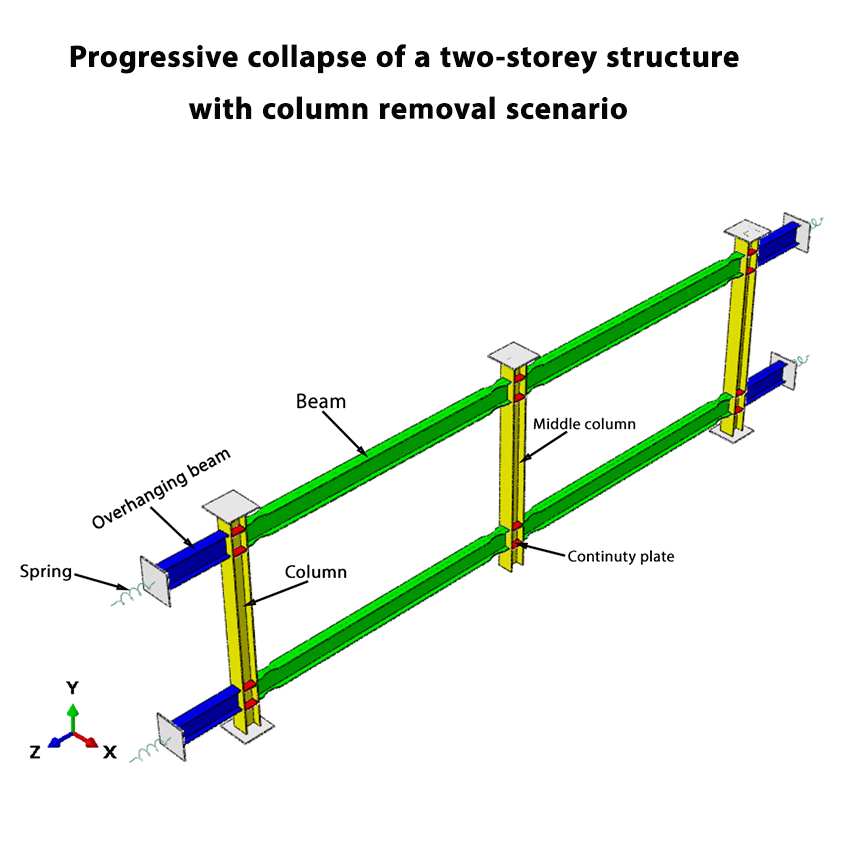
In this example, we simulate the progressive collapse behavior of a two-storey steel sub-frame with a reduced beam section (RBS) connection under a middle-column removal scenario using the Abaqus software.
The model represents the structural response after the removal of the middle column at the first storey, with vertical displacement applied at the column removal location. The simulation captures the deformation and load-resisting behavior of the steel frame under large displacement.
The numerical model is developed based on the experimental study presented in the reference article, allowing the Abaqus results to be compared with the reported experimental response.

Model Description
The numerical model consists of a two-storey steel sub-frame with beams, columns, continuity plates, overhanging beams, and springs. The beam-to-column connections are modeled using the reduced beam section (RBS) configuration, in which portions of the beam flanges are reduced near the column connections to promote plastic deformation away from the column face.
The model also includes continuity plates inside the columns and overhanging beams connected to spring elements to represent the horizontal restraint provided by the surrounding structural system.
Due to the inevitable gaps in the roller connections, the horizontal restraint was represented by spring elements in the numerical model.

Column Removal Scenario
To simulate the progressive collapse scenario, the middle column at the first storey is removed before the vertical loading stage. The removal of the column causes the loads carried by the removed column to be redistributed to the surrounding structural members.
A vertical displacement is then applied at the top of the removed column location to reproduce the loading condition used in the experimental study. The resulting response of the two-storey sub-frame is evaluated as the deformation increases.

Experimental Model
The experimental specimen used in the reference study is also considered for comparison with the numerical model.
As shown in the picture, the experimental sample can be observed.

Deformation of the Model
As the vertical displacement increases, significant deformation develops in the steel sub-frame, with the deformation becoming concentrated around the reduced beam sections (RBS). Plastic hinges form at the reduced sections, allowing the beams to undergo large rotations and accommodate substantial deformation.
At large displacement levels, the load-resisting mechanism involves the combined contribution of flexural action and catenary action. The transition to this combined mechanism enables the RBS sub-frame to maintain its load-resisting capacity as the deformation increases.

Force–Displacement Diagram
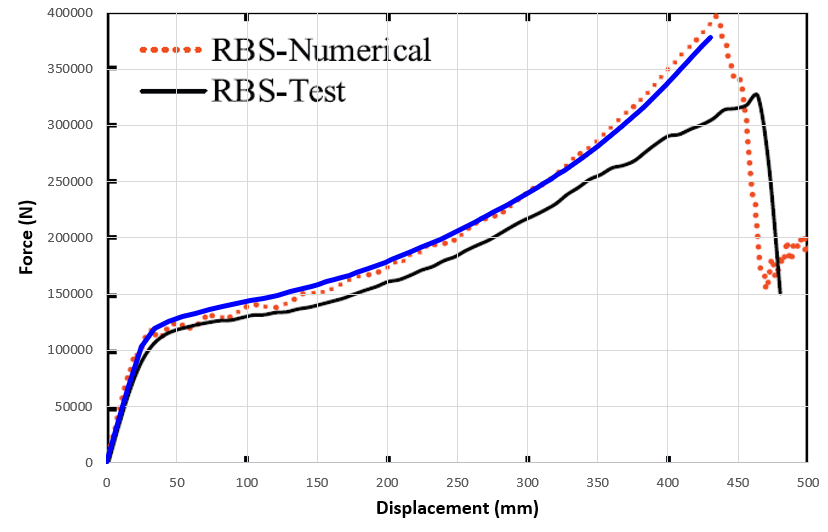
The force–displacement response of the RBS steel sub-frame is obtained from the Abaqus simulation. The diagram represents the relationship between the applied vertical force and the vertical displacement at the middle-column removal location.
The diagram is used to investigate the relationship between the applied force and the displacement of the structure during the progressive collapse analysis.
Validation
This project has been validated, which means that the results obtained from the Abaqus software are similar to the results reported in the article.
In other words, this project is based on the reference article and the numerical model has been developed to reproduce the behavior reported in the study.
Key Features
- Progressive collapse analysis of a two-storey structure.
- Column removal scenario.
- Removal of the middle column at the first storey.
- Application of vertical loading after column removal.
- Beam and column modeling.
- Continuity plate modeling.
- Overhanging beam modeling.
- Spring modeling.
- Investigation of structural deformation.
- Force–Displacement diagram.
- Experimental model comparison.
- Validation against the reference article.
- Complete Abaqus CAE and INP files.
- Excel results file.
- Reference research paper.
- Step-by-step video tutorial.
What You Will Learn
- How to model a two-storey structure in Abaqus.
- How to model the beam and column.
- How to model the continuity plate.
- How to model the overhanging beam.
- How to define the spring in the numerical model.
- How to assemble the structural components.
- How to define the material properties.
- How to define the required boundary conditions.
- How to simulate the column removal scenario.
- How to remove the middle column at the first storey.
- How to apply the vertical load after column removal.
- How to investigate the deformation of the structure.
- How to obtain the Force–Displacement diagram.
- How to compare the numerical results with the experimental results.
- How to validate the Abaqus model using the reference article.
Reference
This project is based on the reference research article. The article is included with the project files and can be used to review the experimental model, loading procedure, and reported results.

Project Information
Important information about this project
Payment & Support
Need help with your purchase?
Secure Payment
Your payment is processed securely through our online payment system.
Need Help?
If you have any questions about this product, please contact us by email.
saeedofmoeini@gmail.com
There are no reviews yet.