

Product Overview
In this project, we simulate the progressive collapse behavior of a steel moment frame joint with a reduced beam section (RBS) using the Abaqus software.
The beam flanges and web are connected to the column using welded connections. The reduced beam section is introduced in the beam flange away from the column face to move the plastic deformation away from the beam-column connection.
In this project, the WUF-W-RBS-50-130-23 specimen is modeled in Abaqus based on the experimental test.

Model Description
Both ends of the beams are supported using pin supports. The distance between the two supports is 3020 mm, and the length of each beam segment from the column face to the corresponding support is 1190 mm.
The numerical model has been developed according to the configuration reported in the reference article to investigate the progressive collapse behavior of the steel moment frame joint.

Vertical Loading
In this analysis, a vertical load is applied to the top of the column.
Following the application of the vertical loading, the structural response of the steel moment frame joint is investigated.

Force–Displacement Diagram
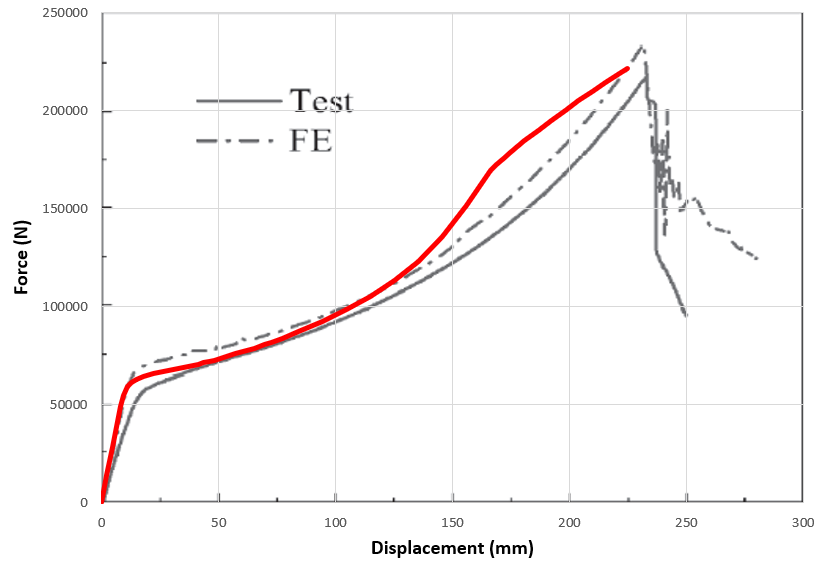
Following the application of the vertical loading, the Force–Displacement diagram is obtained from the Abaqus results.
The Force–Displacement diagram obtained from the Abaqus software is compared with the experimental results to evaluate the accuracy of the numerical model.
Deformation of the Model
As the vertical displacement increases, the inelastic deformation is mainly concentrated around the reduced beam section (RBS). In this model, the final damage develops in the reduced section rather than directly at the beam-to-column connection.
The deformation pattern is used to investigate the structural response of the joint during the progressive collapse analysis.

Equivalent Plastic Strain (PEEQ)
High plastic strain initially develops in the bottom beam flange within the reduced section and progressively extends with increasing displacement, eventually reaching the beam web.
The PEEQ contour is used to investigate the regions of the steel components where significant plastic deformation occurs during the analysis.

Deformation at the Start and End of the Analysis
As you observe in the picture, the deformation of the model at the start and end of the analysis is displayed.
This comparison provides a clear view of the structural deformation developed during the progressive collapse analysis.

Validation
This project has been validated, which means that the results obtained from the Abaqus software are similar to the results reported in the article.
In other words, this project is based on the reference article and the numerical model has been developed to reproduce the behavior reported in the study.
Key Features
- Progressive collapse analysis of a steel moment frame joint.
- Beam, column, and stiffener modeling.
- Vertical loading applied to the top of the column.
- Force–Displacement diagram.
- Comparison between Abaqus and experimental results.
- Investigation of model deformation.
- Equivalent Plastic Strain (PEEQ) contour.
- Comparison of deformation at the start and end of the analysis.
- Validation against the reference article.
- Complete Abaqus CAE file.
- Abaqus INP file.
- Excel results file.
- Reference research paper.
- Step-by-step video tutorial.
What You Will Learn
- How to model a steel moment frame joint in Abaqus.
- How to define the beam, column, and stiffener.
- How to define the material properties of the steel components.
- How to assemble the beam-column joint.
- How to define the required boundary conditions.
- How to simulate the progressive collapse of the joint.
- How to apply vertical loading to the top of the column.
- How to obtain the Force–Displacement diagram.
- How to compare the Abaqus results with experimental results.
- How to investigate the deformation of the model under vertical loading.
- How to obtain the Equivalent Plastic Strain (PEEQ) contour.
- How to investigate the deformation of the model at the start and end of the analysis.
- How to validate the numerical model using the reference article.
Reference
This project is based on the reference research article. The paper is included with the project files and can be used to review the experimental model and reported results.

Project Information
Important information about this project
Payment & Support
Need help with your purchase?
Secure Payment
Your payment is processed securely through our online payment system.
Need Help?
If you have any questions about this product, please contact us by email.
saeedofmoeini@gmail.com
There are no reviews yet.