

Product Overview
In this example, we intend to simulate the steel structure with an end-plate-connected replaceable shear link under cyclic loading in the Abaqus software.
The replaceable shear link is installed between the two beams and acts as a ductile fuse. It dissipates seismic energy mainly through shear yielding and inelastic deformation.
One of the main advantages of the system is that the inelastic deformation and damage are concentrated in the replaceable shear link, helping to protect the main structural components and allowing the damaged link to be replaced after a major earthquake.
The Abaqus model is used to investigate the cyclic behavior, hysteretic response, deformation, and energy dissipation of the structural system. The numerical results are compared with the experimental results reported in the reference study.
Model Components
As you observe in the picture, this model is composed of a beam, column, shear link, end plate, cover plate, bolts, stiffeners, and continuity plate.
The replaceable shear link is connected to the deep beam using end-plate connections and is designed to accommodate the main inelastic shear deformation under cyclic loading.

Test Setup
In this project, the HFTSL-1 specimen is modeled and simulated in Abaqus based on the corresponding experimental study.

Shear Link Behavior
The replaceable shear link is designed to undergo significant shear deformation under cyclic loading.
During the analysis, the shear link develops inelastic shear deformation and dissipates energy, while the other main structural components remain mainly elastic.
This behavior allows the shear link to act as a ductile fuse and helps concentrate damage in the replaceable part of the structure.
After significant cyclic loading, the damaged shear link can be removed and replaced with a new link. This approach can help simplify the repair of the structural system after a major earthquake.
Cyclic Loading
In this problem, cyclic loading is applied to the top of the model to investigate the hysteretic behavior of the structural system.
The cyclic loading history is defined in Abaqus using the corresponding amplitude data.

Results Comparison
As you observe in the picture, the results obtained from the Abaqus software are compared with the experimental results.
The PEEQ results from the Abaqus model show that plastic deformation was mainly concentrated in the replaceable shear link, while the surrounding structural members remained largely elastic. This distribution of plastic deformation is consistent with the behavior observed in the experimental test.
As the displacement increased, shear yielding progressively developed in the web of the shear link. The Abaqus results showed good agreement with the experimental results, reproducing the development and concentration of plastic deformation in the shear link.

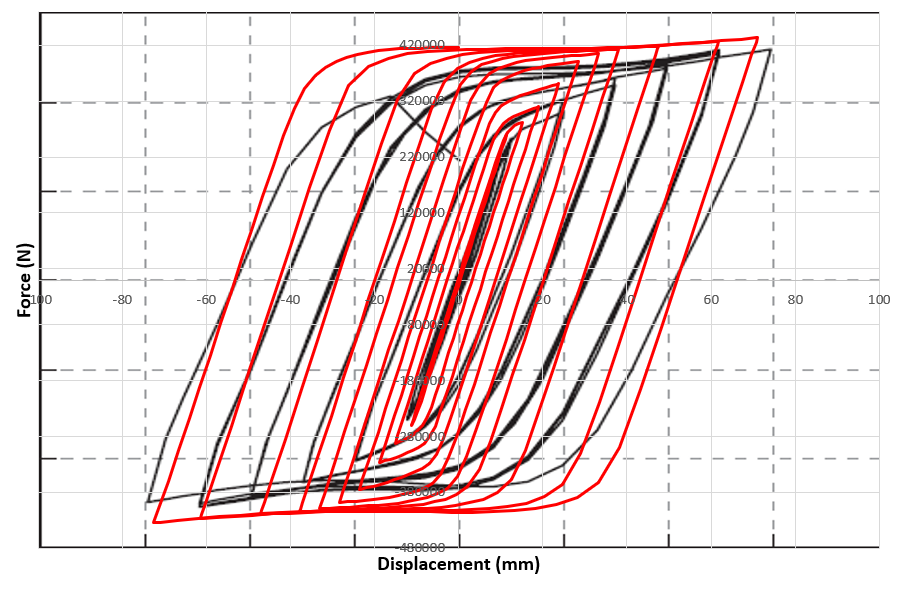
Force-Displacement Hysteresis Diagram
After applying the cyclic loading, the Force-Displacement hysteresis diagram is obtained from the Abaqus analysis.
As you observe in the picture, the Force-Displacement hysteresis diagram obtained from the Abaqus software is compared with the experimental results.
Validation
This project has been validated, which means that the results obtained from the Abaqus software are similar to the results reported in the reference article.
In other words, this project is based on the reference article, and the numerical model has been developed to reproduce the experimental seismic behavior of the steel structure with the end-plate-connected replaceable shear link.

What You Will Learn
- How to model a steel structure with an end-plate-connected replaceable shear link in Abaqus.
- How to model beams and columns.
- How to model the replaceable shear link.
- How to model the end plate and cover plate.
- How to model bolts and stiffeners.
- How to define the continuity plate.
- How to define the material properties.
- How to define the boundary conditions.
- How to apply cyclic loading to the top of the model.
- How to define the cyclic loading amplitude.
- How to obtain the Force-Displacement hysteresis diagram.
- How to compare Abaqus results with experimental results.
- How to validate the numerical model using the reference article.
Key Features
- Steel structure modeling in Abaqus.
- End-plate-connected replaceable shear link.
- Beam and column modeling.
- Cover plate and continuity plate modeling.
- Bolt and stiffener modeling.
- Cyclic loading analysis.
- Force-Displacement hysteresis analysis.
- Comparison between Abaqus and experimental results.
- Validation against the reference article.
- Complete Abaqus CAE file.
- Abaqus INP file.
- Excel file (Amplitude Loading).
- Excel file (Results).
- Reference research paper.
- Step-by-step video tutorial.
Reference
This project is based on the reference research article. The paper is included with the project files and can be used to review the experimental model, test setup, cyclic loading protocol, and reported results.

Project Information
Important information about this project
Payment & Support
Need help with your purchase?
Secure Payment
Your payment is processed securely through our online payment system.
Need Help?
If you have any questions about this product, please contact us by email.
saeedofmoeini@gmail.com
There are no reviews yet.