
Project Overview
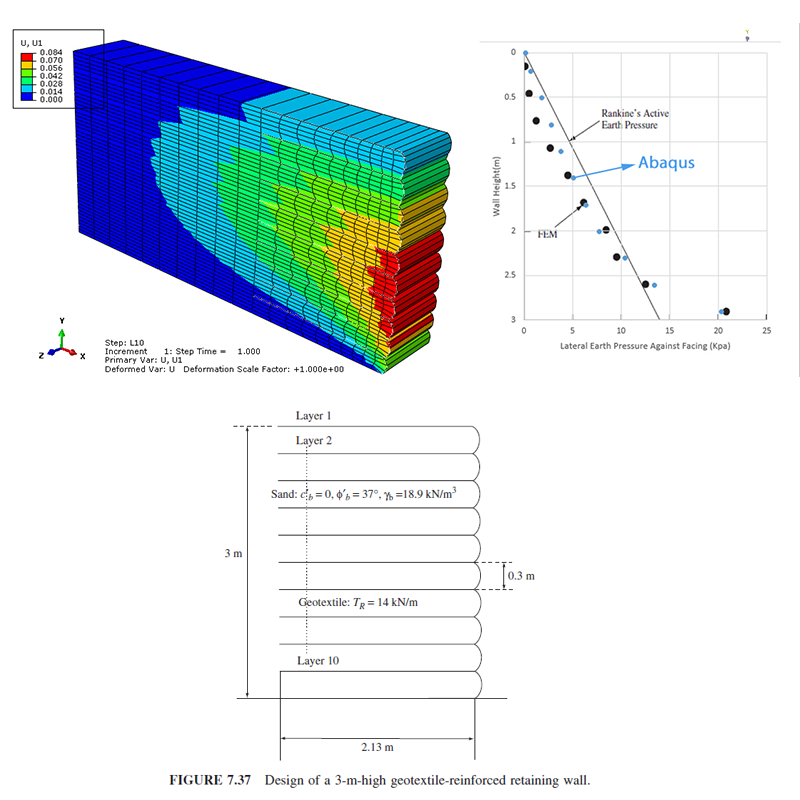
In this Abaqus tutorial, the sequential construction of a geotextile-reinforced soil retaining wall is simulated using the Abaqus software.
This example is based on Example 7.5 from the book by Sam Helwany. The main objective is to simulate the construction process of the retaining wall layer by layer and compare the Abaqus results with the results reported in the book.

Geotextile-reinforced soil retaining wall model.
Geotextile-Reinforced Soil Retaining Wall
Geosynthetic-reinforced soil walls are commonly used when a sudden change in ground elevation is required.
Geosynthetics are polymer-based materials such as polyester and polyethylene. Two widely used types of geosynthetics for soil reinforcement are geotextiles and geogrids.
In this model, the soil behind the wall is divided into two main regions. The part of the backfill containing the reinforcement is referred to as the reinforced soil, while the soil behind this region is referred to as the retained soil.
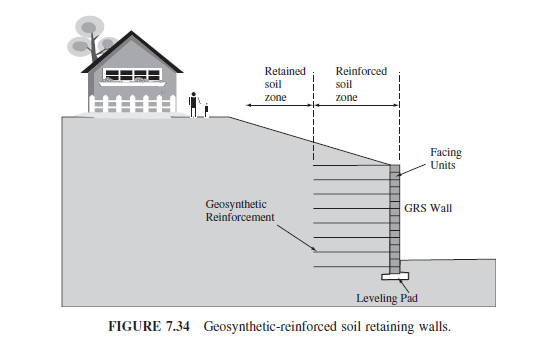
Geotextile-reinforced soil retaining wall model.
Sequential Construction
The retaining wall is constructed layer by layer in the Abaqus simulation. The wall consists of 10 equal soil layers, with each layer having a thickness of 0.3 m.
Each construction stage is simulated over a 1-second period. During each stage, the self-weight of the newly added soil layer is applied using the gravity option.
Therefore, the total simulated construction time is 10 seconds.
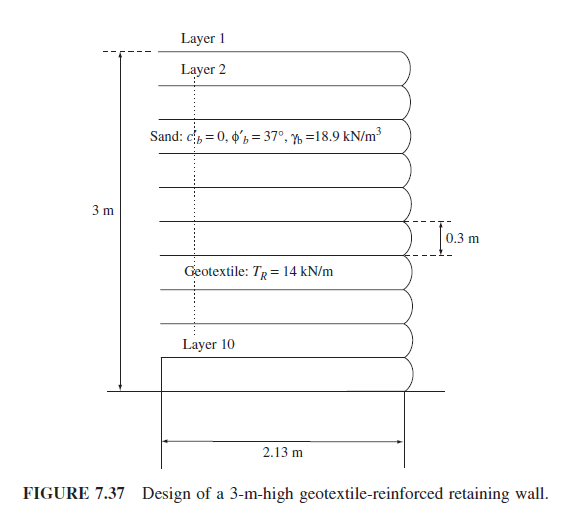
Sequential construction of the retaining wall layer by layer.
Geotextile Reinforcement
The geotextile is modeled as a structural reinforcement inside the soil mass. In this simulation, the geotextile has a thickness of 3 mm and an elastic modulus of 20,000 kPa.
The geotextile reinforcement is modeled using Beam elements in Abaqus.
Soil Material Model
The soil is assumed to behave as an elastoplastic material. The soil behavior is defined using the Cap plasticity model with cap hardening properties.
This material model is used to represent the nonlinear behavior of the soil during the sequential construction of the retaining wall.
Model Activation and Deactivation
In the first calculation step, most of the wall is removed from the finite element mesh, leaving only the bottom soil layer, the first reinforcement layer, and the first skin layer.
In the subsequent calculation steps, the remaining layers are activated one by one to reproduce the actual construction sequence.
The self-weight of each newly activated soil layer is then applied using the gravity loading.
Horizontal Displacement
The horizontal displacement contours at the end of construction are obtained from the Abaqus simulation.
These results are compared with the corresponding horizontal displacement contours reported in the Sam Helwany book.
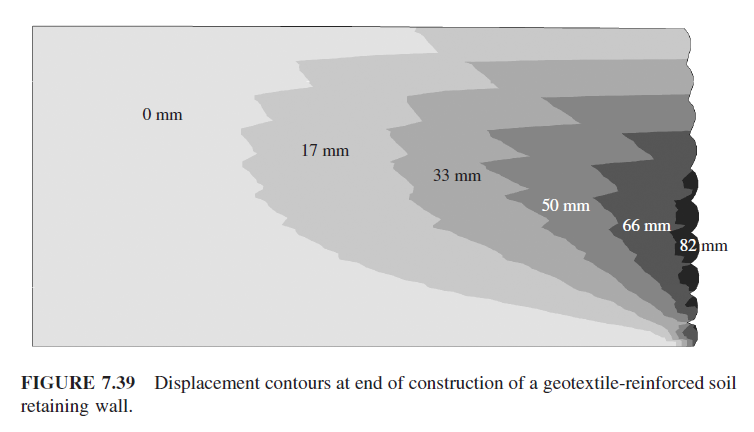
Horizontal displacement contours at the end of construction from the Sam Helwany book.
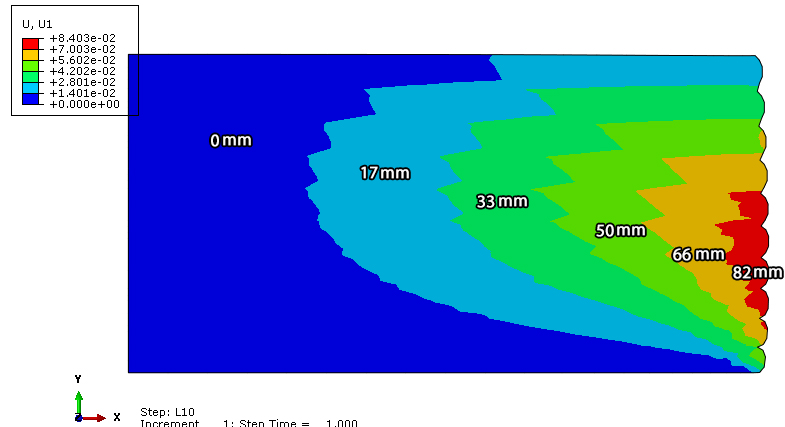
Horizontal displacement contours at the end of construction obtained from Abaqus.
Lateral Earth Pressure
The lateral earth pressure acting against the wall facing is also investigated.
The lateral earth pressure obtained from Abaqus is compared with the corresponding result reported in the Sam Helwany book.

Lateral earth pressure against the wall facing obtained from Abaqus.
Comparison of Abaqus and Reference Results
Finally, the results obtained from Abaqus are compared with the corresponding results from the Sam Helwany book.
This comparison provides a useful verification of the numerical model and demonstrates the ability of Abaqus to reproduce the behavior of the geotextile-reinforced soil retaining wall.
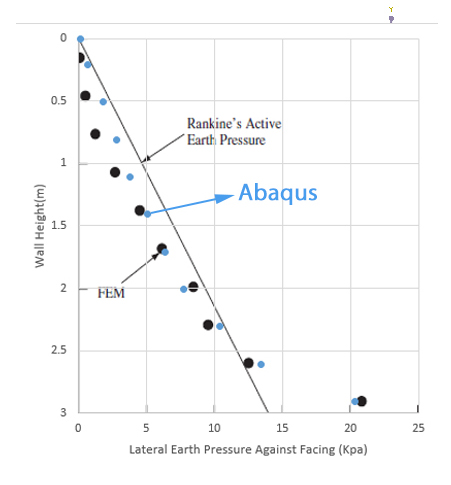
Comparison between Abaqus results and the Sam Helwany book results.
What You Will Learn
- How to model a geotextile-reinforced soil retaining wall in Abaqus.
- How to simulate the sequential construction of a retaining wall.
- How to construct the wall layer by layer.
- How to activate and deactivate soil layers during the analysis.
- How to apply the self-weight of each soil layer using gravity loading.
- How to model geotextile reinforcement using Beam elements.
- How to define elastoplastic soil behavior using Cap plasticity.
- How to obtain horizontal displacement contours.
- How to calculate lateral earth pressure against the wall facing.
- How to compare Abaqus results with the Sam Helwany book.
- How to verify a geotechnical model using reference results.
Key Features
- Geotextile-reinforced soil retaining wall.
- Sequential construction analysis.
- 10 construction layers.
- 0.3 m thickness for each soil layer.
- 1-second construction period for each layer.
- Total construction time of 10 seconds.
- Geotextile reinforcement modeled using Beam elements.
- 3 mm geotextile thickness.
- 20,000 kPa geotextile elastic modulus.
- Elastoplastic soil behavior.
- Cap plasticity with cap hardening.
- Gravity loading.
- Horizontal displacement contours.
- Lateral earth pressure against wall facing.
- Comparison with Sam Helwany book results.
- CAE file.
- INP file.
- Excel file containing the results.
- Step-by-step video tutorial.
Project Information
Important information about this project
Payment & Support
Need help with your purchase?
Secure Payment
Your payment is processed securely through our online payment system.
Need Help?
If you have any questions about this product, please contact us by email.
saeedofmoeini@gmail.com
There are no reviews yet.