

Simulating Buckling-Restrained Brace (BRB) under cyclic loading Abaqus
In this example we intend to simulate the Buckling-Restrained Brace (BRB) under the cyclic loading in the Abaqus software
The Buckling-Restrained Brace (BRB) is composed of: Steel core , Steel tube and Concrete encasement
In this picture the steel core is distinguished by red color. The steel core absorbs the loads and the energy having been applied to the system and causes the energy to be dissipated
The concrete encasement has been marked out by grey color. The concrete encasement has the task of supporting steel core and prevents from the buckling of the steel core
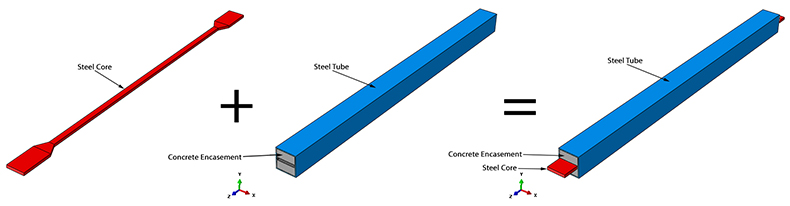
As you observe , the steel core has been placed inside the concrete-filled steel tube
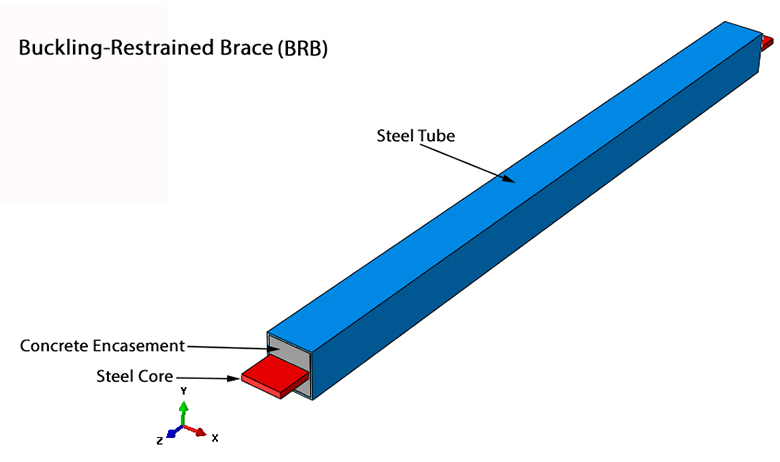
The interaction between the concrete and steel tube is defined by “Tie Constraint” and when we use the “Tie Constraint” , the parts are merged into one another and are converted into a unique part
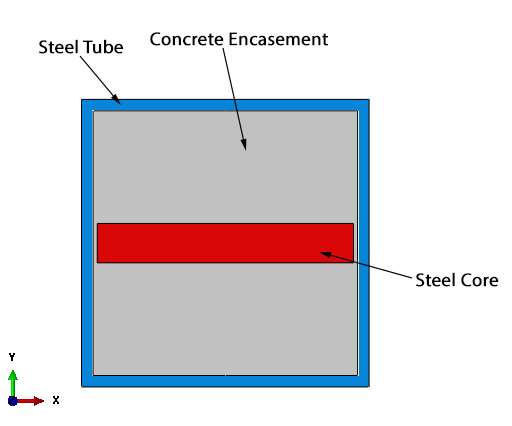
There is a gap between concrete encasement and the middle part of steel core

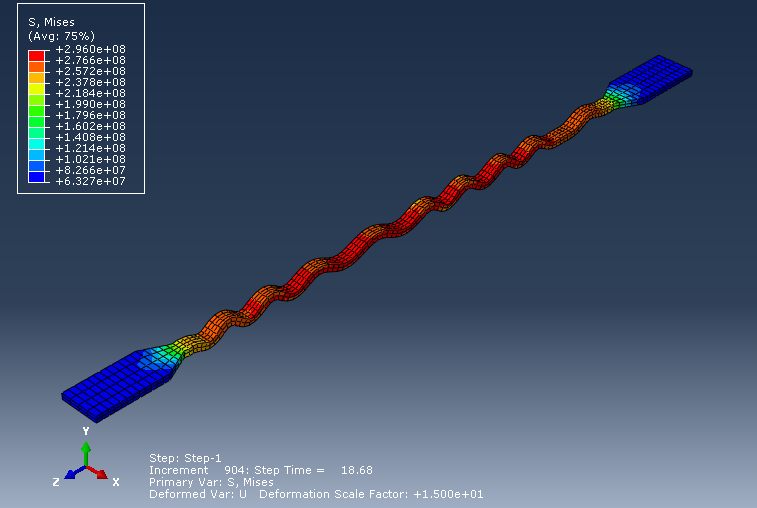

In this problem the hysteresis diagram has been drawn for the buckling-restrained brace

This project has been validated, which means that the results obtained from Abaqus software are similar to the results of the article. In other words, this project is based on the article

Information about this tutorial |
|
|---|---|
You will receive these files after purchase | Full video (Step by step) Cae file inp file Excel file (Material, concrete) Excel file (Amplitude loading) Excel file (Results) Paper (Article) |
The language of the video | English |
Duration of the video | Is 48 minutes |
Size of all files | Is 114 MB |
Video quality | HD, 720p |
Method of receiving | After payment, the download link will be sent to your email immediately |
Payment Method | Method 1 (Visa Card/MasterCard) : You can buy online using Visa Card and MasterCard Method 2 (PayPal) : Contact us by email to purchase with PayPal |
Price | $ 8 |
Contact us | Email : saeedofmoeini@gmail.com |
Jimmy Ccanto Laume(verified owner)
Soy estudiante de maestría de ingeniería estructural
Jimmy Ccanto Laume(verified owner)
Soy Jimmy Ccanto, deseo comprar
Admin
You can buy by credit card